eBook - ePub
Land and Livelihoods in Neoliberal India
- English
- ePUB (mobile friendly)
- Available on iOS & Android
eBook - ePub
Land and Livelihoods in Neoliberal India
About this book
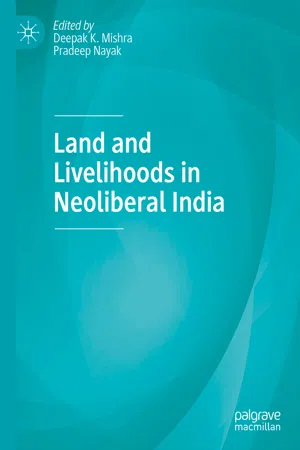
The book discusses important developments emerging around the land questions in India in the context of India's neoliberal economic development and its changing political economy. It covers many issues that have been impinging the political economy in land and livelihoods in India since the 1990s, examining the land question from diverse methodological standpoints. Most of the chapters rely on evidence generated through primary surveys in different parts of the country. The book, via its diversity of approaches and methodologies, brings out new and hitherto unexplored and/or less researched issues on the emerging land question in India. The range of issues addressed in the volume encompasses the contemporary developments in the political economy of land, land dispossession, SEZs, agrarian changes, urbanisation and the drive for the commodification of land across India. The authors also examine role of the state in promoting the capitalist transformation in India and continuities and changes emerging in the context of land liberalisation and market-friendly economic reforms.
Information
© The Author(s) 2020
D. K. Mishra, P. Nayak (eds.)Land and Livelihoods in Neoliberal Indiahttps://doi.org/10.1007/978-981-15-3511-6_11. Introduction: The Political Economy of Land and Livelihoods in Contemporary India
Deepak K. Mishra1 and Pradeep Nayak2
(1)
Centre for the Study of Regional Development, School of Social Sciences, Jawaharlal Nehru University, New Delhi, Delhi, India
(2)
Odisha State Disaster Management Authority, Bhubaneswar, Odisha, India
Deepak K. Mishra (Corresponding author)
Pradeep Nayak
The original version of this chapter was revised. A correction to this chapter can be found at https://doi.org/10.1007/978-981-15-3511-6_16.
End Abstract1 Introduction
Economic development is generally assumed to be a process of gradual decline in the dependence of populations on land and land-based livelihoods. However, the question of land, in its multiple dimensions, continues to be among the most controversial issues in the Global South. Land, which is a key natural resource for addressing global hunger and malnutrition, accelerating agricultural productivity, eradicating poverty, achieving sustainable development goals, mitigating climate change impacts, managing and assisting urbanisation and industrialisation, is also considered to be an essential marker of political and social power and identities of nations, communities and individuals.1 Historically, increasing productivity of agriculture and mobilisation of the agrarian surplus for industrialisation and the associated infrastructure creation have been considered as a critical constraint in the path of economic development.
The global debates around land show remarkable continuity and change in recent years. While the issues of food and nutrition security in the context of the Millennium Development Goals (MDGs) and Sustainable Development Goals (SDGs), increasing environmental degradation, including soil degradation, deforestation, pollution and declining water availability in the backdrop of climate change, the implications of changing land-use practices and the relationship between access to land and poverty have been at the centre-stage of global discussions, it is the issue of control over and access to land that has emerged as flashpoint of discussions around the land question.
2 Land Questions Under Neoliberalism
Neoliberalism2 broadly refers ‘to the new political, economic, and social arrangements within society that emphasize market relations, re-tasking the role of the state, and individual responsibility’ (Springer et al. 2016, p. 2). At a basic level, it involves a fundamental faith in free markets as ‘the most moral and the most efficient means for producing and distributing goods and services’ (Cahill 2012, p. 111) and its extension into all areas of life, including the economy, politics and society. Neoliberalism, understood as ‘the restoration and reinforcement of class power’ (Harvey 2005), is also an ideological project that promotes a market-led policy framework of economic development and identifies unregulated markets and the ‘animal spirit’ of private entrepreneurs, as essential for unleashing growth potentials. From the Marxist political economy perspective, it is primarily seen as a class project of the capitalist class. In the Indian context, the sweeping pro-market reforms since the early 1990s are seen as a phase of the dominance of neoliberalism (Chandrasekhar 2012; Das 2015). As the state is engaged in facilitating the accumulation projects of domestic and international capital, there is a geographical dimension to neoliberalism; it involves ‘massive restructuring of space relations, producing geographical unevenness at multiple scales’ (Das 2015, p. 719). Among the several ways through which these spatial accumulation dynamics unfold are investments in built environments, the commodification of space and restructuring of property rights over natural resources—all of which involve changes in the ‘land relations’.
Land grabbing, particularly by foreign countries and multinational corporations in many developing countries, which has been described as ‘foreignisation of space’ has generated a global debate on the control and management of land (Kaag and Zoomers 2014; Zoomers 2010; Zoomers and Otsuki 2017). Although the empirical basis, as well as the conceptual foundations of the land grabbing discourse, has been questioned (Edelman 2013; Oya 2013), the plurality of the contexts under which land is being acquired at various scales, by different actors and for multiple purposes, has ‘both continuity and change’ from the historical episodes of enclosures (Borras Jr and Franco 2012; White et al. 2012). Underemphasising the historical connections often ‘leads researchers to ignore or underestimate the extent to which pre-existing social relations shape rural spaces in which contemporary land deals occur’ (Edelman and León 2013, p. 1697; Mollett 2016), while the newness of contemporary land control is not only limited to ‘land grabbing or ownership but also new crops with new labor processes and objectives for the growers, new actors and subjects, and new legal and practical instruments for possessing, expropriating, or challenging previous land controls’ (Peluso and Lund 2011, p. 668).
With relentless expansion of the reach of capital across space and a rapid transformation of the economies of the developing countries, capitalist globalisation has brought back some of the well-known debates on the agrarian transition to the centre-stage with a contemporary salience (Akram-Lodhi and Kay 2010; Editors Agrarian South 2012; Lerche et al. 2013; Mohanty 2016). Neoliberalism, with its overwhelming emphasis on the ability of ubiquitous, impersonal and efficient markets as a central institution for economic decisions, has encountered some of its most formidable political and academic challenges on the question of land. As part of its broader framework of agrarian restructuring, which ‘seeks to liberalise international trade in food and agricultural products, deregulate the operation of domestic agricultural markets, privatise rural parastatals, and formalise the ownership and control of property that had been held in public, in common or, in some cases, privately but monopolistically’ (Akram-Lodhi 2007, p. 1438), neoliberal enclosures through market-based land policies result in the deepening of capitalist property relations in the South (Akram-Lodhi 2007).
The on-going nature of dispossession has revived scholarly interest in the question of primitive accumulation in the writings of Marx (Adnan 2015; Byres 2005). Primitive accumulation, originally theorised as a precursor to the development of capitalism, had three distinct aspects to it: (a) the expulsion of independent producers from the ownership of means of production; (b) the appropriation of the resources for capitalist accumulation; and (c) the creation of free labour as a class whose survival depends on the sale of labour power (Chatterjee 2017). The use of force, often through the use of state power, was an essential feature of the early development of capitalism (Marx 1976). The continuing dispossession of peasants (and others) from their land has led some scholars to argue that primitive accumulation is a continuing feature of capitalism. Although capital attempts to replace human labour by machines, ‘it also seeks to bring in new workers under its command as an exploitable human resource’ and hence, ‘capitalist accumulation must depend on the continuous separation of the labourer from the means of production’ (Mitra et al. 2017, p. 3). Harvey (2003, pp. 137–182) has drawn attention to the relevance of such dispossessions to global capitalism, through the notion of accumulation by dispossession (ABD) , which has generated a great deal of attention to the diverse forms of dispossessions across the world (Adnan 2015; Glassman 2006; Hall 2013; Levien 2013b). Sanyal (2014) and Chatterjee (2008), among others, argue that primitive accumulation does not constitute the pre-history of capitalism, but is one of the conditions of its existence. While the logic of capital is accumulation, that of the non-capital is need. An essential feature of post-colonial capitalist development is that all those who are dispossessed from land are not absorbed in the capitalist sector, a majority of them join the non-capitalist, ‘informal sector’, which interacts with the capital sector and is ‘recreated and renewed by the developmental interventions’ of the state (Sanyal 2014).3
By locating the genesis of the problem in the overaccumulation of capital under contemporary capitalism, and by linking it to the spatio-temporal fix that capitalism needs to tackle overaccumulation, Harvey frees the notion of dispossession from its historical specificity. However, by theorising ABD as part of market rather than non-market relations, and also by clubbing a variety of neoliberal attacks on the working classes and the ordinary people under the rubric of ABD, Harvey has made the distinction between ABD and expanded reproduction under capitalism blurred4 (Levien 2017). Levien argues, that since ‘Harvey does not provide a clear defi...
Table of contents
- Cover
- Front Matter
- 1. Introduction: The Political Economy of Land and Livelihoods in Contemporary India
- 2. Land Titling or Land Reforms: India’s Policy Dilemma
- 3. Ownership Versus Control: The Changing Dynamics of Land Use in Liberalised Agricultural Context of India
- 4. Contextualizing Land Question in a Green Revolution Area: Agrarian Transformation and Politics in Western Uttar Pradesh
- 5. Landowners as Non-farm Workers: A Case of Small Farmer Migrants in Karnataka
- 6. Globalising Agrarian Markets and Changing Production Relations: Village-Level Evidence from India
- 7. Land, Caste and Class in Rural West Bengal
- 8. Agricultural Land Markets in India: A Case of Maharashtra
- 9. Dispossession, Neoliberal Urbanism and Societal Transformation: Insight into Rajarhat New Township in West Bengal
- 10. Land, Labour and Industrialisation in Rural and Urban Areas: A Case Study of Reliance SEZ in Gujarat
- 11. Neoliberal Governing as Production of Fantasy: Contemporary Transformations in Ahmedabad’s Landscape
- 12. The Expressway to Agra—Two Roads, Same Destination: Land Acquisition under Old and New Land Acquisition Regimes
- 13. LARR 2013: What Does It Deliver?
- 14. Land Issues and Liberalisation in Northeast India
- 15. The Gendered Transformation of Land Rights and Feminisation of Hill Agriculture in Arunachal Pradesh: Insights from Field Survey
- Correction to: Introduction: The Political Economy Land and Livelihoods in Contemporary India
- Back Matter
Trusted by 375,005 students
Access to over 1.5 million titles for a fair monthly price.
Study more efficiently using our study tools.
Frequently asked questions
Yes, you can cancel anytime from the Subscription tab in your account settings on the Perlego website. Your subscription will stay active until the end of your current billing period. Learn how to cancel your subscription
No, books cannot be downloaded as external files, such as PDFs, for use outside of Perlego. However, you can download books within the Perlego app for offline reading on mobile or tablet. Learn how to download books offline
Perlego offers two plans: Essential and Complete
- Essential is ideal for learners and professionals who enjoy exploring a wide range of subjects. Access the Essential Library with 800,000+ trusted titles and best-sellers across business, personal growth, and the humanities. Includes unlimited reading time and Standard Read Aloud voice.
- Complete: Perfect for advanced learners and researchers needing full, unrestricted access. Unlock 1.5M+ books across hundreds of subjects, including academic and specialized titles. The Complete Plan also includes advanced features like Premium Read Aloud and Research Assistant.
We are an online textbook subscription service, where you can get access to an entire online library for less than the price of a single book per month. With over 1.5 million books across 990+ topics, we’ve got you covered! Learn about our mission
Look out for the read-aloud symbol on your next book to see if you can listen to it. The read-aloud tool reads text aloud for you, highlighting the text as it is being read. You can pause it, speed it up and slow it down. Learn more about Read Aloud
Yes! You can use the Perlego app on both iOS and Android devices to read anytime, anywhere — even offline. Perfect for commutes or when you’re on the go.
Please note we cannot support devices running on iOS 13 and Android 7 or earlier. Learn more about using the app
Please note we cannot support devices running on iOS 13 and Android 7 or earlier. Learn more about using the app
Yes, you can access Land and Livelihoods in Neoliberal India by Deepak K. Mishra, Pradeep Nayak, Deepak K. Mishra,Pradeep Nayak in PDF and/or ePUB format, as well as other popular books in Business & Agribusiness. We have over 1.5 million books available in our catalogue for you to explore.