This book takes a holistic approach by capturing the various perspectives and viewpoints concerning the theory and practice of Human Rights Journalism. Firstly, this book helps fill the epistemological vacuum present in Human Rights Journalism by proposing 'pragmatic objectivity' within the critical constructivist epistemology. Secondly, it defines the Human Rights Journalism-Responsibility to Protect nexus by identifying five key elements. Thirdly, it proposes a Human Rights Journalism-Responsibility to Protect conceptual model, which illustrates how an embedded human rights focussed media strategy can be designed. Fourthly, this book proposes two novel quantitative analysis tools called the 'Framing Matrix' and the 'Multimodal Discourse Analysis Matrix' that are equipped to deal with a big sample size over a long period of time. These tools are used to examine the practice of Human Rights Journalism and the typology of news stories of distant sufferings. Finally, it providesa scientific explanation for those in search of the answer to why one of the worst humanitarian crises in the world, which took place in Sri Lanka in 2009, did not create any global compassion or garner attention.
eBook - ePub
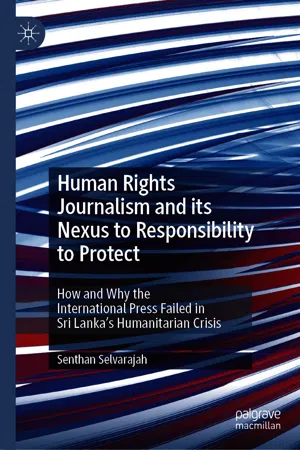
Human Rights Journalism and its Nexus to Responsibility to Protect
How and Why the International Press Failed in Sri Lanka’s Humanitarian Crisis
- English
- ePUB (mobile friendly)
- Available on iOS & Android
eBook - ePub
Human Rights Journalism and its Nexus to Responsibility to Protect
How and Why the International Press Failed in Sri Lanka’s Humanitarian Crisis
About this book
Information
© The Author(s) 2020
S. SelvarajahHuman Rights Journalism and its Nexus to Responsibility to Protecthttps://doi.org/10.1007/978-3-030-49072-0_11. Introduction: Human Rights Journalism and its Nexus to Responsibility to Protect
Senthan Selvarajah1
(1)
Centre for Media, Human Rights and Peacebuilding, London, UK
Responsibility to Protect (R2P) is a liberal and a holistic notion that aims to promote a sense of obligation among individual states as well as the international community, to engage in a manner that prevents violence, promotes peace-making and rebuilds societies during and after mass atrocities such as genocide, war crimes, crimes against humanity, and ethnic cleansing. This study’s understanding of an ‘International Community’ aligns with the International Scholar Hendry Bull’s (1977, p. 13) definition of the term. He states that an international society exists ‘when a group of states, conscious of certain common interests and common values, form a society in the sense that they conceive themselves to be bound by a common set of rules in their relations with one another, and also whilst sharing amidst working of common institutions’. With this in mind, this book contextualises and streamlines the term ‘international community’ as the Member States of the UN. Furthermore, their activities within the United Nation’s framework in reference to the Security Council, United Nations Human Rights Council and the General Assembly, entail maintaining peace, security and human rights.
The norm ‘Responsibility to Protect’ was first introduced in the International Commission, in the Intervention and State Sovereignty report published in 2001 (ICISS 2001). However, Francis Deng brought forth the assumption that sovereignty entails responsibility, much later, in the middle of the 1990s (Deng 2009a, b). This conception argued that the right of a country to protect itself from non-interference by an outsider was conditional, which means that when a state is unable to protect its own population, it stands to lose this right. Deng stated that in those cases, the international community not only has a right, but also a duty to step in (ibid.). Therefore, this means that sovereignty is not absolute and it can be tackled, if human rights are not respected appropriately. The sources of responsibility for R2P interventions, as the ICISS report highlights, are ‘universal human rights’ and ‘common humanity’ (Welsh and Banda 2010, p. 283) and it is on this premise that the three pillars of R2P have been built: (1) The State carries the primary responsibility for protecting populations from genocide, war crimes, crimes against humanity and ethnic cleansing and their incitement. (2) The international community holds a responsibility to encourage and assist States in fulfilling this responsibility. (3) The international community has a responsibility to use appropriate diplomatic, humanitarian and other such means to protect populations from these crimes. If a State is manifestly failing to protect its populations, the international community must be prepared to take collective action to protect populations, in accordance with the Charter of the United Nations.
The protection and prevention of human rights is the core objective of R2P. The aspect of ‘prevention’ is a pro-active and pre-emptive process aimed at changing conditions that minimise the probability of violence and human rights violations. In contrast, ‘protection’ is a reaction to the (near-in-time) outbreak of such violations. According to the Office of the High Commissioner for Human Rights (n.d.), ‘human rights are rights inherent to all human beings, whatever our nationality, place of residence, sex, national or ethnic origin, colour, religion, language, or any other status. We are all equally entitled to our human rights without discrimination. These rights are all interrelated, interdependent and indivisible’. In this book, I define human rights as those inalienable prerogatives established in international human rights instruments, conventions, declarations and legal instruments under international law.1
Therefore, these human rights and security norms, grounded in the cosmopolitan principle of humanitarianism, has evolved as a unique doctrine (R2P) primarily due to two specific reasons: (1) It was the first major organised initiative of the international community to draw global attention and create responses to address humanitarian crisis and causes. (2) It has redefined the concept of sovereignty by changing its role from ‘sovereignty as an impunity of states’ to ‘sovereignty as a responsibility’ to protect every individual in the society.
This concept has drawn considerable scholarly attention regarding how to implement this doctrine in a legitimate and a rightful manner, free from political manipulations and abuses, in times of extreme violence and crisis. Media as a witness, promoter and protector of human rights, seemingly has the ability to facilitate an R2P intervention, wherein it is necessary and appropriate. Nevertheless, conventional journalism has been accused of not fulfilling the duty of the protection of human rights and the prevention of genocide and mass atrocities in times of war.
1.1 Why Is Human Rights Journalism Important for R2P?
The coverage of the Crimean War (1853–1856) by William Howard Russell of The Times, is commonly seen as the marker of the beginning of organised efforts to report war to the population at home, using the services of a civilian reporter (Carruthers 2000, pp. 4–5). Since then, the profession of journalism has undergone dynamic changes due to the continuous advancement and development of newer communication technologies, massive growth and competition in the media industry, changes in global socio-political landscapes, and the constantly evolving international relations. This has, on the one hand, changed the way journalists gather and report information about wars, conflicts and other forms of human rights violations, and on the other hand, resulted in media being used as a tool for both peace and war. Nevertheless, conventional journalism has been accused of being either compliant or complicit with the systems that implant and perpetuate violence, injustice and suffering (Shaw 2012; Lynch and McGoldrick 2007; Shaw et al. 2011; Lynch 2008; Galtung 2002). This is because, as scholars argue, the ideology of objectivity inscribed in the principles of conventional journalism, which demand journalists to ‘just report the facts as they see’, has no meaning in the context of modern journalism, that has evolved and shifted far from its comfortable accommodation within the positivist framework in the early twentieth century, and was developed by Walter Lippman, a writer, reporter and political commentator. According to American Press Institute (n.d.), objectivity was proposed as a scientific approach to news reporting in response to yellow journalism which was practised in abundance back then, wherein exaggeration and sensationalism was used to sell papers by distorting ‘truth’. Nevertheless, the modern-day conventional journalism, which operates within political manipulations, power struggles, lack of journalistic independence, economic constraints, rise of PR agents and organised propaganda ploys, is too restrained by its objectivity convention to search for the truth, expose the lies and the human rights violations, and promote human rights and peace. Additionally, in many instances, conventional journalism has been used as a tool for fuelling conflict and igniting genocides and mass atrocities (see Thompson 2007; McLaughlin 2002). This is the reason why journalism scholars and practitioners have called for ‘pragmatic objectivity’ (Ward 2008) and actively searched for a form and practice that is more responsive to the needs of journalists’ societies. The ‘journalism of attachment’”, advocated by correspondents such as Martin Bell, Christine Amanpour and Michael Nicholson, is one such example (Bell 1998) and Peace Journalism (PJ), initially articulated by Johan Galtung (2002) in the mid-1990s, as a new field in the area of conflict resolution. Human Rights Journalism (HRJ), the theme of this book, is another good example.
In the aftermath of the war in Bosnia, Bell claimed that journalists could and should not remain neutral in ‘the face of modern evils’ but they must take the side of the victims and must actively demand attention and action towards the situation. He criticised what he calls ‘bystander journalism’—the conventional journalistic tradition of keeping a distance and being detached from the news events. He argued that objective and dispassionate journalism does not have a place in the midst of war and human atrocities (McLaughlin 2002, pp. 152–154; Kempf 2003, p. 59, see Bell 1998). Bell also stated that journalists should act responsibly when reporting conflicts; he encouraged reporters to obey their moral responsibility (McLaughlin 2002, p. 178). Nonetheless, to question the validity of objectivity challenges the legitimacy of the profession, and the power it holds. Critics of the journalism of attachment say that drawing a line between the victim and the aggressor will expose and make journalism prone to propaganda. If there is a ‘righteous’ side to a conflict then the temptation to leave out information that does not best suit their ‘truth’ could go unchecked. According to Galtung, the philosophy of PJ is to prevent violence and war (Galtung 2002) by offering a form of critical reporting of the war and also a set of practical plans and options for journalists (Webel and Galtung 2007, p. 248). Lynch and McGoldrick, who are advocators of PJ, believe that PJ is reflected when editors and reporters make c...
Table of contents
- Cover
- Front Matter
- 1. Introduction: Human Rights Journalism and its Nexus to Responsibility to Protect
- 2. The Failings of Conventional War Journalism
- 3. Human Rights Journalism: Tracing Its Epistemological Foundation
- 4. The Nexus Between Responsibility to Protect (R2P) and Human Rights Journalism (HRJ)
- 5. Analysing Feature Detection of Media Representations Via Framing Matrix and Multimodal Discourse Analysis Matrix
- 6. Accessibility Effect: Understanding the Information Politics of the Sri Lankan Humanitarian Crisis
- 7. The Two-Dimensional Framing Process: Understanding the Journalism Discourse of the Sri Lankan Humanitarian Crisis
- 8. Analytics of Mediation of the Distant Suffering of Sri Lanka in the International Press
- 9. Journalists Speak Up on Their Reporting of the Crisis in Sri Lanka
- 10. Conclusion: Theory and Practice of Human Rights Journalism
- Correction to: Human Rights Journalism and its Nexus to Responsibility to Protect
- Back Matter
Trusted by 375,005 students
Access to over 1.5 million titles for a fair monthly price.
Study more efficiently using our study tools.
Frequently asked questions
Yes, you can cancel anytime from the Subscription tab in your account settings on the Perlego website. Your subscription will stay active until the end of your current billing period. Learn how to cancel your subscription
No, books cannot be downloaded as external files, such as PDFs, for use outside of Perlego. However, you can download books within the Perlego app for offline reading on mobile or tablet. Learn how to download books offline
Perlego offers two plans: Essential and Complete
- Essential is ideal for learners and professionals who enjoy exploring a wide range of subjects. Access the Essential Library with 800,000+ trusted titles and best-sellers across business, personal growth, and the humanities. Includes unlimited reading time and Standard Read Aloud voice.
- Complete: Perfect for advanced learners and researchers needing full, unrestricted access. Unlock 1.5M+ books across hundreds of subjects, including academic and specialized titles. The Complete Plan also includes advanced features like Premium Read Aloud and Research Assistant.
We are an online textbook subscription service, where you can get access to an entire online library for less than the price of a single book per month. With over 1.5 million books across 990+ topics, we’ve got you covered! Learn about our mission
Look out for the read-aloud symbol on your next book to see if you can listen to it. The read-aloud tool reads text aloud for you, highlighting the text as it is being read. You can pause it, speed it up and slow it down. Learn more about Read Aloud
Yes! You can use the Perlego app on both iOS and Android devices to read anytime, anywhere — even offline. Perfect for commutes or when you’re on the go.
Please note we cannot support devices running on iOS 13 and Android 7 or earlier. Learn more about using the app
Please note we cannot support devices running on iOS 13 and Android 7 or earlier. Learn more about using the app
Yes, you can access Human Rights Journalism and its Nexus to Responsibility to Protect by Senthan Selvarajah in PDF and/or ePUB format, as well as other popular books in Languages & Linguistics & Journalism. We have over 1.5 million books available in our catalogue for you to explore.