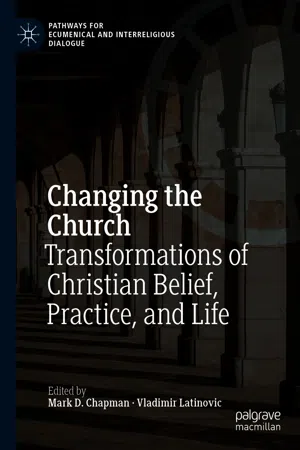
This volume, dedicated to the memory of Gerard Mannion (1970-2019), former Joseph and Winifred Amaturo Chair in Catholic Studies at Georgetown University, explores the topic of changing the church from a range of different theological perspectives. The volume contributors offer answers to questions such as: What needs to be changed in the universal church and in the particular denominations? How has change influenced the life of the church? What are the dangers that change brings with it? What awaits the church if it refuses to change? Many of the essays focus on people who have changed the church significantly and on events that have catalyzed change, for the better or for the worse. Some also present visions of change for particular Christian denominations, whether over the ordination of the women, different approaches to sexuality, reform of the magisterium, and many other issues related to change.
eBook - ePub
Changing the Church
Transformations of Christian Belief, Practice, and Life
- English
- ePUB (mobile friendly)
- Available on iOS & Android
eBook - ePub
Changing the Church
Transformations of Christian Belief, Practice, and Life
About this book
Information
Topic
Theology & ReligionSubtopic
Christian Theology© The Author(s) 2021
M. D. Chapman, V. Latinovic (eds.)Changing the ChurchPathways for Ecumenical and Interreligious Dialoguehttps://doi.org/10.1007/978-3-030-53425-7_11. Introduction
Vladimir Latinovic1 and Mark D. Chapman2
(1)
University of Tübingen, Tübingen, Germany
(2)
Ripon College, Cuddesdon, University of Oxford, Cuddesdon, Oxford, UK
Change is life and life is change. Our bodies and souls move through time, constantly developing from one state to the next. Even time itself can be defined as change because through the present it transforms the unknown future into the unchangeable past. Our cells mutate and die only so that they are replaced by new ones, just as we through our deaths make way for new generations. Our experience and wisdom also grow or degrade, but they never stand still. Our relationships with our family and friends develop and often take unexpected and sometimes unwanted turns. Change is actually one of the rare constants in our existence; if there is not enough of it, we become tired and bored and we feel the urge to change something so that our lives might become interesting and exciting again. Nothing in this world stands still. Heraclitus grasped this changeability of the world inside us and around us by stating that everything flows (panta rhei).
And yet, Christian churches as well as other religions often see change as something essentially negative. They see themselves as based on teachings which are “set in stone”. They call their books “sacred” in order emphasize that nothing in them is allowed to be changed; and even if those religions might have been founded by someone who was himself an innovator and who changed the old teaching in order to create a the new one, which is the case both with Christianity and Islam, they nevertheless emphasize how important it is that people do not change this new teaching.1 The worst word in their vocabulary is reserved for those who try to change the official teachings of the church or religion but who fail to do so. They are called heretics. For those who succeed in changing things, however, another term is used—orthodox. This usually carries a positive connotation, but even where they accept the changes that were brought about, churches desperately try to show that they did not actually change anything: instead, they claim, they have simply found new ways of expressing the old unchangeable truths.
There are many ways that modern psychology could offer an explanation of this phenomenon of rejecting change. Some would connect it with anxiety, because accepting new things requires a degree of courage. Some would say that this rejection of change is unhealthy because it lacks an openness for the new; and some would utter the truism that we need constancy in our lives just as much as we need change.2 Unfortunately, due to some or all of the above mentioned factors in religious circles, there are often cases where change is rejected. There are some, especially in leadership positions, who are simply too comfortable with the way things are to have any great desire to bring about change. Such inertia is of course one of the worst kinds of reasons not to change. Those who resist such temptations which come with power are in almost every case acknowledged by future generations, when things that were considered as innovations become normal and standard. Here we might simply mention Francis of Assisi, Luther, and Pope John XXIII who, while very different personalities, were all bold visionaries and reformers who were not afraid of bringing change into the life of the church.
One of the people who was dedicated with his whole being to positive change was the dedicatee of this volume: Gerard Mannion. Born into a family of Irish immigrants to the UK and educated in a state comprehensive school in all probability he might well have followed a quite different career, perhaps working a normal job, after which he would relax by watching rugby games with his friends and spending his free time in a pub. But Gerard Mannion wanted something more: he was passionate about changing this world and his own Catholic Church for the better. He did his best to succeed academically to achieve these ambitions. He gained a place at King’s College, Cambridge, and then moved to take his doctorate at New College, Oxford, two of the most famous and prestigious academic institutions in the English-speaking world. He read (and later wrote) countless books and articles, he spent his time in the company of brightest theological minds of our time, he socialized with archbishops and cardinals, and yet still he found the time to visit pubs, to talk to normal people, and to watch and play rugby.3 And he achieved all this because he refused to stand still and he embraced change.
But change also played another role in Gerard Mannion’s life. Like many of us he used it therapeutically to learn to live with and even to cure his sense of frustration with the way the things were: Frustration that the church to which he belonged—along with the other churches—is led by those who do not feel the needs of the poor and the oppressed; frustration that theology is not listening to the spirit of the age in a way that would enable the church to survive in our modern world; frustration that the church rejects people based on sexual orientation, gender, heritage, skin color, and religious belonging along with many, many other exasperations. To all of these Gerard saw only one cure: change. He used to say that we cannot keep on doing things the way we have always done them if we want to have a future. This is why he was so excited with the prospects that Pope Francis would start changing the church.4 By praising him he was actually praising change and he hoped that Francis would be able to introduce more and more change.
This passion for change is the main reason why we decided to dedicate this volume to our friend’s honor and memory. In this volume, we have asked our distinguished contributors to ask and hopefully to offer some answers to questions such as: What needs to be changed in the universal church and in the particular denominations? How does or did change influence the life of the church? What are the dangers that change brings with it? What awaits us if we refuse to change certain things? All the essays in this book are in some way related to the topic of change. Many of them focus on historical and living people and events that have made a significant contribution to changing the church for the better or sometimes for the worse. Some also present opportunities to imagine the changes that might need to take place in particular Christian denominations, whether over the ordination of women, different approaches to sexuality, reform of the magisterium, and many other issues related to change.
The first section explores theological and historical topics related to change. The authors explore questions such as how the early church responded to situations such as the decline of large numbers of Christians, changing penitential practices, and considering what these examples of past change might teach us today. David G. Hunter discusses this in relation to our struggles to find adequate pastoral answers to the problem of divorce and remarriage. Vladimir Latinovic shows how changes and development in doctrine itself affected the position of some theologians who had hitherto been considered Orthodox but who suddenly, because of that change, found themselves in the opposite, heretical camp. Other chapters explore the theological role of conflicts that accompany changes in the church, asking whether internal church quarrels can be avoided at any cost, or whether perhaps, as Judith Gruber shows, there can be theological significance to disagreement in the church. Massimo Faggioli examines the fundamental steps that certain churches have had to take and the reforms that have been necessary as they have sought to develop a new relationship with history and modernity.
The second part deals with change in the Church in relation to the wider social context particularly with regard to gender and social and economic issues, including drastic climate change, biodiversity loss and scarcity of natural resources. Elaine Padilla discusses, for example, the need for the Church to uphold a mission that contributes to the preservation of our planet. This section also deals with the changes in behavior that are required to address the impact of modern food economies, which are currently completely unsustainable and cruel in terms of production methods. Matthew Eaton discusses the changes that are required to minimize cruelty to animals through methods that already exist in Christian practice, such as fasting. Cristina Lledo Gomez deals with the question of how the church can address those who have survived abuse, including those who have experienced it outside the church by placing the abused and vulnerable at the forefront of church activity and change. Mary McClintock Fulkerson goes on to explore the ways in which prayer, ritual, and the global community can affect and change the lives of those who do not have the security of their own home. Scott MacDougall looks in depth at the question of the source of change, identifying it in the Holy Spirit in which the human role in such changes is responsive, not causal. Other important topics addressed in this question include Susie Paulik Babka’s discussion of how the fraught incorporation of twentieth-century visual art in the Roman Catholic Church analogizes its relationship to Modernity. Drawing on the theme of synodality as the mode of introducing change in the Church, Patricia Madigan O.P. explores the role of women in decision-taking in the Church. Dennis M. Doyle addresses the issue of birth control from a centrist point of view through a comparison of the opposing views of conservative and progressive groups.
The third part, which addresses issues of mission and world Christianity, begins with a fascinating account by Roger Haight S.J. of how mission theology has developed in the past 75 years due to such factors as ecumenism, increased social freedoms, and interreligious dialogue. Mission is also discussed in other chapters from a historical perspective. Paul M. Collins, for example, addresses how mission changed in the early church, which stands in stark contrast to the modern understanding: The ways in which the concept of mission changes directly affect what kind of Church we are building in the present day. Martyn Percy goes on to ask whether the goal of mission should be the social transformation and renewal of society rather than the recruitment of church members. From a different perspective Gioacchino Campese asks how the mission and role of the Church need to respond to the circumstances of the refugee crisis, and how migration generally affects change. In turn, Darren J. Dias addresses the contested question of how the Church might approach its colonial past and what the role of the Church should be in the post-colonial paradigm. Stan Chu Ilo discusses the challenges facing the Church in Africa and how the Church might change to responds to the particular context of this region: Change is identified as the revolutionary power of the Church to change that derives from the biblical tradition. Indeed, if the Church is not able to change, it will not be able to survive. Sometimes, as Debora Tonelli shows, this change goes to the limits of revolution. The reasons for this revolution, as well as for change itself, are sometimes invisible. Sometimes it can even occur naturally, simply because our world is changing drastically: People have changed their way of life, they travel in search of work and education, and often they leave their countries. How does this affect our understanding of a Church which can still seem too Eurocentric? What contribution, asks Jonathan Y. Tan...
Table of contents
- Cover
- Front Matter
- 1. Introduction
- Part I. History and Theology
- Part II. Society and Gender
- Part III. Mission and World Christianity
- Part IV. Ecumenical and Interreligious Dialogue
- Part V. Ecclesiology
- Part VI. Synodality and Participation
- Correction to: Changing the Church
- Back Matter
Trusted by 375,005 students
Access to over 1.5 million titles for a fair monthly price.
Study more efficiently using our study tools.
Frequently asked questions
Yes, you can cancel anytime from the Subscription tab in your account settings on the Perlego website. Your subscription will stay active until the end of your current billing period. Learn how to cancel your subscription
No, books cannot be downloaded as external files, such as PDFs, for use outside of Perlego. However, you can download books within the Perlego app for offline reading on mobile or tablet. Learn how to download books offline
Perlego offers two plans: Essential and Complete
- Essential is ideal for learners and professionals who enjoy exploring a wide range of subjects. Access the Essential Library with 800,000+ trusted titles and best-sellers across business, personal growth, and the humanities. Includes unlimited reading time and Standard Read Aloud voice.
- Complete: Perfect for advanced learners and researchers needing full, unrestricted access. Unlock 1.5M+ books across hundreds of subjects, including academic and specialized titles. The Complete Plan also includes advanced features like Premium Read Aloud and Research Assistant.
We are an online textbook subscription service, where you can get access to an entire online library for less than the price of a single book per month. With over 1.5 million books across 990+ topics, we’ve got you covered! Learn about our mission
Look out for the read-aloud symbol on your next book to see if you can listen to it. The read-aloud tool reads text aloud for you, highlighting the text as it is being read. You can pause it, speed it up and slow it down. Learn more about Read Aloud
Yes! You can use the Perlego app on both iOS and Android devices to read anytime, anywhere — even offline. Perfect for commutes or when you’re on the go.
Please note we cannot support devices running on iOS 13 and Android 7 or earlier. Learn more about using the app
Please note we cannot support devices running on iOS 13 and Android 7 or earlier. Learn more about using the app
Yes, you can access Changing the Church by Mark D. Chapman, Vladimir Latinovic, Mark D. Chapman,Vladimir Latinovic in PDF and/or ePUB format, as well as other popular books in Theology & Religion & Christian Theology. We have over 1.5 million books available in our catalogue for you to explore.