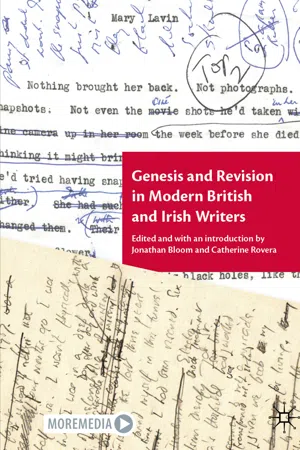
This unusually diverse collection of ten essays, devoted to British and Irish writers and poets from 1895 to the present, explores many aspects of the creative process, from inspiration to publication and beyond. The volume shows how writers' manuscripts and revisions give us a better understanding of their published work by drawing on unpublished archival sources to unveil, across genre and gender, the intricacies of their craft. It examines how the paper medium and writing implements influence the act of composition; reveals the latest developments in such fields as life writing and digital humanities—especially how modern scholars, through the filter of hypertext, revisit modernist texts, or respond to newly-found material; and analyzes the hidden handwork, be it throughout the writer's exhaustive self-editing process or the writer-editor collaboration. Finally, it captures an award-winning poet and a living novelist reflecting upon their craft and work in progress.
eBook - ePub
Genesis and Revision in Modern British and Irish Writers
- English
- ePUB (mobile friendly)
- Available on iOS & Android
eBook - ePub
Genesis and Revision in Modern British and Irish Writers
About this book
Information
© The Author(s) 2020
J. Bloom, C. Rovera (eds.)Genesis and Revision in Modern British and Irish Writershttps://doi.org/10.1007/978-3-030-50277-5_11. Introduction: Archival Revelations
Jonathan Bloom1 and Catherine Rovera1
(1)
University of Paris-Dauphine, Paris Sciences & Lettres, Paris, France
1Accursed who brings to light of dayThe writings I have cast away!But blessed he that stirs them notAnd lets the kind worm take the lot!—W. B. Yeats
Perhaps only the mysteries of creation and existence have preoccupied humankind more than the secrets of its own acts of creation. Writers, composers, painters, sculptors, engravers, architects and luthiers are all involved in creative processes that lead them to finished artistic works, but in many cases that process, once completed, is all but invisible and cannot be recaptured, reassembled or recreated. In some instances, of course, one can get a glimpse of it, through a well-preserved isolated stage—a scrap of manuscript, a study for a painting, an armature or model for a sculpture or building, an engraved plate, or even a wooden mold for a stringed instrument, but in the fine arts and violin making, we know little about each artist’s process as a whole. Paintings now can be scanned, and those images can reveal clues about the way in which particular painters worked. For instance, in Paris recently, the researcher Pascal Cotte, who works regularly with the Louvre, scanned the Mona Lisa with a multispectral camera. Underneath several layers of paint, he discovered another woman’s face, larger, unsmiling, with a more pronounced nose.2 The clothing details prove that the original, heretofore unknown ‘Lisa’, had been erased to make room for the iconic face we marvel at today. Yet despite this intriguing revelation, the story of the making of the world’s most famous portrait remains incomplete. In the case of sculptors and luthiers, once the works are crafted, all—or nearly all—of the stone, clay or wood removed to form the work of art or instrument is discarded. We know that Michelangelo’s choice of stone, a piece of marble twice abandoned by other sculptors, for instance, determined David’s posture, but little about how he chiseled it. Stradivarius’s instruments continue to amaze analysts, but his techniques and craftsmanship—even the composition of his varnish—remain mysterious. Astounding, inexplicable architectural achievements abound, of course, from Stonehenge to Tiwanaku and Pumapuncu to the great pyramids, but their construction and, in the case of Stonehenge, functionality, remains unfathomable.
Perhaps only writers and composers—providing that they preserve their drafts and notes—occasionally offer us the possibility of tracing their creative processes, making their archives arguably the richest source for examining a creative act. Although the complete paper trail of any given author’s work rarely survives or is available, in many instances enough material remains to tell some of the story of its creation. A close examination of unpublished and published materials from notebooks, diaries, sketches and rough drafts with extensive revisions to typescripts and galley proofs enables scholars to trace the evolution and translation of an original impulse into a final published text. Autobiographical material, correspondence with friends, colleagues and editors can, of course, shed further light on a writer’s approach to fashioning the fictive. And beyond the archival revelations are disclosures in recorded radio and television broadcasts, captured on tape or in transcripts, as well as in authors’ published interviews, essays and book reviews.
The value of contextual and source studies is now well established in the field of textual scholarship. But the genetic approach goes beyond the mere observation of primary source material. It is, instead, a reconstruction of ‘the chain of events in a writing process’3 and as such it exposes what happens backstage, behind the scenes or between the acts. In this way, one may view the geneticist as a detective. To begin, genetic critics investigate primary source materials that have somehow been retrieved after their authors have either scrapped or salvaged them. After combing through all the clues or exhibits, they piece them together to reconstruct and ultimately capture the act of creation.
In what ways does the study of revisions give us a better understanding of a published work? At various stages, writers choose to add or remove material that, however minor or extensive, can substantially alter their work. The deletion of a passage, for instance, can make way for a perhaps more wide-ranging unsaid that enlists the reader’s participation. How does the actual choice and use of writing tools influence the creative process? Some authors write exclusively by hand, others compose directly on the typewriter or word processor before making autograph revisions, others use a combination of the two, and many employ collage techniques that anticipate the cutting and pasting so easily achieved on a computer. Do writers’ ethical and moral considerations have an impact on their subject matter and editorial decisions? While some writers have been censored by external voices, others may instead monitor themselves. Is it then possible to detect such considerations at various stages of their work? Editorial suggestions for revision may enter into the process as well, after authors submit for publication what they consider to be their final version, and can transform texts just as dramatically—and sometimes enhance or spoil them. The study of the creative process is not, however, limited to the stages that precede the first published text. In some cases, dissatisfied with the initial publication, writers and poets argue for revising or reworking the text and in some cases republishing it. This volume explores the creative process in all these facets.
Although famous for its seminal role in establishing literary textual criticism in the 1970s as a legitimate alternative to its more celebrated and influential theoretical movements of that period, such as structuralism and deconstructionism, France was not the birthplace of genetic criticism. In their enlightening introduction to Genetic Criticism: Texts and Avant-textes, Jed Deppman, Daniel Ferrer and Michael Groden point out that although the inspiration for genetic research is often attributed to France, and while it ‘originates much of it, France was nonetheless one of the last countries to become engaged in it, and indeed one must look elsewhere for the origins of genetic criticism’.4 The founder of French genetic criticism, Louis Hay, believes that ‘[i]n the aesthetics of German idealism, we find the modern source of reflection on what Goethe first called the “genetic evolution” of a writing’.5 Not surprisingly, poets and writers were the first to become interested in ‘studies dealing with the production of writings, especially literary texts’, long before the critics themselves.6 Therefore, the true founding fathers of modern genetic-critical studies were nineteenth-century early German Romantic poets who understood that tracing the organic composition of a work leads to a greater understanding of the finished product. Goethe believed that the best way of comprehending works of art is to see them in their ‘nascent state’7 and Friedrich Schlegel observed likewise that the most profound understanding of a work comes from tracking its development and composition. A century later in France, yet another famous poet, Paul Valéry, argued that the process itself was even more important than the final product: ‘Creating a poem is itself a poem’, he wrote.8
Scholarly interest in manuscript-based studies and textual criticism emerged on both sides of the Atlantic in the 1950s and 1960s during which a number of English-language scholars focused on individual writers and poets, often devoting entire volumes to the genesis and evolution of one work. Conscious of their importance and aware of posterity, James Joyce and William Butler Yeats saved much of what they wrote, which is why textual scholars who had access to their papers during this burgeoning period had so much material with which to work. A disproportionate focus on Joyce’s and Yeats’s archival material is, of course, only natural. They are arguably the most significant novelist and poet respectively of the twentieth century. Therefore, although there were ground-breaking volumes on Brontë, Hardy, Eliot and Dickinson, not surprisingly, the majority of these manuscript-based volumes focused on Joyce and Yeats, such as A. Walton Litz’s The Art of James Joyce: Method and Design in Ulysses and Finnegans Wake (1961); David Hayman’s monumental annotated reconstruction of Joyce’s last work, A First-Draft Version of Finnegans Wake (1963); Jon Stallworthy’s Between the Lines: Yeats’s Poetry in the Making (1963) and its companion volume, Vision and Revision in Yeats’s Last Poems (1969); Curtis Bradford’s Yeats at Work (1965); Michael Groden’s Ulysses in Progress (1977), the most comprehensive and authoritative history of Ulysses’s evolution. During this productive period, Hayman’s work on Finnegans Wake and Phillip F. Herring’s edition of Joyce’s Ulysses Notesheets in the British Museum (1972) ensured that, together with the aforementioned books, work on the James Joyce archive did more to advance modern textual criticism than anything else.9
Serendipity played a critical role in reinvigorating textual studies in the late 1950s. Though they each had a longstanding interest in modern literature, two unlikely pioneers of that period, the American A. Walton Litz, one of three 1951 Rhodes Scholars from Princeton, and the Englishman Jon Stallworthy, the 1958 Newdigate Prize-winning Magdalen College graduate, pursued graduate studies in Oxford for ...
Table of contents
- Cover
- Front Matter
- 1. Introduction: Archival Revelations
- 2. Vision and Revision in the Manuscripts of William Wordsworth and W. B. Yeats
- 3. The Unwritten Waste: Revisions in the Poetry and Memoir of A. S. J. Tessimond
- 4. Inspiration and Narrative in the Short Poem
- 5. The ‘Newness’ of Manuscripts
- 6. Unwriting The Waves
- 7. The Writer’s Hunger: Considering a Novel in Progress
- 8. To Cut a Long Story Short: The Shaping of Mary Lavin’s New Yorker Stories
- 9. The Handmade Tale: The Paper Medium as the Place for Action
- 10. ‘No Speech at My Command Will Fit the Forms in My Mind’: Shaping the Spiritual Through Writing and Typing in George MacDonald’s Lilith Manuscripts
- 11. Processing Modernism: The Textual Politics of Nightwood
- Back Matter
Trusted by 375,005 students
Access to over 1.5 million titles for a fair monthly price.
Study more efficiently using our study tools.
Frequently asked questions
Yes, you can cancel anytime from the Subscription tab in your account settings on the Perlego website. Your subscription will stay active until the end of your current billing period. Learn how to cancel your subscription
No, books cannot be downloaded as external files, such as PDFs, for use outside of Perlego. However, you can download books within the Perlego app for offline reading on mobile or tablet. Learn how to download books offline
We are an online textbook subscription service, where you can get access to an entire online library for less than the price of a single book per month. With over 1.5 million books across 990+ topics, we’ve got you covered! Learn about our mission
Look out for the read-aloud symbol on your next book to see if you can listen to it. The read-aloud tool reads text aloud for you, highlighting the text as it is being read. You can pause it, speed it up and slow it down. Learn more about Read Aloud
Yes! You can use the Perlego app on both iOS and Android devices to read anytime, anywhere — even offline. Perfect for commutes or when you’re on the go.
Please note we cannot support devices running on iOS 13 and Android 7 or earlier. Learn more about using the app
Please note we cannot support devices running on iOS 13 and Android 7 or earlier. Learn more about using the app
Yes, you can access Genesis and Revision in Modern British and Irish Writers by Jonathan Bloom, Catherine Rovera, Jonathan Bloom,Catherine Rovera in PDF and/or ePUB format, as well as other popular books in Languages & Linguistics & Creative Writing. We have over 1.5 million books available in our catalogue for you to explore.