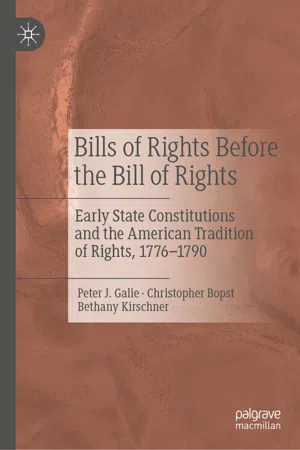
This book is a documentary history of the rights found in the American state constitutions adopted between 1776 and 1790. Despite the rich tradition of rights at the state level, rights in America have been identified almost exclusively with the national Bill of Rights. Indeed, there is no work that provides a comprehensive treatment of the early state declarations of rights. Rather, these declarations have been viewed as halting first steps towards the adoption of the national Bill of Rights in 1791. Bringing together the full text of the rights provisions from the 13 original states and Vermont, this book presents America's first tradition of rights on its own terms and as part of this country's heritage of rights. Early chapters will examine the sources of these rights and provide a comparative framework. An introduction to each chapter will review that state's colonial history, focusing on any charters or legislation related to rights protections that help explain its constitutional provisions. This work will make it possible for students, scholars, and interested citizens to rediscover the first fruits of the American Revolution.
eBook - ePub
Bills of Rights Before the Bill of Rights
Early State Constitutions and the American Tradition of Rights, 1776-1790
- English
- ePUB (mobile friendly)
- Available on iOS & Android
eBook - ePub
Bills of Rights Before the Bill of Rights
Early State Constitutions and the American Tradition of Rights, 1776-1790
About this book
Information
States Adopting Declarations of Rights
© The Author(s) 2020
P. J. Galie et al.Bills of Rights Before the Bill of Rightshttps://doi.org/10.1007/978-3-030-44301-6_4Virginia
Peter J. Galie1 , Christopher Bopst2 and Bethany Kirschner3
(1)
Department of Political Science, Canisius College, Buffalo, NY, USA
(2)
Wilder & Linneball, LLP, Buffalo, NY, USA
(3)
Woehrle Dahlberg Jones Yao, PLLC, Fredericksburg, VA, USA
Virginia’s heritage of constitutionalism and the protection of rights can be traced back to its very first charter, granted by King James I to the Virginia Company on April 10, 1606. This founding document contained, in the words of Virginia statesman Edmund Randolph, a “ray of freedom”1:
Also we do, for Us, our Heirs, and Successors, DECLARE, by these Presents, that all and every the Persons being our Subjects, which shall dwell and inhabit within every or any of the said several Colonies and Plantations, and every of their children, which shall happen to be born within any of the Limits and Precincts of the said several Colonies and Plantations, shall HAVE and enjoy all Liberties, Franchises, and Immunities, within any of our other Dominions, to all Intents and Purposes, as if they had been abiding and born, within this our Realm of England, or any other of our said Dominions.2
This promise that settlers would be guaranteed the rights enjoyed by Englishmen was echoed in the second charter of Virginia in 1609, which further instructed the Virginia Company to operate a legal system “as near as conveniently may be…to the Laws, Statutes, Government, and Policy of this our Realm of England.”3 Together, these two clauses would seem to guarantee to the settlers all the benefits of the common law, although the common law would not begin to take root in Virginia until it became a royal colony in 1624.4
In 1618, Sir Edwin Sandys, Virginia Company investor and member of the royally appointed Council of Virginia (located in England), helped prepare a commission to the governor that provided for a new system of representative governance, with a popularly elected, unicameral legislature.5 This general assembly was to be made up of the governor, the members of the council of state (chosen by the Company) and two representatives (burgesses) elected from each town and plantation.6 The first meeting of the Virginia General Assembly, on July 30, 1619, marked the beginning of political self-government for those who came to the New World.7
In 1624, the Virginia Company’s charter was revoked, and Virginia became a royal colony governed by the rule of law. This change in political affairs did not alter the fact that colonists considered the liberty guarantees afforded by the colonial charters as their birthright.8 The popularly elected house of burgesses began to meet separately as the lower house of the general assembly after 1643; it operated largely unchecked by royal authority for much of the seventeenth century, encouraging the growth of self-government in the colony. Crown policies that infringed on the assembly’s legislative authority provoked dissatisfaction and protest. The Virginia Assembly asserted the “rights of Englishmen” guaranteed by the charters when it passed resolutions protesting the Revenue Act of 1764 and the Stamp Act of 1765.9 The assembly’s resolutions of 1774 in response to the Intolerable Acts added natural rights theory to the arguments based on colonial charters and the English Constitution.10
Royal authority in Virginia began to collapse in the latter part of the eighteenth century. The governor dissolved the house of burgesses in May 1774; nevertheless, the house continued to meet on its own until May 1776. During this period, a series of extra-legal conventions exercised de facto governance of the colony.11 On May 15, 1776, the Fifth Virginia Convention passed a resolution instructing its delegates to the Continental Congress to move for a declaration of independence from England.12 Having decided to sever ties with the mother country, the convention next resolved to form a committee “to prepare a DECLARATION OF RIGHTS and such a plan of government as will be most likely to maintain peace and order in this colony, and secure substantial and equal liberty to the people.”13 Legal historian A. E. Dick Howard explains the significance of the placement of the declaration of rights ahead of a plan of government:
The members of the 1776 Convention, steeped in Lockean notions of the social contract, might well have considered themselves in a state of nature upon the dissolution of the bond with Great Britain. Heirs to a tradition of written liberties, they found it a natural step to declare man’s inherent rights.14
Consistent with the idea that rights are declared, not granted, by governments and to emphasize the importance of rights, delegates wrote and adopted a declaration of rights prior to adoption of the body, or frame, of the constitution.
The task of drafting the first American state bill of rights fell to George Mason. Regarded as “one of the most thorough students of constitutional law in the American colonies,”15 Mason had previously penned annotated extracts from the colonial charters (1773), the Fairfax Resolves (1774), and Remarks on Annual Elections for the Fairfax Independent Company (1775). Significant portions of these documents found their way into the Virginia Declaration of Rights.16 After a few alterations and additions in committee, the declaration was passed unanimously by the convention on June 12, 1776.17 Mason’s influence is evident in all but two sections of the final product.18 The constitution was adopted shortly thereafter on June 29.
Constitutional Developments: 1776 Declaration and Constitution
The Virginia Declaration of Rights illustrates the predominantly communal context for understanding rights shared by most early state constitution writers. It was written, as its preamble states, to the people of Virginia to set forth the rights that were the foundation of the new government, and to inform citizens of their duties and obligations to preserve liberty. Edmund Randolph, a member of the convention’s drafting committee, would later assert that the declaration of rights was “the cornerstone” of the constitution and had been written with a two-fold purpose: “that the legislature should not in their acts violate any of those canons;” and “that in all the revolutions of time, of human opinion, and of government, a perpetual standard should be erected, around which the people might rally and by notorious record be forever admonished to be watchful, firm, and virtuous.”19
After asserting in section 1 that men had inherent rights they were not divested of when leaving a state of nature to form a social compact, the declaration then defined popular sovereignty in sections 2 and 3. These provisions proclaimed that a government’s legitimate authority was derived from the people; government was established for the common benefit of the people; and public officials were the servants of the people. When adopted, these sections announced to Virginians, to the newly-independent states, and to the world the political philosophy of the state’s first constitution.
Many of the essential rights of the people proclaimed in the declaration had implicit corresponding duties, such as the right and duty to vote, the right to trial by jury and the duty of jury service, the right to serve in a militia and the duty of militia service, and the right and duty to worship. The religious liberty provision (Decl. 1776, sec. 16) especially demonstrates the interwoven character of rights and duties, postulating that the right to free religious exercise arises out of a duty to worship our Creator as conscience dictates. The last clause of section 16, “that it is the mutual duty of all to practise Christian forbearance, love, and charity toward each other,” was an aspirational provision—not legally enforceable, but rather meant to exhort the people to practice civic and religious virtue, which was believed to be crucial for effective self-government and ordered liberty. The preceding section was also an admonition to the people. Section 15 stated: “That no free government, or the blessings of liberty, can be preserved to any people, but by a firm adherence to justice, moderation, temperance, frugality, and virtue, and by frequent recurrence to fundamental principles.” The emphasis on the corresponding duties associated with fundamental rights demonstrates that Mason and his colleagues were relying on the independence, integrity, and vigilance of the electorate as the primary safeguards of liberty. If this failed, section 3 asserted that the majority of the people had an inalienable right to alter or abolish a wayward government.
The declaration also contained provisions denouncing offensive governmental actions fresh in the delegates’ minds as grievances the colonists had against the Crown and Parliament: taxing the people or taking their property without their consent (Decl. 1776, sec. 6); issuing general warrants, which lacked a sufficiently particularized description of the person or thing to be seized or the place to be searched (ibid., sec. 10); having standing armies (ibid., sec. 13); restraining the freedom of the press (ibid., sec. 12); and suspending or executing laws without the consent of t...
Table of contents
- Cover
- Front Matter
- Framing
- States Adopting Declarations of Rights
- States Adopting Constitutions Without Separate Declarations of Rights
- States Maintaining Their Colonial Charters
- Epilogue
Trusted by 375,005 students
Access to over 1.5 million titles for a fair monthly price.
Study more efficiently using our study tools.
Frequently asked questions
Yes, you can cancel anytime from the Subscription tab in your account settings on the Perlego website. Your subscription will stay active until the end of your current billing period. Learn how to cancel your subscription
No, books cannot be downloaded as external files, such as PDFs, for use outside of Perlego. However, you can download books within the Perlego app for offline reading on mobile or tablet. Learn how to download books offline
Perlego offers two plans: Essential and Complete
- Essential is ideal for learners and professionals who enjoy exploring a wide range of subjects. Access the Essential Library with 800,000+ trusted titles and best-sellers across business, personal growth, and the humanities. Includes unlimited reading time and Standard Read Aloud voice.
- Complete: Perfect for advanced learners and researchers needing full, unrestricted access. Unlock 1.5M+ books across hundreds of subjects, including academic and specialized titles. The Complete Plan also includes advanced features like Premium Read Aloud and Research Assistant.
We are an online textbook subscription service, where you can get access to an entire online library for less than the price of a single book per month. With over 1.5 million books across 990+ topics, we’ve got you covered! Learn about our mission
Look out for the read-aloud symbol on your next book to see if you can listen to it. The read-aloud tool reads text aloud for you, highlighting the text as it is being read. You can pause it, speed it up and slow it down. Learn more about Read Aloud
Yes! You can use the Perlego app on both iOS and Android devices to read anytime, anywhere — even offline. Perfect for commutes or when you’re on the go.
Please note we cannot support devices running on iOS 13 and Android 7 or earlier. Learn more about using the app
Please note we cannot support devices running on iOS 13 and Android 7 or earlier. Learn more about using the app
Yes, you can access Bills of Rights Before the Bill of Rights by Peter J. Galie,Christopher Bopst,Bethany Kirschner in PDF and/or ePUB format, as well as other popular books in Politics & International Relations & Public Law. We have over 1.5 million books available in our catalogue for you to explore.