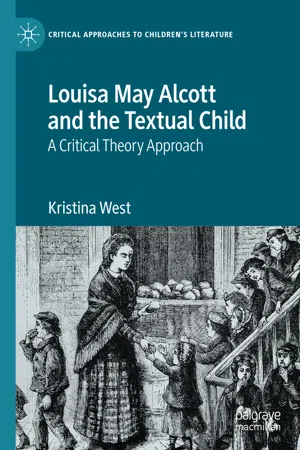
This book examines constructions of childhood in the works of Louisa May Alcott. While Little Women continues to gain popular and critical attention, Alcott's wider works for children have largely been consigned to history. This book therefore investigates Alcott's lesser-known children's texts to reconsider critical assumptions about childhood in her works and in literature more widely. Kristina West investigates the trend towards reading Alcott's life into her works; readings of gender and sexuality, race, disability, and class; the sentimental domestic; portrayals of Transcendentalism and American education; and adaptations of these works. Analyzing Alcott as a writer for twenty-first-century children, West considers Alcott's place in the children's canon and how new media and fan fiction impact readings of her works today.
- English
- ePUB (mobile friendly)
- Available on iOS & Android
eBook - ePub
About this book
Information
© The Author(s) 2020
K. WestLouisa May Alcott and the Textual ChildCritical Approaches to Children's Literaturehttps://doi.org/10.1007/978-3-030-39025-9_11. Reading Alcott’s Textual Childhood
Kristina West1
(1)
London, UK
Childhood and Literature
The purpose of this book is to investigate, as a body, Louisa May Alcott’s works for and about children. In doing so, I will also consider how childhood is constructed within Alcott’s texts and by those who read them, thereby questioning the basis on which assumptions about childhood in literature are made. All too often, and despite extensive work in this area by theorists such as Jacqueline Rose and Karín Lesnik-Oberstein, claims that childhood is self-evident continue to thrive; and such assumptions direct readings of the textual child as much as they construct the so-called real child that is frequently called into being as the literary child’s point of origin. Alcott’s literature is of particular interest in looking at childhood via this approach because of the overwhelming critical and popular focus on just one of her works, Little Women , with most of her novels and short stories for children occasioning very little attention beyond the author’s own lifetime. I therefore intend to investigate Alcott’s children’s literature, including and beyond Little Women , to consider portrayals of childhood within her texts and their criticism, and to ask: why analyze the textual child at all?
In looking at Alcott’s works, I also want to consider what is at stake in reading the child in literature from a critical perspective. In ‘Holiday House: Grist to The Mill on the Floss, or Childhood as Text’, Lesnik-Oberstein claims:
The assumption—or bestowal—of childhood’s status as a ‘field’ positions it as other, as separate from a default adulthood, and places it within of a body of literature that is positioned as marginal against an assumed norm that is designated as prior to, or beyond the need of, the qualifying term ‘field’. The ‘field’ of childhood is therefore an adult production, separated from the normative adult world and categorized in terms of that claim to difference and the resultant separation. Such categorizing, here, is constructed in terms of an excess under the critical adult judgment: childhood is always ‘too’ much of something, ‘too simple […] too pure’, to be worthy of any serious adult engagement. As such, it sits outside the boundaries of what is deemed an acceptable focus of adult critical attention, with each claim to excess providing a reason—or excuse—to stay away. And here can also be read the adult anxiety about engaging with childhood at all: childhood either infantilizes the adult engaging with it, with the adult moving into what it has constructed as the child’s space, or any such engagement brings the child into the ostensibly adult world of sexuality and desire, through the adult rejection of its own potential ‘touch’. It is, therefore, the adult engagement with childhood that produces the very child it appears to be rejecting; the child that can only exist in uneasy relation to the adult who does not want it.[C]hildhood […] usually remains a field regarded with anything from mild amusement to derision, judged either too simple to be serious, or too pure to be touched. The studies that have been devoted to it have equally been seen, and often see themselves, as strictly specialized and local, if not positively marginal.1
However, Caroline F. Levander and Carol J. Singley, in their introduction to The American Child, disagree with this perspective, claiming that critical study is not turning away from the child, but toward it: ‘Scholars from a wide range of disciplines have turned their attention to the child in order to interrogate how it comes to represent, and often codify, the prevailing ideologies of a given culture or historical period.’2 According to this cultural studies approach, scholars are investigating childhood not to discover what it is or might be, but to see what the child can tell them about a society of which, by default, the child is not a part. In a sense, the child does not exist here but rather represents, or even re-presents as a mirror, that which also produces it; and its representation of culture or period pre-exists the adult attention that, in fact, positions it as that representation. In Levander and Singley’s reading, what gives the child its value is the very re-inscription of that which it is not.
Reading the child in Alcott’s works is no more straightforward, with different perspectives creating a variety of responses in which the textual child is up for grabs. Is Alcott’s child an ‘adult-in-process’, as claimed by Charles Strickland?3 Is it the biographical Louisa and her three sisters, as read primarily through popular and critical responses to Little Women? Is it unproblematically female, as many of Alcott’s protagonists and her readers are still assumed, largely, to be? Is her child the site of Transcendental and Romantic simplicity and innocence, in what Levander and Singley claim is ‘the repeated figuring, in nineteenth-through late-twentieth century American culture, of the child as a nostalgic symbol of lost innocence and youth’?4 Is Alcott’s child also, therefore, a nineteenth-century child, one separated by time period from other figurations of childhood and therefore representative of the period in which it exists? This work aims to explore some of these possibilities through the body of Alcott’s works for and about children; not to result in any claims to a single and knowable Alcottian child, but to look at some of the claims that have been made and explore the varying constructions of childhood in these texts.
So, under what terms will this book question the textual child? In Bodies That Matter, Judith Butler claims:
In reading ‘child’, ‘childhood’, and other related constructions, and in seeking to understand how they operate within and between texts, I am not arguing that these terms no longer have currency or should be abandoned altogether: in asking what a child is in Alcott’s works, I am not attempting to annihilate ‘child’ from language. Rather, as Butler argues—in terms of ‘materiality’ rather than ‘child’, although it could be argued that it is the supposed materiality of the child that is at stake in many critical readings—I am calling ‘a presupposition into question’ in that I intend to argue that ‘child’ is not a stable term, that its lodging is indeed ‘metaphysical’ and can be, if not exactly freed, at least analyzed and explored in order to consider how it operates in literature and, in particular, to look at both what those ‘political interests’ might be, and how they are constructed in the locating and relocating of the child in these critical and Alcottian texts. In questioning these terms, then, I will endeavor to analyze how each term is being used, what is at stake in its usage and, indeed, what ‘political interests’ are both secured and displaced in doing so. In ‘permit[ting] the term [‘child’] to occupy and serve very different political aims’, however, in no way do I intend to secure a resolution whereby ‘child’ becomes stabilized; rather, it is in the question itself that the child will be continually re-located in this work.6To call a presupposition into question is not the same as doing away with it; rather, it is to free it from its metaphysical lodgings in order to understand what political interests were secured in and by that metaphysical placing, and thereby to permit the term to occupy and serve very different political aims.5
In the destabilization of the term ‘child’, however, is the concurrent problem of children’s fiction; after all, if we cannot say with any certainty what a child is, either inside or outside of the text, how can we designate any work as about and/or for children? Anne Scott MacLeod considers this problem in her essay on the nineteenth-century textual child, and the development of the children’s literature market from the didacticism of the ‘rational’ era to the idealization of the Romantics, one that she positions—in American children’s literature at least—as arising from outside the text, ‘on a wave of social concern for the children of the urban poor’.7 Yet this separation of children’s literature into two separate camps is not without its problems, and MacLeod calls on Alcott as a writer who troubles such a linear process of children’s literature development. Having positioned the American Civil War as the marker between one era and the other, MacLeod argues: ‘Closest in some ways to prewar fiction, curiously enough, was the novel that has survived longest […] Louisa May Alcott’s [post-war novel] Little W...
Table of contents
- Cover
- Front Matter
- 1. Reading Alcott’s Textual Childhood
- 2. ‘We Really Lived Most of It’: The Trouble with Autobiography
- 3. Subverting the Sentimental Domestic
- 4. Queering the Child
- 5. Race, Disability, and Class: Alcott’s Peripheral Children
- 6. A Transcendental Childhood
- 7. ‘The Model Children’: Alcott’s Theories of Education
- 8. Retelling Alcott in the Twenty-First Century
- Back Matter
Trusted by 375,005 students
Access to over 1.5 million titles for a fair monthly price.
Study more efficiently using our study tools.
Frequently asked questions
Yes, you can cancel anytime from the Subscription tab in your account settings on the Perlego website. Your subscription will stay active until the end of your current billing period. Learn how to cancel your subscription
No, books cannot be downloaded as external files, such as PDFs, for use outside of Perlego. However, you can download books within the Perlego app for offline reading on mobile or tablet. Learn how to download books offline
Perlego offers two plans: Essential and Complete
- Essential is ideal for learners and professionals who enjoy exploring a wide range of subjects. Access the Essential Library with 800,000+ trusted titles and best-sellers across business, personal growth, and the humanities. Includes unlimited reading time and Standard Read Aloud voice.
- Complete: Perfect for advanced learners and researchers needing full, unrestricted access. Unlock 1.5M+ books across hundreds of subjects, including academic and specialized titles. The Complete Plan also includes advanced features like Premium Read Aloud and Research Assistant.
We are an online textbook subscription service, where you can get access to an entire online library for less than the price of a single book per month. With over 1.5 million books across 990+ topics, we’ve got you covered! Learn about our mission
Look out for the read-aloud symbol on your next book to see if you can listen to it. The read-aloud tool reads text aloud for you, highlighting the text as it is being read. You can pause it, speed it up and slow it down. Learn more about Read Aloud
Yes! You can use the Perlego app on both iOS and Android devices to read anytime, anywhere — even offline. Perfect for commutes or when you’re on the go.
Please note we cannot support devices running on iOS 13 and Android 7 or earlier. Learn more about using the app
Please note we cannot support devices running on iOS 13 and Android 7 or earlier. Learn more about using the app
Yes, you can access Louisa May Alcott and the Textual Child by Kristina West in PDF and/or ePUB format, as well as other popular books in Literature & Literary Criticism. We have over 1.5 million books available in our catalogue for you to explore.