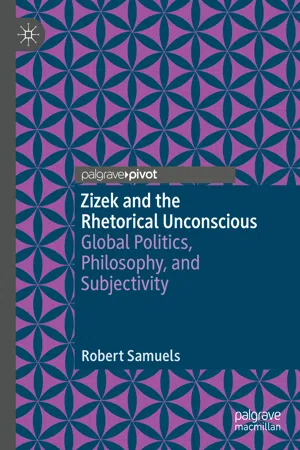
This book builds on a critique of Slavoj Zizek's work to outline a new theory of psychoanalytic rhetoric. It turns to Zizek because not only is he one of the most popular intellectuals in the world, but, this book argues, his discourse is shaped by a set of unconscious rhetorical processes that also determine much of contemporary politics, culture, and subjectivity. Just as Aristotle argued that the three main forms of persuasion are logos (reason), pathos (emotion), and ethos (authority), Samuels describes each one of these aspects of communication as related to a fundamental psychoanalytic concept. He also turns to Aristotle's work on theater to introduce a fourth form of rhetoric, catharsis, which is the purging of feelings of fear and pity.
eBook - ePub
Zizek and the Rhetorical Unconscious
Global Politics, Philosophy, and Subjectivity
- English
- ePUB (mobile friendly)
- Available on iOS & Android
eBook - ePub
About this book
Information
© The Author(s) 2020
R. SamuelsZizek and the Rhetorical Unconscioushttps://doi.org/10.1007/978-3-030-50910-1_11. Introduction
Robert Samuels1
(1)
Writing Program, University of California, Santa Barbara, Goleta, CA, USA
Robert Samuels
Abstract
The book uses a critique of Slavoj Zizek’s work in order to outline a theory of psychoanalytic rhetoric. I turn to Zizek because not only is he one of the most popular intellectuals in the world, but his discourse is shaped by a set of unconscious rhetorical processes that also determine much of contemporary of politics, culture, and subjectivity. Just as Aristotle argued that the three main forms of persuasion are logos (reason), pathos (emotion), and ethos (authority), I posit that each one of these aspects of communication is related to a fundamental psychoanalytic concept. Moreover, I turn to Aristotle’s work on theater to posit a fourth form of rhetoric, catharsis, which is the purging of feelings of fear and pity.
Keywords
ZizekRhetoricEthosPathosCatharsisLogosThis book uses a critique of Slavoj Zizek’s work in order to outline a theory of psychoanalytic rhetoric. I turn to Zizek because not only is he one of the most popular intellectuals in the world, but his discourse is shaped by a set of unconscious rhetorical processes that also determine much of contemporary of politics, culture, and subjectivity.1 Just as Aristotle argued that the three main forms of persuasion are logos (reason), pathos (emotion), and ethos (authority), I posit that each one of these aspects of communication is related to a fundamental psychoanalytic concept.2 Moreover, I turn to Aristotle’s work on theater to posit a fourth form of rhetoric, catharsis, which is the purging of feelings of fear and pity.3
Freud called his initial psychoanalytic method, catharsis, and he argued that the fundamental drive of all human beings is the pleasure principle as the desire to avoid all tension and excessive stimulation.4 As a form of unconscious rhetoric, catharsis represents a desire to attain pleasure by escaping feelings of guilt and shame. Thus, according to the dictates of the pleasure principle, language can be utilized as a medium for reducing the need for mental energy, and popular culture is fundamentally shaped by the desire to escape from anxiety caused by conflict. Just as people turn to their iPhones or opiates in order to stop thinking about the reality of their lives, catharsis through entertainment allows people the possibility to deny feelings of anxiety, guilt, and shame as they receive instant access to pleasure.
In Zizek’s work, we will see how his use of jokes, popular culture, and obscenities helps him to deliver pleasure to his audience, and as Freud argued in relation to jokes, the speaker bribes the audience with enjoyment so that he or she will not be held accountable for what is being said.5 Jokes, then, provide a safe social space where people are able to express their violent and sexual impulses in a sublimated fashion without fear of retribution. In the context of contemporary culture, we find that entertainment reduces the tension caused by the central conflict between nature and culture. Since society is structured around the regulation of sex and violence, humans have to sacrifice part of their own inner nature to be members of a culture, but as Freud insisted, these natural urges can never be fully effaced, and so they have to be displaced through the use of symbolic substitutions.6
It is my contention that we need this theory of catharsis to explain how someone like Donald Trump became president of the United States. From this perspective, we cannot understand his popularity simply by seeing how he caters to certain groups (Christian fundamentalists, nationalists, libertarians, wealthy business people, and the white working class); moreover, the Right’s opposition to the Left, to liberals, and the Democrats only represents one aspect of contemporary political polarization.7 What we get from the theory of catharsis is the extra thing that fuels the Right’s hegemonic coalition.
In his first important book, The Sublime Object of Ideology, Zizek calls this special connecting force, enjoyment, but I would like to use Freud’s original theory of the pleasure principle to replace enjoyment with catharsis.8 While enjoyment is associated with positive feelings, pleasure has to do with the escape from guilt, shame, and ultimately reality.
We shall see that what Trump embodies is the contemporary blending of capitalism, art, and politics, which were once thought to be separate and opposed areas of culture and everyday life.9 It is therefore impossible to tell if Trump is a politician or a media star or a businessman because he is all of these things at once, and since entertainment is driven by the delivery of catharsis to its audience, a society where entertainment has spread to most aspects of life is a society shaped by the pleasure principle.
As I show in Chap. 2, it is vital to understand how catharsis works because so much of our culture, politics, and subjectivity is shaped by this unconscious use of rhetoric. As politics becomes a form of entertainment, and the news becomes another mode of art, we see that catharsis enters different aspects of our lives. Moreover, whether we look at the opiate epidemic, the rise of Trump, and or the hypnotic effect of iPhones, we find the same desire of people to escape from reality by accessing an easy and immediate form of pleasure.10 In examining Zizek’s rhetoric, I will demonstrate the role played by catharsis in contemporary culture.
After I elaborate the psychoanalytic rhetorical theory of catharsis, I turn to the use of pathos in contemporary politics, culture, and subjectivity. Drawing from Freud’s conception of hysteri...
Table of contents
- Cover
- Front Matter
- 1. Introduction
- 2. Catharsis: The Politics of Enjoyment
- 3. Pathos, Hysteria, and the Left
- 4. Ethos, Transference, and Liberal Cynicism
- 5. Logos, Global Justice, and the Reality Principle
- 6. Conclusion: Communism or Commonism?
- Back Matter
Trusted by 375,005 students
Access to over 1.5 million titles for a fair monthly price.
Study more efficiently using our study tools.
Frequently asked questions
Yes, you can cancel anytime from the Subscription tab in your account settings on the Perlego website. Your subscription will stay active until the end of your current billing period. Learn how to cancel your subscription
No, books cannot be downloaded as external files, such as PDFs, for use outside of Perlego. However, you can download books within the Perlego app for offline reading on mobile or tablet. Learn how to download books offline
We are an online textbook subscription service, where you can get access to an entire online library for less than the price of a single book per month. With over 1.5 million books across 990+ topics, we’ve got you covered! Learn about our mission
Look out for the read-aloud symbol on your next book to see if you can listen to it. The read-aloud tool reads text aloud for you, highlighting the text as it is being read. You can pause it, speed it up and slow it down. Learn more about Read Aloud
Yes! You can use the Perlego app on both iOS and Android devices to read anytime, anywhere — even offline. Perfect for commutes or when you’re on the go.
Please note we cannot support devices running on iOS 13 and Android 7 or earlier. Learn more about using the app
Please note we cannot support devices running on iOS 13 and Android 7 or earlier. Learn more about using the app
Yes, you can access Zizek and the Rhetorical Unconscious by Robert Samuels in PDF and/or ePUB format, as well as other popular books in Psychology & Critical Theory. We have over 1.5 million books available in our catalogue for you to explore.