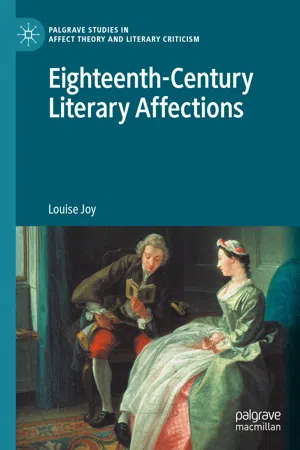
This book assesses the mediating role played by 'affections' in eighteenth-century contestations about reason and passion, questioning their availability and desirability outside textual form. It examines the formulation and idealization of this affective category in works by Isaac Watts, Lord Shaftesbury, Mary Hays, William Godwin, Helen Maria Williams, and William Wordsworth. Part I outlines how affections are invested with utopian potential in theology, moral philosophy, and criticism, re-imagining what it might mean to know emotion. Part II considers attempts of writers at the end of the period to draw affections into literature as a means of negotiating a middle way between realism and idealism, expressivism and didacticism, particularity and abstraction, subjectivity and objectivity, femininity and masculinity, radicalism and conservatism, and the foreign and the domestic.
- English
- ePUB (mobile friendly)
- Available on iOS & Android
eBook - ePub
Eighteenth-Century Literary Affections
About this book
Information
© The Author(s) 2020
L. JoyEighteenth-Century Literary AffectionsPalgrave Studies in Affect Theory and Literary Criticismhttps://doi.org/10.1007/978-3-030-46008-2_11. Introduction: Affective Knowledge
Keywords
PassionAffectionAffectEmotionFeelingReason‘There is no truth more universally known’, writes Henry Home, Lord Kames, the eminent Scottish Enlightenment man of letters, ‘than that tranquillity and sedateness are the proper state of mind for accurate perception and cool deliberation. […] Passion […] hath such influence over us, as to give a false light to all its objects’ (Henry Home 1785, I. 153). As Kames observes, reason’s necessary dominance over the passions is one of the most axiomatic precepts of the age. It is asserted and reasserted throughout eighteenth-century writing. The frequency with which this maxim is reiterated during the period gives the impression that its viability and desirability are accepted as straightforward. ‘What Reason weaves, by Passion is undone,’ proclaims Alexander Pope in his Essay on Man (Pope 1734, II, l. 42). Pope’s neat wisdom reappears at the end of the century in a sermon by the Reverend James Archer, who warns his congregation of ‘the conflict of tumultuous passion warring against our reason’ (Archer 1794, 60). Pronouncements such as these, which proffer what Kames refers to as ‘truth’, assert that which is purportedly ‘universally known’ with aphoristic certainty. But does the word ‘known’ here signify that which is discovered from experience (empirically) or that which is believed in theory (conjecturally)? Does the word ‘truth’ refer to the idea that reason should govern passion or to the utterance of this idea? It is hard to discern whether Kames’s statement, like Pope’s a few decades earlier and Archer’s a few decades later, functions as a philosophical proposition or a critical observation; whether the knowledge on offer is their own or a reminder of other people’s; whether the hyperbole that colours each of these rhetorical flourishes indicates emphasis or irony. Despite their authoritative posturing—their apparent confidence that passion must necessarily be subordinate to reason—the authors’ linguistic inflations and semantic equivocations at critical expositional moments index misgivings concerning the truth of this knowledge and the knowledge of this truth.
Eighteenth-Century Literary Affections starts from the premise that the urgency, the forcefulness and the regularity with which reason’s influence over the passions is invoked in eighteenth-century writing, far from pointing towards an uncontroversial verity, in fact reveal the palpable resistance with which this principle is frequently met. This book seeks to capture some of the ways in which the period’s many utterances of the belief in reason’s necessary dominance over passion lay bare a discernible shortfall between the conviction of the rhetorical mode typically used to declare it and the characteristic evasiveness of attempts to explain it. The sharp discrepancy between the two, the book proposes, produces an unacknowledged pathos that registers not just the unattainability of an ideal that is mounted with such cheerful optimism in the period, but the persistence, against all the odds, of the hope that this ideal might yet become reality.
In recent decades, scholars have begun more closely to attend to the range of conceptual categories that were used by writers in the long eighteenth century to frame debates about reason and passion. Amélie Rorty’s pioneering essay, ‘From Passions to Emotions and Sentiments’, charts the ways in which the terms “emotion” and “sentiment” began to displace the term “passion” over the course of this period (Rorty 1982). Isabel Rivers’s two-volume work, Reason, Grace, and Sentiment: A Study of the Language of Religion and Ethics in English, 1660–1780, documents some of the many ways in which the period’s affective vocabulary derives from Christian theology (Rivers 1991–2000). Thomas Dixon builds on this work in his book From Passions to Emotions: The Creation of a Secular Psychological Category to show how the shifts in terminology that are witnessed over the course of the eighteenth and nineteenth centuries reflect a gradual move away from Christian conceptions of the soul towards a secular, more scientific understanding of the relations between the mind and body (Dixon 2003). Amy Schmitter has outlined in detail the ways in which key affective terms used in seventeenth- and eighteenth-century moral philosophy—notably “passion”, “affection” and “sentiment”—mutate and accrue new meanings over the course of the period (Schmitter 2013a, 2013b). The work of such scholars has revealed that the binary between reason and passion was never as clear-cut as Kames’s ostensible truism would have us believe. In fact, as the work of Rorty, Dixon and Schmitter has shown, eighteenth-century discourse had already made available a term with which to capture the distinctiveness of a hybrid category, or what Raymond Williams might have termed a ‘structure of feeling’, that occurs at the fault-line between reason and passion (Williams 1977, 131).1 In eighteenth-century writing, the term “affection” is used to denote emotions that are calm, orderly and permanent, as opposed to emotions that are violent, disorderly and fleeting (passions). Like reason, affections are deliberately chosen and therefore resemble thoughts. But, like passions, they take intentional objects and are therefore conceived as emotions, since, as Peter Goldie has explained, ‘at least since the time of Aristotle’ philosophers have believed that emotions ‘are directed towards an object: if I feel fear, then there is something, some object, which is the object of my fear’ (Goldie 2000, 3–4). Engaging thought and emotion at once, they reconcile passion and reason. Intriguingly, frustrated by the obvious limitations presented by the view that passion and reason must be oppositional in character, recent philosophers of the emotions have sought to generate revisionist accounts that understand emotions as a form of, and not in tension with, cognition. Robert Solomon, for example, in his influential book The Passions: Emotions and the Meaning of Life has argued that all emotions (which he calls “passions”) are chosen (Solomon 1993). Philip Fisher similarly finds in Vehement Passions that emotions are a cue to legibility: each ‘of the strong emotions or passions designs for us an intelligible world and does so by means of horizon lines that we can come to know only in experiences that begin with impassioned or vehement states within ourselves’ (Fisher 10). By equipping us with a way to distinguish between “passions”, which are emotions that are precisely unchosen, and “affections”, which prefigure Solomon’s notion of emotions conceived as kinds of judgements, and Fisher’s notion of emotions as a form of intelligence that mark ‘the contours of the limited radius of our will’ (12), eighteenth-century philosophy provides a means to resolve a conceptual problem that contemporary philosophers, limited by the relative paucity of twentieth- and twenty-first-century affective vocabulary, have struggled to find the language to overcome.
Validated by reason, affections are not merely identified by eighteenth-century commentators as an alternative kind of emotion to passion, they are viewed as a positively redemptive kind of emotion, and their cultivation is recommended throughout eighteenth-century writing as a guaranteed route to religious, moral, social, political and aesthetical order. Indeed, so consequential are the goals that regulated affections promise to fulfil that they often inspire a markedly didactic rhetorical mode. Such didacticism is most readily apparent in writing on the affections which is set up as what Natasha Glaisyer and Sara Pennell call ‘a conversation between the “expert” and the reader’ (Glaisyer and Pennell 2003, 13). But, as the eighteenth-century medic and cleric, Thomas Cogan, observes in one of his several seminal extended essays on the emotions, An Ethical Treatise on the Passions (1807), whether or not its author adopts an overtly teacherly role, writing on the affections anyway participates in an enterprise that aims to reform the reader’s emotions:
The study of the passions and affections of the human mind […] is not confined to the mere contemplation of a force, which we all acknowledge, and all have felt, both by its salutary and pernicious influence; it is a study, which also enables us to direct the impetus of the mind to its proper objects, temper the degrees of its energy to the peculiarities of the case, and place the more permanent affections on those things which cannot deceive or disappoint. For, although speculations of a philosophical nature may amuse and flatter, it is UTILITY alone which makes every species of knowledge of sterling value. (Cogan 1807, vi)
Cogan highlights the widespread assumption in the period that the statement in print of the desirability of ‘permanent affections’ directly facilitates the reader’s capacity to exert reason over passion (the perceived urgency of which is underscored by Cogan’s strained use of capitalization). Even when a work on the affections does not explicitly advertise the practical benefits of the theories it mounts, then, it lays the groundwork for others to do so.
Eighteenth-Century Literary Affections sets out to better our understanding of the relationship that eighteenth-century writers forge between the category of the affections and the didactic mode. This book’s central argument is that eighteenth-century writing on the affections is prescriptive not just because, as John Morillo has observed, all writing on the emotions during the period participates in the education of the reader, but more particularly because affections are created by their categorization in linguistic form.2 Unlike passions, affections resist William Empson’s notion that emotions are ‘expressed by language’ (Empson 1985, 1). Equally, they resist Isobel Armstrong’s theory that textual emotions come into being in the ‘broken middle’, ‘the gap […] between affect and representation’ (Armstrong 2000, 110; 115). The orderly affections prized in eighteenth-century writing come into being only through the act of their ordering in language. Writers during the period who represent the affections use language not as a vehicle in which to transmit them but as a tool with which to constitute them. It is not possible, then, to refer to a gap between these emotions and their representation in language; the affections are unavailable outside their inscription in written form. Consequently, writing can recommend, but cannot convey, the orderly emotions it represents. The textual act of ‘plac[ing]’ the ‘permanent affections’—their categorization in language—is thus always a didactic gesture, a gesture that aspires for worldly, and even after-worldly, perfection.
Given the significance of what rests on the linguistic differentiation between affections and passions, it is striking to observe that eighteenth-century works are persistently unable to pin down concrete definitions of the emotions they promote. While passions are outlined in precise detail, outlines of the affections are invariably vague and obscure. For example, in Elements of Criticism, Kames provides an appendix of ‘Terms Defined or Explained’. In this compendium, “passion” and “emotion” are glossed in passing, but “affection” is given a substantial entry. The dedication of such space to an explanation of the term ratifies its importance in eighteenth-century analytical vocabulary. At the same time, it underlines its opacity, tacitly acknowledging the epistemological problems it yields. The entry for “affection” reads:
Affection, signifying a settled bent of mind toward...
Table of contents
- Cover
- Front Matter
- 1. Introduction: Affective Knowledge
- Part I
- Part II
Trusted by 375,005 students
Access to over 1.5 million titles for a fair monthly price.
Study more efficiently using our study tools.
Frequently asked questions
Yes, you can cancel anytime from the Subscription tab in your account settings on the Perlego website. Your subscription will stay active until the end of your current billing period. Learn how to cancel your subscription
No, books cannot be downloaded as external files, such as PDFs, for use outside of Perlego. However, you can download books within the Perlego app for offline reading on mobile or tablet. Learn how to download books offline
Perlego offers two plans: Essential and Complete
- Essential is ideal for learners and professionals who enjoy exploring a wide range of subjects. Access the Essential Library with 800,000+ trusted titles and best-sellers across business, personal growth, and the humanities. Includes unlimited reading time and Standard Read Aloud voice.
- Complete: Perfect for advanced learners and researchers needing full, unrestricted access. Unlock 1.5M+ books across hundreds of subjects, including academic and specialized titles. The Complete Plan also includes advanced features like Premium Read Aloud and Research Assistant.
We are an online textbook subscription service, where you can get access to an entire online library for less than the price of a single book per month. With over 1.5 million books across 990+ topics, we’ve got you covered! Learn about our mission
Look out for the read-aloud symbol on your next book to see if you can listen to it. The read-aloud tool reads text aloud for you, highlighting the text as it is being read. You can pause it, speed it up and slow it down. Learn more about Read Aloud
Yes! You can use the Perlego app on both iOS and Android devices to read anytime, anywhere — even offline. Perfect for commutes or when you’re on the go.
Please note we cannot support devices running on iOS 13 and Android 7 or earlier. Learn more about using the app
Please note we cannot support devices running on iOS 13 and Android 7 or earlier. Learn more about using the app
Yes, you can access Eighteenth-Century Literary Affections by Louise Joy in PDF and/or ePUB format, as well as other popular books in Literature & Social History. We have over 1.5 million books available in our catalogue for you to explore.