eBook - ePub
Italian Fascism and Spanish Falangism in Comparison
Constructing the Nation
- English
- ePUB (mobile friendly)
- Available on iOS & Android
eBook - ePub
About this book
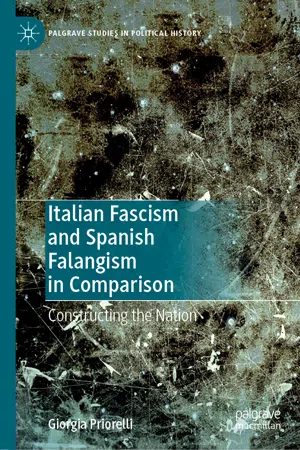
This book compares the Italian Fascist and the Spanish Falangist political cultures from the early 1930s to the early 1940s, using the idea of the nation as the focus of the comparison. It argues that the discourse on the nation represented a common denominator between these two manifestations of the fascist phenomenon in Mussolini's Italy and Franco's Spain. Exploring the similarities and differences between these two political cultures, this study investigates how Fascist and Falangist ideologues defined and developed their own idea of the nation over time to legitimise their power within their respective countries. It examines to what extent their concept of the nation influenced Italian and Spanish domestic and foreign policies. The book offers a four-level framework for understanding the evolution of the fascist idea of the nation: the ideology of the nation, the imperial projects of Fascism and Falangism, race and the nation, and the place of these cultures in the new Nazi continental order. In doing so, it shows how these ideas of the nation had significant repercussions on fascist political practice.
Information
© The Author(s) 2020
G. PriorelliItalian Fascism and Spanish Falangism in ComparisonPalgrave Studies in Political Historyhttps://doi.org/10.1007/978-3-030-46056-3_11. Introduction
The myth of the nation has permeated all aspects of Fascism from the beginning: culture and ideology, the concept of the individual and of masses, relations between state and society, domestic policy and foreign policy, the sense of tradition and attitude towards the future.1
The words of Emilio Gentile are particularly suited to introducing this work, resulting as it does from a reflection on the ideological dimension of the fascist phenomenon generically understood.2 It is true that fascism had as a ‘principle of its ideology the critique of ideologies’ and preferred to emphasise its practical action-oriented nature.3 Nonetheless, it was not ‘only a set of polemic negations’, but expressed a revolutionary vision of society and the state to be achieved in the light of its principles.4 Among these principles, corresponding to the ‘core concepts’ of the fascist ideological universe, is the concept of the nation.5 Far from constituting the object of a sterile theoretical debate within the fascist intellectual elites, it was, on the contrary, a real political myth that decisively contributed to the construction of the fascist reality and crucially influenced fascist political practices.
Retracing how fascism approached the issue of the nation and how it broke with the previous liberal national tradition is central. To this end, it is appropriate to dwell on the modern idea of the nation for a moment, drawing on an enlightening comparison of the historical experience of France and Great Britain by Roberto Vivarelli. In I caratteri dell’età contemporanea, the Italian historian stresses that in both countries the appearance of the nation-state went hand in hand with the renovation of public institutions and with the substitution of ‘citizens’ for ‘subjects’. The citizens—no longer the monarch or an oligarchy—held sovereignty and collectively constituted the nation, leading Vivarelli to conclude that the nation ‘is born after the state’: without the state, there is no public right and the qualification of ‘citizens’ has no value.6
Determining who were these new political actors is by no means simple, since the possession of political rights was not sufficient to identify them. The British and French models reveal that the right to vote, for instance, was not an essential concession for attributing the status of citizen. This right was progressively recognised throughout Europe from the end of the eighteenth century but was fully applied without distinction of social class or gender about a century and a half later. The central issue, therefore, is not so much to investigate what rights determined the attribution of the title of ‘citizen’ to an individual, but rather to establish ‘who [had] the right to be recognised as belonging to a [particular] national community’.7
In this regard, Vivarelli recalls the lesson of Federico Chabod who pinpointed the existence of two different concepts of the nation: one of French origin, and one of German origin. The former evokes the Rousseauian concept of the volonté générale and emphasises the ‘will of action’ of the individual who feels part of a national community and consciously decides to be a member of it.8 The latter has, instead, a naturalistic feature. It presumes that belonging to a nation is primarily dependent on nature, which attributes ‘“permanent” physical characteristics to different nations […] based on blood (that is, the generation) and the “soil” to which that particular blood remains attached’.9
In Vivarelli’s opinion, the most obvious limitation of Chabod’s thesis is that he did not adequately take into account the relationship between the state and the nation. The nation, to be a real community of citizens, could not have a voluntary or naturalistic foundation since both were insufficient to ensure the presence of free and stable institutions. According to him, a community presupposes shared ideals and principles, and involves ‘the acceptance of rules that, in the life of a state, are the laws’.10 Ultimately, the essence of a nation-state lies in the ‘quality of civil values’ which each social community shares and in its ability to answer ‘the pivotal problem in the history of modern institutions’, namely the issue of freedom.11
This conceptualisation is of exemplary clarity, but it must be noted that the nation-state described above corresponds to the liberal-democratic state. How did fascism relate to such a model and how did it plan to replace it? The thought of Alfredo Rocco—Minister of Grace, Justice and Religious Affairs from 1925 to 1932 and a critical figure in the construction of the fascist institutional order—provides important indications in this respect. In La trasformazione dello Stato, which summarises the fundamental principles of the legal organisation of Fascist Italy, he stressed the existence of two main features of the liberal-democratic state. First, in his view, this kind of state placed on the same level and protected equally all the forces that were active in a country. Second, it did not have its own identity and consistency, meaning it welcomed all ideals and programmes without distinction. This implied that the state would become a battlefield in which different forces would compete for power. In Rocco’s opinion, such was the case in Italy, where the ‘almost complete triumph of liberalism and democracy’ inexorably brought the country to the ‘edge of the abyss’.12
The Fascist jurist acknowledged that the liberal-democratic experience yielded good results for the Anglo-Saxon peoples and in France due to the presence of an unbroken national tradition and a strong sense of the state. In Italy, things were different since the Roman tradition—nurtured by the Catholic Church and based on the ‘principle of discipline, hierarchy and the submission of individuals to the state’—fell apart because of ‘Germanism’, ‘medieval anarchy’ and ‘foreign servitude’.13 This last feature in particular made the state appear like an ‘instrument of oppression’ of external powers, which caused a particular ‘spirit of mistrust and revolt against public authority’ in the Italian people.14 The liberal-democratic state should have tamed this constant feeling of rebellion through a systematic process of ‘political education’ and ‘state discipline’, but it was ‘spiritually and materially incapable’ of doing so.15 Precisely because of this failure, the Italian masses inevitably showed the unified nation-state the same mistrust and aversion they had towards foreign domination.
For Rocco, the fact that the liberal state had survived under such conditions for more than 60 years was almost miraculous. Nonetheless, he believed it was just a matter of time before it would crumble since ‘at the first great blow, that state larva would [be] shattered’.16 During the Great War, the Italian people showed their virtue and courage and saved the fatherland from destruction. However, once the hostilities had ended, the country entered a phase of complete confusion and disorientation. All weaknesses were exposed as fighting ensued between opposing internal factions that tore it apart, and which it was unable to control. For the Fascist jurist, it was evident that the experience of the liberal-democratic state had exhausted Italy, and that the March on Rome represented the ‘historical consecration of the collapse’.17
Once Mussolini had taken over the reins of the country, the building of the Fascist state began. It was conceived as the ‘juridical incarnation of the nation’, and in content and form its characteristics were distinct from those of the liberal-democratic state.18 It was a state with its own ‘morals’ and ‘religion’, its own idea of ‘social justice’, a precise ‘economic task’ and ‘its political mission in the world’ that foreshadowed its potential imperial expansion.19 Moreover, and above all, the Fascist state had its ‘function’, its ‘will’ and ‘aims superior to those of individuals’.20 Ultimately, it was a ‘truly sovereign’ state since, following a Machiavellian approach to politics, its goals prevailed, justifying any means to realise them.21
Fascism would have wiped out the old ‘atomistic and mechanic’ interpretation of the state.22 For Rocco, this was typical not only of the liberal and democratic doctrine but also of the socialist ideology that sacrificed the nation in favour of blind loyalty to the proletarian cause.23 To such an idea of the political community, Fascism opposed a new organic and historical understanding of society. It was organic because society has ‘objectives and life that go beyond the objectives and life of individuals’; it was historica...
Table of contents
- Cover
- Front Matter
- 1. Introduction
- 2. The Ideology of the Nation in Fascism and Falangism
- 3. The Imperial Destiny of the Nation
- 4. On Race and Nation: Certainties and Changing Definitions
- 5. The Arbiters of Post-war Europe: Fascist and Falangist Nations in the New Nazi Continental Order
- Back Matter
Trusted by 375,005 students
Access to over 1.5 million titles for a fair monthly price.
Study more efficiently using our study tools.
Frequently asked questions
Yes, you can cancel anytime from the Subscription tab in your account settings on the Perlego website. Your subscription will stay active until the end of your current billing period. Learn how to cancel your subscription
No, books cannot be downloaded as external files, such as PDFs, for use outside of Perlego. However, you can download books within the Perlego app for offline reading on mobile or tablet. Learn how to download books offline
Perlego offers two plans: Essential and Complete
- Essential is ideal for learners and professionals who enjoy exploring a wide range of subjects. Access the Essential Library with 800,000+ trusted titles and best-sellers across business, personal growth, and the humanities. Includes unlimited reading time and Standard Read Aloud voice.
- Complete: Perfect for advanced learners and researchers needing full, unrestricted access. Unlock 1.5M+ books across hundreds of subjects, including academic and specialized titles. The Complete Plan also includes advanced features like Premium Read Aloud and Research Assistant.
We are an online textbook subscription service, where you can get access to an entire online library for less than the price of a single book per month. With over 1.5 million books across 990+ topics, we’ve got you covered! Learn about our mission
Look out for the read-aloud symbol on your next book to see if you can listen to it. The read-aloud tool reads text aloud for you, highlighting the text as it is being read. You can pause it, speed it up and slow it down. Learn more about Read Aloud
Yes! You can use the Perlego app on both iOS and Android devices to read anytime, anywhere — even offline. Perfect for commutes or when you’re on the go.
Please note we cannot support devices running on iOS 13 and Android 7 or earlier. Learn more about using the app
Please note we cannot support devices running on iOS 13 and Android 7 or earlier. Learn more about using the app
Yes, you can access Italian Fascism and Spanish Falangism in Comparison by Giorgia Priorelli in PDF and/or ePUB format, as well as other popular books in History & European History. We have over 1.5 million books available in our catalogue for you to explore.