- English
- ePUB (mobile friendly)
- Available on iOS & Android
eBook - ePub
About this book
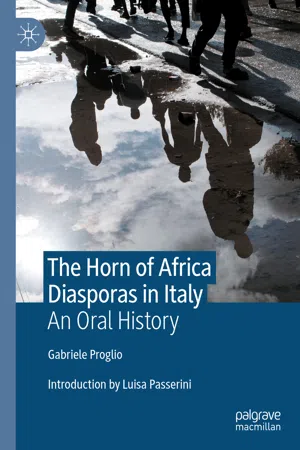
This book delves into the history of the Horn of Africa diaspora in Italy and Europe through the stories of those who fled to Italy from East African states. It draws on oral history research carried out by the BABE project (Bodies Across Borders: Oral and Visual Memories in Europe and Beyond) in a host of cities across Italy that explored topics including migration journeys, the memory of colonialism in the Horn of Africa, cultural identity in Italy and Europe, and Mediterranean crossings. This book shows how the cultural memory of interviewees is deeply linked to an intersubjective context that is changing Italian and European identities. The collected narratives reveal the existence of another Italy – and another Europe – through stories that cross national and European borders and unfold in transnational and global networks. They tell of the multiple identities of the diaspora and reconsider the geography of the continent, in terms of experiences, emotions, and close relationships,and help reinterpret the history and legacy of Italian colonialism.
Information
© The Author(s) 2020
G. ProglioThe Horn of Africa Diasporas in Italyhttps://doi.org/10.1007/978-3-030-58326-2_11. Introduction
Gabriele Proglio1
(1)
Centre for Social Studies, University of Coimbra, Coimbra, Portugal
Keywords
MethodologyOral historyTheoretical referencesGeography of emotionsMemoryThis book is the outcome of my efforts to elicit the oral tales of black people from the former Italian colonies in the Horn of Africa, namely Ethiopia, Eritrea, and Somalia, as well as those of “second-generation” individuals born in Italy to mixed families, or whose parents migrated to Europe from the Horn of Africa. It delves into this diasporic context, focusing on salient topics that emerged during the oral interviews that I conducted in Italy. My aim in writing it is to show how subjectivities and memories were and continue to be pertinent for the proposal and affirmation of new postcolonial positionalities and diasporic geographies across Europe, as well as globally. Within this interpretive framework, I consider Italy, specifically, not just as a national territory but as part of a transnational and global space of mobility. Through their narratives and within diasporic archives that reveal mobility, these black voices depict slices of life in Europe, centering on personal connections and social linkages operating across borders. In this sense, these stories are not only representations of particular places and times; they are practices that are actively changing Europe and its sociocultural territories, which are being crossed by black bodies and shared memories.
Since 2014, as a member of a research project led by Professor Luisa Passerini, I collected in excess of eighty interviews conducted with men and women holding different citizenship statuses (refugees, asylum seekers, Italians, etc.), and of different ages (teenagers, adults, and elders), who are culturally affiliated with and/or from the Horn of Africa. The interviews took place in a host of cities across Italy: Turin, Milan, Padua, Asti, Pavia, Rome, Bologna, Modena, Verona, Venice, Florence, Naples, and Palermo. The interviews focused on various topics, such as the respondents’ memories of their homelands, their journeys to Europe, their Mediterranean crossings, and the conditions they encountered in Italy. All of these fragments of memory were conjoined within the same narrative, entailing different objects of recall and different temporalities and experiences. Accordingly, in this book, the chronological time of the interview and its transcription can be understood as the field within which tales that deal with multiple aspects of being black in Europe have been gathered and translated within a scientific framework. It was necessary to preserve the multidimensionality of this process relating to time, space, feelings, practices, and expectations—which differed for each life trajectory, from person to person, and from interview to interview—within these operations. This approach and intersubjectivity, which are integral to the oral historian’s work, have important implications from the perspective of intersectionality, illuminating how each subjectivity is crossed by many positionalities according to the sociocultural contexts of reference, typologies of relations, and emotions and imaginaries evoked during an interview.
The research project, “Bodies Across Borders in Europe: Oral and Visual Memories in Europe and Beyond” (known by the acronym, BABE), was based at the Department of History and Civilization of the European University Institute in Florence and was funded by the European Research Council through a starting grant.1 The project’s aim was to engage with both native and “new” Europeans in an exploration of intercultural connections within contemporary Europe. These connections, which focused on Italy and the Netherlands, were woven through memory, visuality, and mobility, which are the faculties of embodied subjects, and related to the movements of people, ideas, and images across the borders of European nation states, with a focus on Italy and the Netherlands.
Within this framework, the research team developed several subprojects. All of these were interconnected and were implemented synergistically, based on a common aim of sharing reflections and theoretical thoughts. Intersubjectivity was both the context of meanings elaborated during the cultural exchange that occurred between the interviewer and the interviewee and a memory process entailed in the invention of new ways of staying and living in Europe as Afro-descendants. We, the researchers, were always connected with two kinds of intersubjectivity during our investigations. The first one was created through dialogue as an ongoing interchange of narratives and an exchange of meanings between subjectivities. By contrast, the second was indirectly approachable through relationships forged with the interviewees through the movements of meanings and practices that are reconfiguring the geography of Europe around the condition of being black and in diaspora. Parts of these acts of resignification were and are strategies and methods for providing a contrast to or resisting white hegemony and its genealogies in various contexts (societal, border crossings, the private sphere, and public contexts). Evidently, we were only able to engage with a small portion of this wider field of signification and to develop a limited understanding through the interview process.
Focusing on two countries, Italy and the Netherlands—two countries bearing resemblances to each other in terms of migration and their colonial pasts, but also evidencing differences relating to their cultural policies and sociopolitical contexts—the BABE project explored relationships among borders, mobilities, and Europe from many perspectives. Many research pathways were created: Luisa Passerini and Giada Giustetto worked with students in the Centri Territoriali Permanenti (Italian schools for adults and migrants) mapping oral and visual memories of migrations to Europe through single and group interviews. Working with students at various Italian high schools across the peninsula from north to south, stretching from Turin to Palermo, Graziella Bonansea focused on the topic of the border in relation to bodies in movement, paying particular attention to the theme of generation. Liliana Ellena explored the idea of the colonial archive through an analysis of various works (documentaries, video-installations, and movies) by visual artists who have problematized European borders. She examined the story of Eva Nera, a movie directed by Giuliano Tomei that explores the postcolonial condition of those who were formerly colonized. Milica Trakilović investigated certain categories deployed in the Netherlands to describe the condition of migrant people. Iris van Huis’ research project was devoted to a study of migrations from Indonesia to the Netherlands through collected interviews. Lastly, Leslie Hernández Nova’s investigation focused on the Peruvian diaspora in Europe. Specifically, she examined the use of memory within migrant subjectivities in the narration of the history and geography of this South American country.
My aim in this book is to illuminate a portion of Italy and Europe that has remained largely invisible—that of the Horn of Africa diasporas. In doing so, I show how the cultural memory of the interviewees is embedded in an intersubjective context and linked to cultural practices that could change, among other things, the face of Italianness and Europeanness. Therefore, these interviews should be read both as traces of a past that is either silent or largely unknown in Europe and as signs of an impending future that is not yet fully visible. In this future, Italy and Europe will no longer conform to the prevailing contemporary imaginary that is being promoted by white people across Europe of national and communitarian communities that are exclusively white, Western, and Christian. This is because despite the xenophobic rhetoric that has pervaded both the public and private spheres over the last three decades, transnational migration flows have redesigned and reformulated the geopolitical scenarios and have infiltrated cultures, bringing into question the centrality of key core concepts—nation, state, citizenship, and masculinity—mobilized in descriptions of who belongs to a community and the alterity of the rest.
This book examines a cross-section of Italy and Europe that is linked in the collective imaginary to notions such as foreigner, non-EU, black/African, asylum seeker, or refugee. The collected narratives reveal the existence of another Italy and another Europe through stories that cross national and European borders and unfold within transnational and global relational and affective networks. They tell of multiple identities within the diaspora and reconceptualize the geography of the continent—and, we might say, of the world—in terms of experienced emotions and close relationships. Adopting a shifting perspective, they reinterpret the history of Italian colonialism in relation to continuities and discontinuities with the present. Last, they map out the Black Mediterranean—a space of crossing between worlds and cultures of Africa, Asia, and Europe—which begins thousands of miles away and entails stories of escape from oppressive conditions, of violence suffered in Sudan, of detention in Libyan prisons, of illegal border crossings, of disguises and survival strategies, and, finally, the epic tales of those who made it but who face the constant worry of ending up like the identity-less thousands at the bottom of the sea.
The book is organized into five chapters. The following chapter, which focuses on diasporic identities and subjectivities, opens with some theoretical reflections by Paul Gilroy and Stuart Hall on the formation of cultural identities that simultaneously arise from an initial condition of subordination and relate to a subsequent condition in which rethinking the self, the imagined community, and the world is still possible. Here, Gilroy’s concept of “double consciousness,” which was firstly elaborated by W.E.B. Du Bois, finds a new application in a completely different context from that of the Black Atlantic, slavery, and the condition of African-Americans (Gilroy 1993). All of the interviewees described themselves as being poised between several cross-cultural, geographical, and relational worlds, revealing an abundance of positionings: Italian-Somalian, Italian-Ethiopian, Italian with a foreign-looking appearance, Italian-Tigrinya, Black African-Italian, second generation, Ambescià , Oromo-European, and so forth. Each of these definitions refers to a subjectivity that is articulated within two or more cultural contexts.
In the last three decades, several social theories have attempted to approach and describe postcolonial conditions in Europe, positioned between assimilation and multiculturalism. The first is an ideological approach for France’s management of colonies and continuing migrations from former French domains. It entails reassembling the idea of empire, after its fall, through a process of inclusion within French society that requires migrants to conform with and adapt to specific criteria. This adaptation process begins with a moment of desocialization from the cultural context of origin, followed by resocialization framed by the norms, moral decrees, and ethical precepts of French society. By contrast, the English assimilation model is based on the colonial experience of the Commonwealth, which gathers together, under the Union Jack, diverse societies and cultures. The concept of multiculturalism has been introduced to describe a society that welcomes and includes people from other cultures, offering them the possibility of conserving their habits and traditions, if not in opposition with the general mandates of the community, while simultaneously involving them in a process of inclusion. Both approaches are characterized by a European idea of superiority, privileging the role of whiteness and the centrality of masculinity in defining the positionality of the “other” within society. It is possible to graphically represent these models, which, despite their different approaches, ensure that alterities remain far from the center—both symbolically and physically—in relation to their subjectivities and the combination of race, class, gender, sexual identity, and political and religious belonging.
Since the end of the1980s, multiple migration flows have converged at the southern European borders and at Italian shores for millions of people coming from Eastern Europe—Albania, Romania, and the former Yugoslavia—and from Maghreb. Since that time, new trajectories for reaching Europe have opened up across the entire Mediterranean route. Libya has become one of the pivotal points for entering the European Union through Italy. Flows originating from the east and south have been contained through prevailing norms on citizenship, border protection mechanisms, and the expulsion and detention of non-Italian subjects.
Following a first moment entailing the introduction of a procedure for regularizing illegal migrants in Italy through the Martelli law enacted in 1990, several normative measures were applied to define the status of migrants in Italy. The Turco-Napolitano law, which was approved in 1998, led to the establishment of “Temporary Residence Centers” (the Italian acronym is CPTs) where “illegal” migrants were jailed while awaiting repatriation. This and other aspects relating to both the acquisitio...
Table of contents
- Cover
- Front Matter
- 1. Introduction
- 2. Diasporic Identities and Subjectivities
- 3. Postcolonial Memories of Colonialism
- 4. The Black Mediterranean
- 5. Geographies of Emotions
- Back Matter
Trusted by 375,005 students
Access to over 1.5 million titles for a fair monthly price.
Study more efficiently using our study tools.
Frequently asked questions
Yes, you can cancel anytime from the Subscription tab in your account settings on the Perlego website. Your subscription will stay active until the end of your current billing period. Learn how to cancel your subscription
No, books cannot be downloaded as external files, such as PDFs, for use outside of Perlego. However, you can download books within the Perlego app for offline reading on mobile or tablet. Learn how to download books offline
Perlego offers two plans: Essential and Complete
- Essential is ideal for learners and professionals who enjoy exploring a wide range of subjects. Access the Essential Library with 800,000+ trusted titles and best-sellers across business, personal growth, and the humanities. Includes unlimited reading time and Standard Read Aloud voice.
- Complete: Perfect for advanced learners and researchers needing full, unrestricted access. Unlock 1.5M+ books across hundreds of subjects, including academic and specialized titles. The Complete Plan also includes advanced features like Premium Read Aloud and Research Assistant.
We are an online textbook subscription service, where you can get access to an entire online library for less than the price of a single book per month. With over 1.5 million books across 990+ topics, we’ve got you covered! Learn about our mission
Look out for the read-aloud symbol on your next book to see if you can listen to it. The read-aloud tool reads text aloud for you, highlighting the text as it is being read. You can pause it, speed it up and slow it down. Learn more about Read Aloud
Yes! You can use the Perlego app on both iOS and Android devices to read anytime, anywhere — even offline. Perfect for commutes or when you’re on the go.
Please note we cannot support devices running on iOS 13 and Android 7 or earlier. Learn more about using the app
Please note we cannot support devices running on iOS 13 and Android 7 or earlier. Learn more about using the app
Yes, you can access The Horn of Africa Diasporas in Italy by Gabriele Proglio in PDF and/or ePUB format, as well as other popular books in History & African History. We have over 1.5 million books available in our catalogue for you to explore.