eBook - ePub
Grievances and Public Protests
Political Mobilisation in Spain in the Age of Austerity
- English
- ePUB (mobile friendly)
- Available on iOS & Android
eBook - ePub
About this book
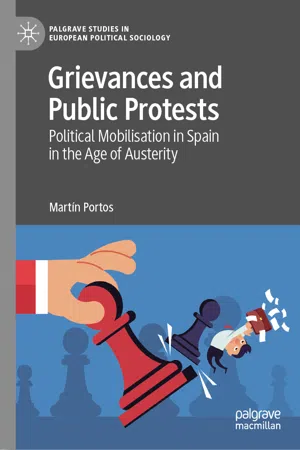
This book sheds light on the role that grievances play for mobilisation dynamics in a context of material deprivation. Why do people protest? To what extent do grievances account for the varying size of protest events over time? Covering different levels of analysis, the author argues that effects of socioeconomic aspects (both objective-material deprivation and subjective-attitudinal grievances) are mediated by political attitudes, especially political dissatisfaction. He develops a framework to account for the dynamics, trajectory and timing of the cycle of contention that unfolded in Spain in the shadow of the Great Recession, contributing not only to the field of social movement studies but to our broader understanding of European politics, political sociology, political economy and economic sociology.
Information
© The Author(s) 2021
M. PortosGrievances and Public ProtestsPalgrave Studies in European Political Sociologyhttps://doi.org/10.1007/978-3-030-53405-9_11. Exploring the Ground: Grievances and Protest
Introduction
Following a demonstration and some encounters with the police, a crowd of around 130,000 people occupied Plaza Puerta del Sol in Madrid on 15 May 2011, in light of coming—local and regional—elections the following week. They protested against policymaking in an austerity-ridden scenario and demanded “real democracy now!”.1 Given the mainstream media’s initial lack of coverage, information diffused through social media and digital tools. The occupations quickly snowballed to other Spanish cities and grew larger. Within less than 24 hours, outraged crowds (of varying sizes) occupied the main squares of many Spanish cities. The camps (“acampadas”) became spaces of prefigurative politics, that is spaces for living out and building real democracies in contrast to a system no longer capable of implementing democracy (della Porta 2015a, b; Kaldor and Selchow 2015). In one way or another, 6–8 million people got involved in 15M activities (camps, assemblies, demonstrations, etc.), making these the most crowded contentious performances outside the umbrella of traditional unions and political parties in Spain’s recent democratic history (Feenstra 2015; Monterde et al. 2015).
The 15M campaign became a major turning point in Spanish recent mobilisation history.2 It triggered and shaped further contentious activities.3 In fact, these events and subsequent performances are part of a broader cycle of collective action that unfolded in the country between 2007 and 2015.4 While focusing on the 15M mobilisations specifically but also taking a longitudinal perspective, this volume seeks to shed light on the dynamics, trajectory and particularities of the Spanish wave of contention against austerity and the political status quo in the shadow of the Great Recession.5
On the one hand, from a longitudinal perspective, this monograph analyses the role that grievances play for (extra-institutional) mobilisation in a context of material deprivation. At odds with the expectation in social movement studies that protest will rise with the opening of windows of political opportunities—and also with the expectation, widespread in labour sociology, that contention will increase with full employment—, mass protests often accompanied the design and implementation of austerity policies (della Porta and Portos 2020: 117). With a renewed interest on the basis of organised dissent, I will attempt to answer the following questions: how do grievances matter for protest (over time)? Can subjective attitudinal grievances trigger mobilisation without an objective dimension? When do perceptions follow objective conditions—and when not? Are not these perceptions of grievances shaped by dynamics of protest themselves? What is the interplay between the economic and political dimensions of grievances? Are grievances constant across different frequencies of participation? The main argument developed throughout is that grievances matter for protest behaviour. However, the effect of objective-material aspects is mediated by subjective attitudinal socioeconomic and political grievances, especially by political dissatisfaction.
On the other hand, from a political process-based approach, the monograph unravels the timing of the cycle of contention that evolved in light of the recession scenario. Different questions will be addressed: what does explain protest success and decline? How are activists able to keep standards of mobilisation high over time? Does demobilisation come about as a consequence of strategic divisions among protesters? Do protesters radicalise as the cycle unfolds? Why (and when) activists seek alternative channels of participation and embrace more institutional forms of action? Overall, I argue that the peak of protest persisted from mid-2011 until late 2013 because institutionalisation was postponed and radicalisation was contained. I contend that three specific aspects are key to understanding the evolution of the cycle of collective action: (1) issue specialisation of protest after the first triggering points, (2) the role of alliances built between new and traditional actors to determine the trajectory of movements, and (3) the institutionalisation process that came about as protest performances decreased.
Although specific hypotheses are developed and tested in the subsequent chapters, in this first chapter, I review the evolution of grievance theories. I also develop the theoretical framework upon which the bulk of this book is built (i.e. Chapters 4, 5 and 6), and place my contribution in relation to extant literature. After that, the case selection is justified and the empirical design is introduced. Finally, I present the structure of this volume and summarise the content of each chapter.
Theoretical Framework (I): Grievances
Five decades after Albert O. Hirschman (1970) wrote his ground-breaking contribution Exit, Voice and Loyalty. Responses to Decline in Firms, Organisations, and States, his approach is gaining momentum again. His core argument was that members of an organisation understood as any form of human grouping (whether a nation, a business, an interest group, a political party, etc.) have two basic alternatives at hand when they perceive a decrease in the quality or benefit to the member within that organisation. Members can either voice their discontent (communicating the complaint in order to redress the grievance, introduce a change and improve the relationship with the organisation) or exit (withdraw from the relationship). Cost–benefit analyses are, however, affected by loyalty dynamics (i.e. how attached and committed agents remain to the organisation, which might make them opt for sticking to the status quo). When their voice is heard and they can reform the organisation, loyal members will be particularly devoted to organisational success.
Applying Hirschman’s (1970) theory to a political situation, we find that in a context of generalised discontent (for instance, with the socioeconomic and political status quo), many citizens might choose to voice discontent through formal-institutional mechanisms. If institutional channels for voicing it are malfunctioning or ineffective, this might feed outrage. As a consequence, many might choose to withdraw from the game and disengage from politics. When circumstances are pressing and claims are widely shared, many others are likely to voice discontent through collective action. This framework helps to understand the protest events that unfolded in Spain and elsewhere from May 2011 onwards. However, it falls short of (1) accounting for the exact timing of action—protest potentials were in the making for a long time, but were mobilised only at a certain point—; (2) accounting for how discontent that drives action comes to being in the first instance. Precisely, grievance theories are helpful for addressing these limitations.
Throughout this volume, I understand grievances as exogenous shocks—i.e. objective situations, such as unemployment or income deprivation—plus the attitudinal and emotional consequences that these engender (in terms of social discontent, fear or resentment), which might disrupt taken-for-granted routines and act as motivational impulses for mobilisation (Snow et al. 1998; Kriesi 2012; Snow 2013). Hence, troublesome conditions and their associated sentiments and values can be thought of as grievances.
Grievances have been ce...
Table of contents
- Cover
- Front Matter
- 1. Exploring the Ground: Grievances and Protest
- 2. The Context: Spain, Protest and the Great Recession
- 3. Eventful Protests and No-radicalisation: The Trajectory of Contention in Spain, 2007–2015
- 4. The Merrier, the Fewer? Political Dissatisfaction and Protest Size Fluctuations in Times of Austerity
- 5. Unpacking the Virtuous Circle: Aggrieved Protesters, Feedback Effects or Both at the Same Time?
- 6. Voicing Outrage Unevenly: Democratic Dissatisfaction and Frequency of Participation in the 15M Campaign
- 7. Moving from the Squares to the Ballot Box: Podemos and the Institutionalisation of the Cycle of Anti-austerity Protest
- 8. Conclusion: Movements of Crisis and Democratic Deepening
- Back Matter
Trusted by 375,005 students
Access to over 1.5 million titles for a fair monthly price.
Study more efficiently using our study tools.
Frequently asked questions
Yes, you can cancel anytime from the Subscription tab in your account settings on the Perlego website. Your subscription will stay active until the end of your current billing period. Learn how to cancel your subscription
No, books cannot be downloaded as external files, such as PDFs, for use outside of Perlego. However, you can download books within the Perlego app for offline reading on mobile or tablet. Learn how to download books offline
Perlego offers two plans: Essential and Complete
- Essential is ideal for learners and professionals who enjoy exploring a wide range of subjects. Access the Essential Library with 800,000+ trusted titles and best-sellers across business, personal growth, and the humanities. Includes unlimited reading time and Standard Read Aloud voice.
- Complete: Perfect for advanced learners and researchers needing full, unrestricted access. Unlock 1.5M+ books across hundreds of subjects, including academic and specialized titles. The Complete Plan also includes advanced features like Premium Read Aloud and Research Assistant.
We are an online textbook subscription service, where you can get access to an entire online library for less than the price of a single book per month. With over 1.5 million books across 990+ topics, we’ve got you covered! Learn about our mission
Look out for the read-aloud symbol on your next book to see if you can listen to it. The read-aloud tool reads text aloud for you, highlighting the text as it is being read. You can pause it, speed it up and slow it down. Learn more about Read Aloud
Yes! You can use the Perlego app on both iOS and Android devices to read anytime, anywhere — even offline. Perfect for commutes or when you’re on the go.
Please note we cannot support devices running on iOS 13 and Android 7 or earlier. Learn more about using the app
Please note we cannot support devices running on iOS 13 and Android 7 or earlier. Learn more about using the app
Yes, you can access Grievances and Public Protests by Martín Portos in PDF and/or ePUB format, as well as other popular books in Politics & International Relations & Political Economy. We have over 1.5 million books available in our catalogue for you to explore.