This edited book explores critical issues relating to Content and Language Integrated Learning (CLIL) and English as a Medium of Instruction (EMI), setting out their similarities and differences to demystify the terms and their implications for classroom practice. The authors show how CLIL and EMI practices are carried out in different institutional contexts and demonstrate how both approaches can benefit language and content acquisition. This book is addressed to second/foreign language teaching staff involved in teaching in English at primary education, secondary education, and higher education levels.
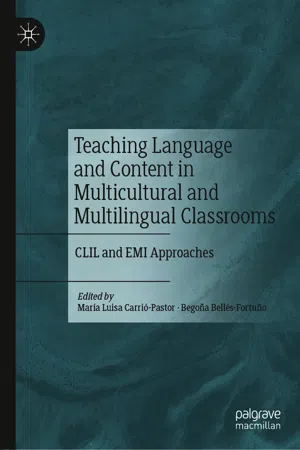
eBook - ePub
Teaching Language and Content in Multicultural and Multilingual Classrooms
CLIL and EMI Approaches
- English
- ePUB (mobile friendly)
- Available on iOS & Android
eBook - ePub
Teaching Language and Content in Multicultural and Multilingual Classrooms
CLIL and EMI Approaches
About this book
Information
Part ICLIL and EMI
© The Author(s) 2021
M. L. Carrió-Pastor, B. Bellés Fortuño (eds.)Teaching Language and Content in Multicultural and Multilingual Classroomshttps://doi.org/10.1007/978-3-030-56615-9_2CLIL vs EMI: Different Approaches or the Same Dog with a Different Collar?
María Luisa Carrió-Pastor1
(1)
Departamento de Lingüística Aplicada, Universitat Politècnica de València, Valencia, Spain
1 Introduction
2 Content and Language Integrated Learning (CLIL)
3 English as a Medium of Instruction (EMI)
4 Discussion: Differences and Similarities of CLIL and EMI
5 Conclusions and Future Directions
References
1 Introduction
This chapter takes into consideration the fact that the way English is being taught has undergone a massive change internationally. It can be observed that English language teaching has changed from teaching English as a foreign language (EFL), then teaching English for Specific Purposes (ESP), after that, Content and Language Integrated Learning (CLIL) and, finally, to using English as a Medium of Instruction (EMI). In my view, ESP, CLIL and EMI are based on Content-based Instruction (CBI), an umbrella term that describes classrooms where “students are taught academic content in a language they are still learning” (Lightbown 2014: 3). The author of chapter “Focus on Language in CBI: How Teacher Trainees Work with Language Objectives and Language-Focused Activities in Content-Based Lessons” in this volume adds more information about CBI, as this approach may be considered the precursor of ESP, CLIL and EMI. It should be noted that ESP is always implemented in foreign language classes, meanwhile CLIL and EMI are applied in content classes, but all these approaches include specific content teaching.
In this chapter I focus specifically on CLIL and EMI as these are two approaches that have been lately promoted by educational institutions, such as primary education, secondary education and universities. In 2003, some researchers included a third term, which is extensively used in research on European higher education settings, Integrating Content and Language in Higher Education (ICLHE). I here use CLIL and EMI as general terms that embrace integrating content and language in different educational settings, such as higher education, secondary education, primary education, etc. In this chapter, my purpose is to analyse the similarities and differences of CLIL and EMI, as sometimes these approaches have been used in a similar way, and to highlight the positive aspects of both approaches.
In this vein, if we think about their definitions, some aspects are similar while others are different. CLIL was described by Marsh (1994: 2) as “CLIL refers to situations where subjects, or parts of subjects, are taught through a foreign language with dual-focused aims, namely the learning of content, and the simultaneous learning of a foreign language”. One of the most popular definitions of EMI is the one by Dearden (2015: 2), who describes EMI as “The use of the English language to teach academic subjects (other than English itself) in countries or jurisdictions in which the majority of the population’s first language is not English”.
It should be noticed that EMI started at tertiary level in universities while CLIL was mainly used in primary and secondary schools. Both approaches wanted to attract students from abroad and prepare their home students to study and work abroad, publish in English, and survive in an increasingly competitive education system.
The implementation of both approaches has been supported by governmental policies. Institutions have received economic aid to train teachers in EMI and CLIL practices as well as to attract the brightest students, share their knowledge with the widest possible audience and develop their own teaching. Internationalization and globalization are two key terms in EMI and CLIL that are also the initial aims of supporting these approaches. As we live in a globalized world, educational institutions advertise the quality of their teaching methods, describing them as international in the expectation of attracting the best students and graduating the best professionals.
With these facts in mind, the most relevant aspects of Content and Language Integrated Learning and English as a Medium of Instruction are described in this chapter. Additionally, the most outstanding differences and similarities are discussed and, finally, the conclusions summarize the most important differences and similarities of these two approaches.
2 Content and Language Integrated Learning (CLIL)
Content and Language Integrated Learning is an approach that emerged in the 1990s. One of the best-known definitions is the one provided by Coyle et al. (2010: 1): “a dual-focused educational approach in which an additional language is used for the learning and teaching of both content and language”. It is based on content-based instruction but it involves specifically the integration of language and content instruction. In this approach, English-as-a-second-language students can acquire their academic development while practicing and improving language proficiency (Marsh 1994, 2009; Marsh et al. 2001; Carrió-Pastor 2007, 2008, 2009c, 2011, 2013). As Carrió-Pastor (2019: 77) points out, “CLIL means the integration of teaching based on focus on form and focus on meaning. Students are trained to know the content of words (meaning) and language (form), thus acquiring language rules and knowledge at the same time”.
There are a variety of strategies used in content-based instruction; for example, cooperative learning, task-based learning, case studies, whole language approach, etc. (Crandall 1992). These strategies are also employed in CLIL, as many studies show (Carrió-Pastor 2008, 2009a, b, 2011, 2013; Carrió-Pastor and Perry 2010; Carrió-Pastor and Romero Forteza 2019). For example, Davison (2005) studies secondary school English in Hong Kong and Australia and argues that the terms language and content are problematic but, at the same time, the combination of content and foreign language acquisition allows students to become competent members of their community. Also, Dalton-Puffer (2005) explains the degrees of indirectness as well as variability in the realization of directive speech acts in six content lessons in Austrian upper secondary schools. The author highlights that CLIL is firmly situated within English as a foreign language lessons and it provides communicative opportunities to language learners. CLIL became progressively very popular as a new approach used in secondary and primary schools, as well as in universities, and it was practised following different approaches: a content subject or a language subject, depending on the needs of the educational centre. Studies by Schleppegrell and de Oliveira (2006), Zwiers (2006), Dalton-Puffer (2007), Coyle et al. (2010), and Lasagabaster (2011), for example, explore several methodological issues related to the use of an L2 as the medium of instruction when teaching content subjects and discuss the effectiveness of the theoretical and practical issues involved when learning and teaching content through an additional language, appealing to researchers and teachers to use this innovative approach in their classrooms to improve student motivation.
Some researchers have highlighted the importance of the coordination of language teachers and content teachers (Carrió-Pastor 2008, 2019) to design materials; both teachers can even collaborate in the same classroom. Teachers play a very important role in obtaining positive results, as stated by Carrió-Pastor and Perry (2010: 72).
We believe that CLIL should be taught as a single subject being based on close cooperation between content teachers and language teachers. Some researchers into this approach consider that the role of the language teacher is merely that of ‘assistant’ to the content teacher. In our view, both content and language are of equal importance and both the content and language teachers collaborate to produce specific materials which allow different aspects to be focused on.
There were other aspects that are important for the use of CLIL to improve language acquisition and gain positive results, but also some negative aspects that questioned the quality of the education received by students in CLIL subjects and non-CLIL subjects, focusing on the impact of adding the burden of a foreign language to, in some cases, deficient pedagogy (Bruton 2011, 2013, 2015). Specifically, this author observes that CLIL can be adopted by teachers with very limited training in this approach, or that CLIL can cause a division between students—those that are successful in a CLIL classroom and those that cannot benefit from this approach as they do not have the same foreign language support or they are immigrants and their mother tongue is very different. Also, some researchers point out that some teachers consider a CLIL subject should emphasize conversation and so they focus on simple topics; additionally, some students are not proficient in English and thus teachers tend to design easy activities (Sasajima 2013).
Nevertheless, despite some criticisms, this approach has been defended by many researchers (Hüttner and Smit 2014), and proof of this is the many studies on this topic (Carrió-Pastor 2013, 2019; Cenoz et al. 2014; Rea Rizzo and Carbajosa Palmero 2014; Pérez-Vidal and Roquet 2015; Cenoz 2015; Arnó-Macià and Mancho-Barés 2015; Carrió-Pastor and Tamarit Vallés 2015; Yang 2016; Piesche et al. 2016; Dallinger et al. 2016; Lasagabaster 2019; Carrió-Pastor and Romero Forteza 2019). These researchers highlight the support of national governments to CLIL and the benefits of its use; for example, the improvement of foreign language learning as well as content acquisition, the development of motivation in the classrooms, in the case of English, CLIL is also seen relevant for gaining higher professional status, etc. In this volume, the chapters by Marzà, Bellés-Fortuño, Álvarez-Gil, and Martín-del Pozo and Rascón-Estébanez reflect on methodology, assessment and training, and the way CLIL is applied in Spanish educational institutions.
CLIL is also considered an umbrella term, covering (Cenoz, Genesee and Gorter 2014: 246)
the following educational approaches: “language showers”, CLIL camps, student exchanges, local projects, international projects, fami...
Table of contents
- Cover
- Front Matter
- Introduction
- Part I. CLIL and EMI
- Part II. English as a Medium of Instruction
- Part III. Content and Language Integrated Learning
- Back Matter
Trusted by 375,005 students
Access to over 1.5 million titles for a fair monthly price.
Study more efficiently using our study tools.
Frequently asked questions
Yes, you can cancel anytime from the Subscription tab in your account settings on the Perlego website. Your subscription will stay active until the end of your current billing period. Learn how to cancel your subscription
No, books cannot be downloaded as external files, such as PDFs, for use outside of Perlego. However, you can download books within the Perlego app for offline reading on mobile or tablet. Learn how to download books offline
Perlego offers two plans: Essential and Complete
- Essential is ideal for learners and professionals who enjoy exploring a wide range of subjects. Access the Essential Library with 800,000+ trusted titles and best-sellers across business, personal growth, and the humanities. Includes unlimited reading time and Standard Read Aloud voice.
- Complete: Perfect for advanced learners and researchers needing full, unrestricted access. Unlock 1.5M+ books across hundreds of subjects, including academic and specialized titles. The Complete Plan also includes advanced features like Premium Read Aloud and Research Assistant.
We are an online textbook subscription service, where you can get access to an entire online library for less than the price of a single book per month. With over 1.5 million books across 990+ topics, we’ve got you covered! Learn about our mission
Look out for the read-aloud symbol on your next book to see if you can listen to it. The read-aloud tool reads text aloud for you, highlighting the text as it is being read. You can pause it, speed it up and slow it down. Learn more about Read Aloud
Yes! You can use the Perlego app on both iOS and Android devices to read anytime, anywhere — even offline. Perfect for commutes or when you’re on the go.
Please note we cannot support devices running on iOS 13 and Android 7 or earlier. Learn more about using the app
Please note we cannot support devices running on iOS 13 and Android 7 or earlier. Learn more about using the app
Yes, you can access Teaching Language and Content in Multicultural and Multilingual Classrooms by María Luisa Carrió-Pastor, Begoña Bellés Fortuño, María Luisa Carrió-Pastor,Begoña Bellés Fortuño in PDF and/or ePUB format, as well as other popular books in Languages & Linguistics & Education Teaching Methods. We have over 1.5 million books available in our catalogue for you to explore.