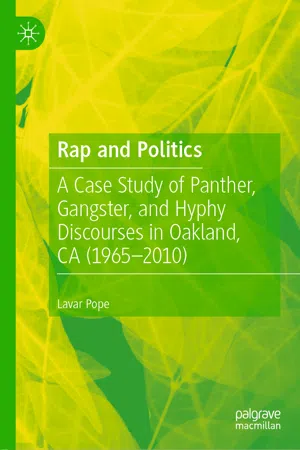
Rap and Politics maps out fifty years of political and musical development by exploring three specific moments of local discourse, each a response to failures by local, state, and national governments to address police brutality, violence, poverty, and poor social conditions in Oakland, California and the surrounding Bay Area. First, in the mid-1960s, Black youth responded to repressive political and socioeconomic factors in West Oakland by founding the Black Panther Party for Self Defense, whose representation of violence and community aid, as well as its radical and militant approach to Black Nationalism, became a foundational discourse that shaped the development of rap music in the region. Second, from the collapse of the Party in the early 1980s through the 1990s, gangster rap emerged as a form of political expression among local youth, who drew heavily on radical and militant elements of Panther discourse in their lyrics and artwork. Third, hyphy music in themid-1990s to early 2000s continued these radical discourses and also incorporated coordinated, subversive public behavior to the mix. The result was a critique of endemic problems facing the local Black community, but also an infectious subgenre of party music that gained mainstream popularity. Overall, this study shows that the specific types of representation created to resist problems of racism and poverty in Oakland is actually key to understanding other rap undergrounds, grassroots subcultures, and social movements elsewhere. In the process, Rap and Politics offers readers a new model focused on the development of settings, representation, movements, discourse banks, and impact within underground rap scenes.
In Oakland, California, rap music has been used as a vehicle for Black, Latinx, and poor youth to document their struggleagainst oppression and to relate their struggle to other struggles against oppression in other locations and at other times. Zion I, a group from Oakland, is able to use part of a rap verse to transcend time and space to connect their current, local experience to the evolution of Black life in America since at least 1619 (Fig. 1):
Fig. 1
A soundwave representation Zion I’s “Hit ‘Em (featuring The Grouch and Mistah F.A.B.)” with the quote above highlighted (Zion I, “Hit ‘Em [Featuring the Grouch and Mistah F.A.B.],” Heroes in the City of Dope [Sound recording] [Om Records, 2006])
Hey, I got this blues train runnin’ all through to my veins / Slave ships, Middle Passage, crack cocaine / ‘Ten[s] slap in the ‘Lac, corner boys ground packs / In the belly of the beast where the life go flat / But the music is the remedy, inhale my rhythm steadily / Perched on the curb, watch church converge / It’s the meeting of the minds, at time, light occurs / How we cultivated words like they sacred herbs / Put it in your pipe and puff it, squares can’t touch it / Rough and rugged, how you love it, with no budget / Independent game, man, with my Sleng Teng / You can do the same thang, utilize your damn brain / Metaphors are mountains, countless bouncin’ / A multitude in viewed, clubs and houses / We rain like fountains to wash it clean / I’m in the back with my mug on mean, my whole team.1
The lyrics above trace the complexities of Black life in Oakland to forge a connection to Black people domestically and worldwide. The “blues train” is a reference to the long legacy of Black arts in Oakland and the use of popular blues images in the creation of rap and certain rap forms; this imagery is connected to the slave ships, which is connected to the slavery of hustling drugs within one’s community, which is connected to death in a Babylon-like place (“belly of the beast where the life go flat”). By looking at music as the remedy to these issues, elements of a secularized religious experience are articulated (“watch church converge” while “perched on the curb”). As local community building occurs and the power of “metaphors” is unleashed, the speaker gains a new level of power. This is one verse of a similar voluminous discourse originating from Oakland. This book is an examination of the political content of the local music and the rise of underground leaders, movements , and discourses.
Rap and Politics (RAP) maps out a 50-year political-historical narrative of three eras of local discourse starting in West Oakland, the Oakland/East Bay Area, and the San Francisco Bay Area. The book makes the case that Oakland became a training ground for radical and militant Black youth starting as early as the mid-1960s, and that these elements continued—both in society and in rap music—as a response to government failures to adequately address the political, economic, and social problems facing local youth. In the mid-1960s, the socioeconomic and political setting of West and North Oakland, compounded by geographical, cultural, and educational factors, produced the dynamic that gave rise to the Black Panther Party for Self Defense (hereafter, Panthers or BPPSD), one of the most radical and militant forms of Black Nationalism.2 While the BPPSD was experiencing the last signs of collapse in the early 1980s, local Black youth were already beginning to use rap music as a primary mode of political expression for grievances against “the state,” and increasingly drew on radical and militant elements of Panther discourse during the 1980s, 1990s, and 2000s. Around 1991, that same locale contributed to the emergence of 2Pac’s mixture of political/gangster rap and in the early 2000s, it was the birthplace of the hyphy rap subgenreand subculture , both of which are examined in this book.
Through these cases, RAP makes the argument that local rap discourses remained connected in their use of day-to-day accounts to express three forms of politics: a politics of visibility, expressed through the use of violence and centered on protection of self; a politics of last resort, expressed through the rhetoric of hustling and centered on escaping poverty; and a politics of contempt, expressed as disregard and disdain for political officials, state authorities, and state institutions and leveraged as a basis for social justice campaigns toward de facto equality. By examining this evolutionary discourse in rap music through the frameworks of setting, representation, movements, discourse banks , and impact, RAP advances our understanding of the underground rap music and Black politics.
Methodologically, RAP approaches these research questions through an “underground research method.” This process began with the author’s experience as an “involved participant” in the local Bay Area rap scene as a performative Bay Area disc-jockey (DJ) for over five years. This firsthand experience led to a closer understanding of the political history of the scene and a comprehensive collection of music actually requested at live events in the local community by members of the local community. The findings in this book are directly based on a content analysis-based examination of an extensive source bank of 100 Panther statements, 100 local rap albums, 100 mainstream rap albums, 100 local rap singles, and 100 mainstream rap singles. RAP’s key finding is that the local rap sources contained nearly twice as much political content as the mainstream rap sources. The latter, in turn, included significant political content from rap artists and groups from eight to ten US locales where significant racial justice activity occurred in the late 1960s.
More broadly, this book examines the relationship between political content and local rap music by comparing a case study of rap music’s development in Oakland and the Bay Area to mainstream rap in 10 other US cities during the 1980s, 1990s, and 2000s. RAP seeks to answer previously unaddressed questions. First, how was the local development of rap music in Oakland, CA influenced by the politicsof the BPPSD? Second, how does this local political development relate to mainstream rap music and rap music from other locales? Through this examination, RAP offers a new scope, framework, and method for future analyses of urban locales. This approach seeks to better understand the political development of local underground power, protest media, and representation; the tools and technologies used in the production of local messages; and comparative relationships b...
Table of contents
Cover
Front Matter
Introduction to Rap and Politics
The Panther Discourse (1965–1982)
The Gangster Discourse (1981–2000)
The Hyphy Discourse (2000–2010)
Conclusion: The Future of Rap Discourses in America’s Colonies
Back Matter
Trusted by 375,005 students
Access to over 1.5 million titles for a fair monthly price.
Study more efficiently using our study tools.
Frequently asked questions
Yes, you can cancel anytime from the Subscription tab in your account settings on the Perlego website. Your subscription will stay active until the end of your current billing period. Learn how to cancel your subscription
No, books cannot be downloaded as external files, such as PDFs, for use outside of Perlego. However, you can download books within the Perlego app for offline reading on mobile or tablet. Learn how to download books offline
Perlego offers two plans: Essential and Complete
Essential is ideal for learners and professionals who enjoy exploring a wide range of subjects. Access the Essential Library with 800,000+ trusted titles and best-sellers across business, personal growth, and the humanities. Includes unlimited reading time and Standard Read Aloud voice.
Complete: Perfect for advanced learners and researchers needing full, unrestricted access. Unlock 1.5M+ books across hundreds of subjects, including academic and specialized titles. The Complete Plan also includes advanced features like Premium Read Aloud and Research Assistant.
Both plans are available with monthly, semester, or annual billing cycles.
We are an online textbook subscription service, where you can get access to an entire online library for less than the price of a single book per month. With over 1.5 million books across 990+ topics, we’ve got you covered! Learn about our mission
Look out for the read-aloud symbol on your next book to see if you can listen to it. The read-aloud tool reads text aloud for you, highlighting the text as it is being read. You can pause it, speed it up and slow it down. Learn more about Read Aloud
Yes! You can use the Perlego app on both iOS and Android devices to read anytime, anywhere — even offline. Perfect for commutes or when you’re on the go. Please note we cannot support devices running on iOS 13 and Android 7 or earlier. Learn more about using the app
Yes, you can access Rap and Politics by Lavar Pope in PDF and/or ePUB format, as well as other popular books in Politics & International Relations & Music. We have over 1.5 million books available in our catalogue for you to explore.