This book examines the contribution of mass-produced original painting to the psychology of art, psychological aesthetics, and art criticism. Mass-produced paintings are an inexpensive, accessible, ubiquitous, and hand-painted popular art by anonymous artists or teams. Sold in an array of outlets, ranging from flea markets to shopping centers to cruise ships, they decorate hotels, offices, and homes. Addressed is their neglect in current scholarship in favor of a nearly exclusive investigation of the high arts and their audiences, as represented by museum paintings. Lindauer contextualizes his analysis by tracing the historical origins of this type of painting, popular art in general, and their evolutionary trajectory, exploring issues including: the impact of art and artists' creativity on viewers; the overemphasis on originality and name recognition; what is art and who can be called an artist; and the extension of aesthetics to include an everyday kind.
The book concludes with directions for future research in the popular and traditional arts, the psychology of art, and, more broadly, the ties that transcend barriers between science, the arts, and the humanities. It will appeal to students and scholars from across the fields of psychology, sociology, philosophy, art history, and cultural, media and communication studies.
M. S. LindauerMass-Produced Original Paintings, the Psychology of Art, and an Everyday Aestheticshttps://doi.org/10.1007/978-3-030-51641-3_1
Begin Abstract
1. What This Book Is About
Martin S. Lindauer1
(1)
State University of New York, College at Brockport, Brockport, NY, USA
Abstract
The book’s coverage is outlined. The reasons for focusing on the visual arts, popular arts, and paintings not in the collections of art museums are explained. Mass-produced original paintings are described along with their importance to art criticism, the psychology of art, and aesthetics; why they serve as a bridge between the popular and traditional arts; and how their study interrelates science and the humanities. Noted, too, is the place of mass-produced paintings in the fine arts, the popular arts, evolutionary theory, history, cultural studies, aesthetics, and the social sciences, especially psychology. The advantages of studying mass-produced originals and their neglect by the artworld are introduced. The author’s empirical and multidisciplinary approach is emphasized. Mass-produced paintings are illustrated.
Keywords
Mass-produced original paintingsThe psychology of artPsychological aestheticsThe popular and traditional artsScience and the humanitiesMultidisciplinary approaches
End Abstract
A sale at a Sears sold 39,000 pieces of art, $120,000 worth, in 10 days, including 400 in a single day. Over 3000 people were present on each day of the two-week sale.
(“Art sales in supermarkets,” 1995)
People are interested in if not fascinated by the arts, and not just the traditional ones: symphonies, ballet, literary classics, and other expressions of the fine arts. But appealing to many who may know little if anything about the arts listed above and don’t care to are the popular arts, also known as commercial, decorative, mass market, and low-brow.1 Nonetheless, they are appreciated by people who rarely if ever attend or read plays by Shakespeare and literary masterpieces; attend a performance of Madame Butterfly and operas; sees a Fellini film retrospective in an art film theater; or visit an art museum. Among the visual varieties of the popular arts are mass-produced original paintings, the focus of this book.
It seems contradictory, though, to call mass-produced paintings original since they imitate if not copy museum works.2 Derivative in subjectmatter and style, highly familiar looking, and considered trivial, they are not “genuine.”3 I’ll have more to say about this apparent conundrum subsequently.
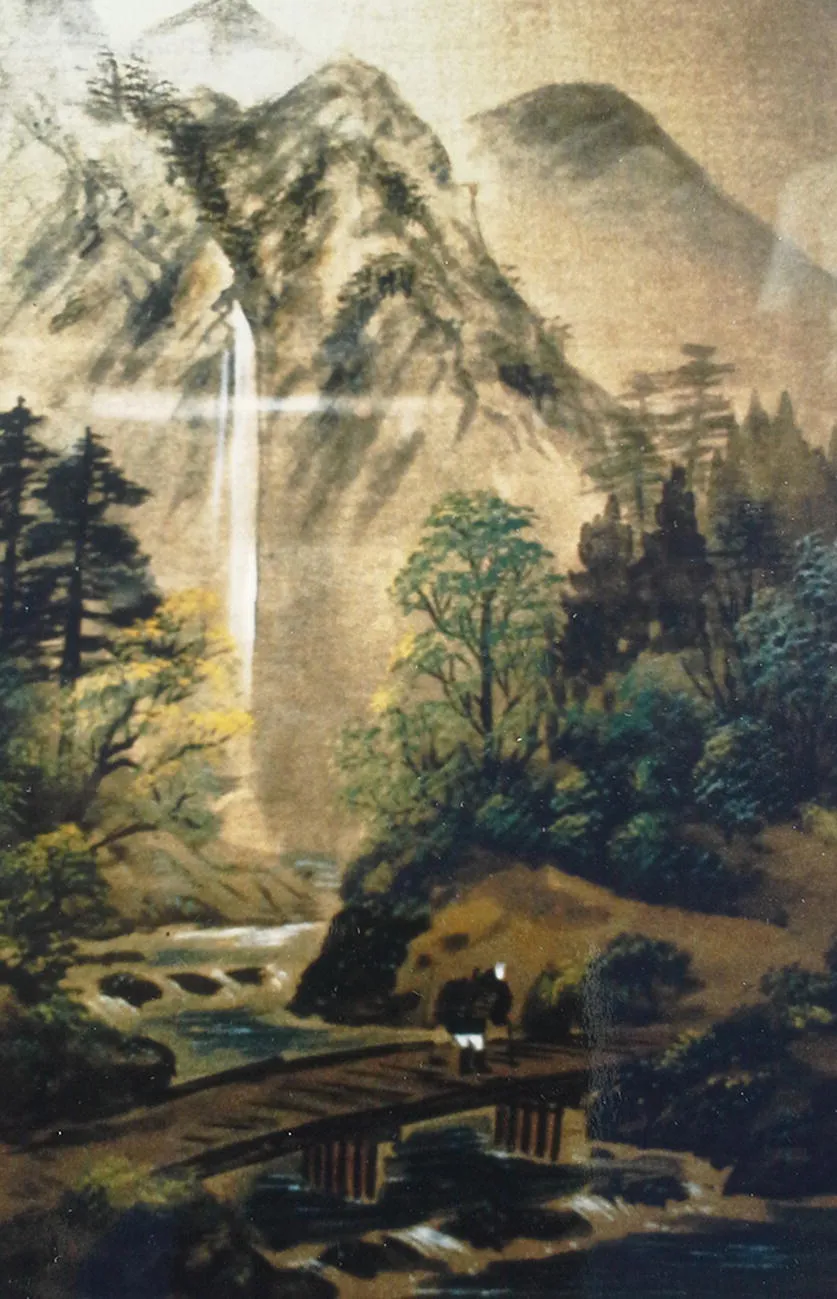
For now, though, look at the examples of mass-produced original paintings. Depicted below are five frequent scenes: a seascape, a rustic landscape, a watercolor and ink Chinese landscape, a street or urban location, and a still-life. You may have seen one like these in your home as a child or in the living room of a relative of a friend, own one now, and have probably come across examples in motel rooms and other public places.
They raise the following question: Can “assembly-line paintings” be considered “art” in the same way as masterpieces in museums are called that? Mass-produced original paintings, despite the apparently clashing juxtaposition of “mass-produced” and “original,” nonetheless touch on a number of important questions. Begin with the fact that ordinary people who don’t know much about art and don’t feel the need to do so, find them approachable and pleasing, see beauty in them, like and buy these paintings, and feel pleasure in looking at them. Contrast these attractive features with the masterpieces in art museums, about which a modicum of knowledge about art history, criticism, and theory adds to their enjoyment. This raises the question (addressed in the studies reported in this book) of how much one should know about art in order to appreciate it? Nothing? A little? One can ask the same question of casual readers, occasional listeners of music, and ordinary audiences of dance, opera, and theater.
Another key question is raised in the course of examining mass-produced paintings: “What makes a painting liked?” To which one can add related questions: What makes it good or bad? Creative? Original? Is the difference between museum and non-museum paintings obvious? Is it justifiable for scholars and researchers to focus exclusively on “good” (museum) paintings? If mass-produced originals are poor examples of art, do they nonetheless deserve serious attention?
One can easily think of many other pertinent questions:
How important is skill compared to a work’s “message,” especially if it is novel or insightful? Can a painting be decorative as well as inspire? What is the difference between art that appeals to informed or unsophisticated audiences? Can preferences for art include both high- as well as low-brow tastes? Are there unexpected similarities between museum-caliber and pedestrian paintings despite their obvious differences in quality? If so, what are they? Are the masterpieces in museums the optimum if only basis for an aesthetic experience?
These questions are addressed directly and indirectly, or partially, along with others. What is the role of evolution and history in the development of art, whether traditional (museum-caliber) or popular (mass-produced original paintings)? What is the impact of signatures on viewers’ evaluation of a work, especially if they are by recognized artists?
I do not promise definitive answers to these questions, or ones that will satisfy all readers. How could I, or anyone, given the complexities of art and the individual tastes of viewers? Experts have discussed these questions for centuries and have offered many answers. But a consideration of contentious matters about art within the context of rather ordinary paintings throws some unexpected light on works that hang in museums and our reactions to them.
Five examples of mass-produced original paintings
Fig. 1.1
Seascape
Fig. 1.2
Watercolor and ink Chinese landscape
Fig. 1.3
Stilllife
Fig. 1.4
Rustic landscape
Fig. 1.5
Street or urban location
A close look at mass-produced paintings, as this book does systematically for the first time, provides a more complete picture of art than is usually the case: what it is, the audience it attracts, and the reasons for its appeal. This promise rests on my emphasis on non-elitist and unsophisticated viewers of rather commonplace paintings, rather than focusing, as most treatments of art do, on sophisticated audiences of great works. But rather than sharpening distinctions between the fine and low arts, traditional and popular, high- and low-brow, I emphasize the amorphous and shifting boundaries between mass-produced and museum paintings.
Mass-produced originals therefore have more significance than meets the eye. Nonetheless, most academics, scholars, and researchers strongly object to including them in discussions of art—except to censor, condemn, or ridicule them. The low opinion of mass-produced paintings is reflected by their many negative synonyms: sofa-, factory-, assembly-line-manufactured-, motel-, and manufactured-art; junk, kitsch, schlock, rubbish, and “dreck.”
However, these labels miss a great deal of what is valuable about mass-produced original paintings if we ask those who shop for, like, and display them. What do they see, feel, and think about such works, especially when compared to museum examples? Are mass-produced paintings really that bad? The original research reported here (Part IV) examines these questions, along with the role played by age, gender, art background, and setting.
In raising these issues, I must make this disclaimer: My expertise is not in art history, theory, or criticism. To attempt to include what these fields have written about the questions raised above would take me too far afield and blur what I am trying to say (and would require much more than a book-length treatment if not several books). My focus is much more limited.
I am an empirically grounded (research-oriented) psychologist who studiesperception and the arts. I emphasize subjective and personal reactions, observe people’s behavior, and obtain self-reports along with objective measures: ratings, checklists, questionnaires. These are completed under standard conditions and carefully planned procedures. I concentrate on facts, the evidence.
But I recognize that a “hard-headed” approach of the sort outlined above is not sufficient when it comes to the arts. Needed, too, is a qualitative context, a framework, in which to place statistical data. That comes from scholarly discussions of both the traditional and popular arts in the humanities: history, philosophy, and popularculture. Additional contexts are sociology and psychology, theoretical and research-oriented, evolutionary arguments, and neuroscience. In short, I take a multidisciplinary approach. The relationship between art and science need not be one of “a conflict between cultures” (Chap. 14).
Aside from taking multiple perspectives, mass-produced original paintings are examined along the following lines: their predominant subject matter and colors; the artists and their production methods; their cost, buyers, and sales outlets; and their evaluation in different settings by shoppers who differ in age, gender, and art background (Part IV). The primary questions are these: Are mass-produced originals liked and, if so, to what extent? How do they compare with museum paintings? What are the similarities as well as differences between the two kinds of paintings?
Criticisms of mass-produced paintings are presented and addressed (Part II). Covered, too, are...
Table of contents
Cover
Front Matter
Part I. Introduction
Part II. Critical Issues
Part III. Two Larger Contexts for Mass-Produced Original Paintings: The Popular Arts and Evolution
Part IV. Studies of Mass-Produced Original Paintings
Part V. Mass-Produced Original Paintings, the Psychology of Art, and an Everyday Aesthetics
Back Matter
Trusted by 375,005 students
Access to over 1.5 million titles for a fair monthly price.
Study more efficiently using our study tools.
Frequently asked questions
Yes, you can cancel anytime from the Subscription tab in your account settings on the Perlego website. Your subscription will stay active until the end of your current billing period. Learn how to cancel your subscription
No, books cannot be downloaded as external files, such as PDFs, for use outside of Perlego. However, you can download books within the Perlego app for offline reading on mobile or tablet. Learn how to download books offline
Perlego offers two plans: Essential and Complete
Essential is ideal for learners and professionals who enjoy exploring a wide range of subjects. Access the Essential Library with 800,000+ trusted titles and best-sellers across business, personal growth, and the humanities. Includes unlimited reading time and Standard Read Aloud voice.
Complete: Perfect for advanced learners and researchers needing full, unrestricted access. Unlock 1.5M+ books across hundreds of subjects, including academic and specialized titles. The Complete Plan also includes advanced features like Premium Read Aloud and Research Assistant.
Both plans are available with monthly, semester, or annual billing cycles.
We are an online textbook subscription service, where you can get access to an entire online library for less than the price of a single book per month. With over 1.5 million books across 990+ topics, we’ve got you covered! Learn about our mission
Look out for the read-aloud symbol on your next book to see if you can listen to it. The read-aloud tool reads text aloud for you, highlighting the text as it is being read. You can pause it, speed it up and slow it down. Learn more about Read Aloud
Yes! You can use the Perlego app on both iOS and Android devices to read anytime, anywhere — even offline. Perfect for commutes or when you’re on the go. Please note we cannot support devices running on iOS 13 and Android 7 or earlier. Learn more about using the app
Yes, you can access Mass-Produced Original Paintings, the Psychology of Art, and an Everyday Aesthetics by Martin S. Lindauer in PDF and/or ePUB format, as well as other popular books in Psychology & Art General. We have over 1.5 million books available in our catalogue for you to explore.