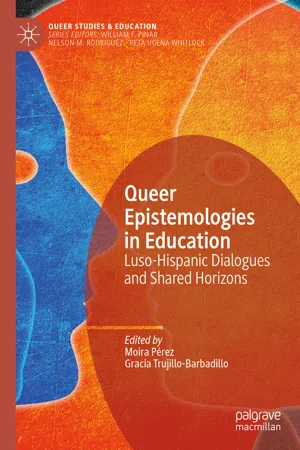
This edited collection brings together the work of researchers and educators from Argentina, Brazil, Spain, Colombia, Costa Rica, Portugal,and Mexico on education, pedagogy, and research from a queer perspective. It offers a space for the dissemination and development of new lines of analysis and intervention in the field of Queer Pedagogies in the region, relevant to the present and future of the field both in our countries and beyond. Chapters provide perspectives aware of the regional context but relevant from a theoretical and practical perspective beyond Ibero-America. The volume covers elementary, middle, and higher education, formal and informal, and includes theoretical and applied contributions on a variety of topics including public policies on education, queer youth, sex education, and conservative attacks against "gender ideology" in the region.
eBook - ePub
Queer Epistemologies in Education
Luso-Hispanic Dialogues and Shared Horizons
- English
- ePUB (mobile friendly)
- Available on iOS & Android
eBook - ePub
Queer Epistemologies in Education
Luso-Hispanic Dialogues and Shared Horizons
About this book
Information
Topic
Scienze socialiSubtopic
Didattica comparata© The Author(s) 2020
M. Pérez, G. Trujillo-Barbadillo (eds.)Queer Epistemologies in EducationQueer Studies and Educationhttps://doi.org/10.1007/978-3-030-50305-5_11. Introduction
Moira Pérez1 and Gracia Trujillo-Barbadillo2
(1)
Universidad de Buenos Aires/CONICET, Buenos Aires, Argentina
(2)
Faculty of Education, Universidad Complutense de Madrid, Madrid, Spain
Keywords
Ibero-AmericaEpistemologyCuirSouthThis project was born from a desire to bring Spanish- and Portuguese-speaking perspectives on queer(ing) education into the English-speaking world, in order to give more visibility to the theoretical production taking place in our region, and contribute to current debates on queer approaches on education more broadly. Although there is a fertile production in Ibero-America connecting a queer/cuir1 theoretical framework with issues pertaining to education, pedagogy, teaching and the academy, these are usually under-represented in existing anglophone publications. This is the first time that a volume in English compiles the works of scholars working in Spanish- and Portuguese-speaking contexts. Its pages offer an overview of some of the main topics, tendencies and debates currently marking the theoretical production in this field, in the hope of opening space to further exchanges and synergies.
Queer Epistemologies in Education was projected and realized through an open call for contributions, along with specific invitations sent out by the editors. In the selection process, apart from assessing the potential and quality of each proposal, we prioritized geographical and thematic variety, and sought to include the broadest array of topics, methodological approaches and educational levels. The resulting volume brings together the work of some of the key figures in the field along with many of our most promising scholars, including authors from Argentina, Chile, Brazil, Spain, Colombia, Costa Rica, Portugal and Mexico. Although the compilation has a number of limitations, which will be addressed toward the end of this Introduction, we still believe we have been able to provide a look into many of the key concerns and original developments in our region, and offer practical resources and theoretical developments that will also prove relevant elsewhere.
In recent times, many of the countries included in this compilation have been at the forefront of political change and activism in terms of gender and sexual diversity, but have also been witness to high levels of violence and considerable backlash from conservative sectors. In particular, campaigns against what has been called “gender ideology” have profoundly altered the game for educational policies, institutions and activism, as well as the everyday reality of teaching and navigating school/university life. Theoretical work has accompanied these tendencies with sophisticated and nuanced readings of our past, present and future realities and possibilities. The chapters that follow are the proof of how research and writing can be situated and engaged in its specific geopolitical context, while also remaining informed about current theoretical developments in the field and able to contribute greatly to global debates. It is our hope that this volume will help foregrounding such valuable production, and spark broader theoretical and practical collaborations among scholars working on Queer/cuir Theory queer/cuir theory, education and pedagogies worldwide.
Dialogues Around Queer/Cuir Epistemologies in Our (Non) Region
Organizing these pages and collaborating with its authors have given us the opportunity to reflect on the framework offered here and what it means to think queerly about education in Spanish- and Portuguese-speaking contexts. Each of the notions that articulate this volume could be—and has been—analyzed at length, and their combined choice was the result of extensive discussions. What does “queer” mean in our countries and our scholarship? What are the gains and what the concessions involved in incorporating this term into our work, be it in its English spelling or transformed into cuir and other variations? Are Luso-Hispanic dialogues possible, considering the tremendous differences within and between the countries represented here (and those absent)? Is it possible to think of Ibero-America as a region? Why approach education through queer/cuir epistemologies? How should we understand “education”, and how does it relate to institutional life? And, finally, what have queer/cuir epistemologies of education harvested in our (non) region so far, and where do we go from here? In this Introduction, we intend to share some of our reflections on these questions.
The travels and vicissitudes of “queer” as a concept and as a theoretical framework have resulted in transformations, displacements and disputes that by far exceed what can be summarized in a few lines. If “queer” is not reducible to a single meaning in English-speaking contexts, or in the academic environment that gave rise to queer theory, it certainly cannot be homogenized across latitudes in which language, worldviews, identities and theoretical production are profoundly diverse. Does “queer” make any sense as an imported term? In some Spanish- and/or Portuguese-speaking contexts, it shares the radical genealogy and significance that was reappropriated at the origins of queer theories and political practices in the United States (Trujillo, 2005, 2016); in others, its uses expose an academic route which places it in specific racial and class positions (Padilha & Facioli, 2015; Vargas Cervantes, 2016; González Ortuño, 2016; Piña Narváez, 2018; Bello Ramírez, 2018; Pérez & Radi, 2020). In this context, can “queer” maintain some (or any) of its political thrust? How should we deal with the fact that, as Berenice Bento (2017, p. 249) has stressed, “my language must go into hard gymnastics to say ‘queer’, and I don’t know whether the person listening to me shares the same senses”? Can this be addressed by reframing it as “cuir”, “kuir”, “torcido”, “marica”, “viada”, “teoria cu”, “estudos transviados”2 or other formulations proposed by local theorists/activists? After all, as an imported notion, “queer” demands not only translating and/or explaining, but also decolonizing through the transformation of its meanings and the incorporation of the specificities of each location, such as what val flores has called a “Latinamericanization of cuir” (2013, p. 61). As Manuel López-Pereyra stresses in his contribution to this volume, in this side of the world “the development of queer studies must be framed through an in-depth understanding of the region’s experiences of racism and classism, which come from a history and politics of colonization and resistance”.
These and other points in relation to the term and the concept(s) behind it have been examined extensively in our region for well over a decade, as is evident in Trujillo (2005, 2008), Epps (2008), Delfino and Rapisardi (2010), Viteri, Serrano, and Vidal-Ortiz (2011), Pelúcio (2014a, 2016), Falconí Trávez, Castellanos, and Viteri (2014), and Pereira (2015), among others. Nevertheless, these issues continue to be part of the pedagogical task expected (or demanded) from scholars in the South3 who wish to join the dialogues taking place in hegemonic sites of theoretical production. In this volume we have chosen not to focus on these preliminaries, moving forward instead toward the collective construction and dissemination of the long-standing work in our region that is not about, but in or with queer theory, and particularly that focusing on queer pedagogies.
Referring to a region or conceiving transnational commonalities that justified the specificity of this compilation was also a matter of debate throughout the project. To what extent can we say that the countries represented here (as well as those present through citations and intellectual lineage) constitute a region or a more or less recognizable entity? What sets it apart from others, such as North America, the English- and French-speaking Caribbean, or Lusophone Africa? Can this distinction translate into something like an identity—and if so, how should we call it? Issues such as the denomination of the Spanish State and its so-called historical nationalities (Pastor, 2014), the preferred name for Latin/Indo/Hispanic America/Abya Yala (Oberlin & Chiaradía, 2019), or the common heritage and future of Lusofonia (Davis, Straubhaar, & Ferin Cunha, 2016), reveal some of the complexities of these long-standing questions. In this book, far from affirming a common voice or assuming that all the authors included here speak from the same location, we have preferred to propose an open dialogue that begins with contributors from various Luso/Hispanic countries, but hopefully continues with readers, critics and other educators and scholars who may join the conversation in the future. A conversation that can bring together different realities marked not only by country and continent, but also by race, gender, sexuality and academic career, among many other factors. Such differences cut through the traits that indeed constitute a set of shared heritages, sometimes to the point of making them unrecognizable: a common colonial past mutates into a present marked by contrasting forms of coloniality (Lander, 2000; Lugones, 2016; Vergès, 2019); the historical role of the Catholic Church and its influence on social life and State policies has been reduced in some locations, while in others it rapidly mutates toward a strong Evangelical presence; the whitening of society and denial of indigenous, afrodescendant and migrant communities and cultures can take the form of complete denial of their existence an...
Table of contents
- Cover
- Front Matter
- 1. Introduction
- 2. Prologue: On the Importance of Queer Perspectives on Education in and from the Ibero-American Context
- 3. Perspectivizing and Imagining Queer Pedagogies Through Collaborative Interventionist Research in a Brazilian School
- 4. Queering Freire’s Pedagogies: Resistance, Empowerment, and Transgression in Teacher Training
- 5. Queer, Crip and Social Pedagogy. A Critical Hermeneutic Perspective
- 6. The Pedagogy of/in Images. Notes on Lesbian Desire and Knowing How to Fuck
- 7. Gender and Sexuality in the Brazilian Educational Rhizome: A Cartogenealogy of Production, Marking and Governance of Difference
- 8. “Diva Yes! Free to Fly!” Young Students in Queer Resistance at a Public School in the Capital of Piauí, Brazil
- 9. Fear of a Queer Pedagogy of Law
- 10. “Gender Ideology” in Conservative Discourses: Public Sphere and Sex Education in Argentina
- 11. Voices, Subjectivities and Desires. Costa Rican Secondary Teachers’ and Students’ Discourses About Sexual Diversity
- 12. “At Least They Know We Exist”. Claiming Their Right to Appear: The Gender Studies Research Group in Cúcuta, Colombia, as Maker of Oppositional Knowledge
- 13. Epilogue: A Glossary of Queer by The Criscadian Collective
- 14. Queer/Cuir Pedagogies: Fictions of the Absurd, Writings of the Stagger
- Back Matter
Trusted by 375,005 students
Access to over 1.5 million titles for a fair monthly price.
Study more efficiently using our study tools.
Frequently asked questions
Yes, you can cancel anytime from the Subscription tab in your account settings on the Perlego website. Your subscription will stay active until the end of your current billing period. Learn how to cancel your subscription
No, books cannot be downloaded as external files, such as PDFs, for use outside of Perlego. However, you can download books within the Perlego app for offline reading on mobile or tablet. Learn how to download books offline
Perlego offers two plans: Essential and Complete
- Essential is ideal for learners and professionals who enjoy exploring a wide range of subjects. Access the Essential Library with 800,000+ trusted titles and best-sellers across business, personal growth, and the humanities. Includes unlimited reading time and Standard Read Aloud voice.
- Complete: Perfect for advanced learners and researchers needing full, unrestricted access. Unlock 1.5M+ books across hundreds of subjects, including academic and specialized titles. The Complete Plan also includes advanced features like Premium Read Aloud and Research Assistant.
We are an online textbook subscription service, where you can get access to an entire online library for less than the price of a single book per month. With over 1.5 million books across 990+ topics, we’ve got you covered! Learn about our mission
Look out for the read-aloud symbol on your next book to see if you can listen to it. The read-aloud tool reads text aloud for you, highlighting the text as it is being read. You can pause it, speed it up and slow it down. Learn more about Read Aloud
Yes! You can use the Perlego app on both iOS and Android devices to read anytime, anywhere — even offline. Perfect for commutes or when you’re on the go.
Please note we cannot support devices running on iOS 13 and Android 7 or earlier. Learn more about using the app
Please note we cannot support devices running on iOS 13 and Android 7 or earlier. Learn more about using the app
Yes, you can access Queer Epistemologies in Education by Moira Pérez, Gracia Trujillo-Barbadillo, Moira Pérez,Gracia Trujillo-Barbadillo in PDF and/or ePUB format, as well as other popular books in Scienze sociali & Didattica comparata. We have over 1.5 million books available in our catalogue for you to explore.