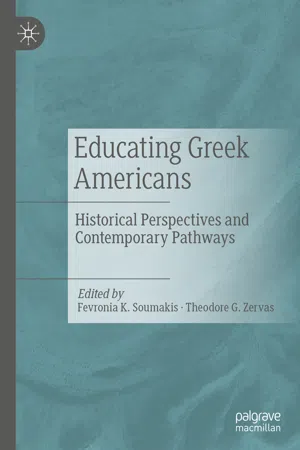
This edited collection considers Greek American formal and informal educational efforts, institutions, and programs, broadly conceived, as they evolved over time throughout the United States. The book's focus on Greek Americans aims to highlight the vast array of educational responses to local needs and contexts as this distinct, yet, heterogeneous immigrant community sought to maintain its linguistic, cultural, and religious heritage for over one hundred years. The chapters in this volume amend the scholarly literature that thus far has not only overlooked Greek American educational initiatives, but has also neglected to recognize and analyze the community's persistence in sustaining them. This book is an important contribution to an understanding of Greek Americans' long overdue history as a significant diaspora community within an American context.
eBook - ePub
Educating Greek Americans
Historical Perspectives and Contemporary Pathways
- English
- ePUB (mobile friendly)
- Available on iOS & Android
eBook - ePub
Educating Greek Americans
Historical Perspectives and Contemporary Pathways
About this book
Information
Topic
EducationSubtopic
Education Theory & Practice© The Author(s) 2020
F. K. Soumakis, T. G. Zervas (eds.)Educating Greek Americanshttps://doi.org/10.1007/978-3-030-39827-9_11. Introduction
Fevronia K. Soumakis1
(1)
Queens College, The City University of New York, Queens, NY, USA
The co-editors express their sincerest gratitude to the editors at Palgrave Macmillan for their support of this project. A special note of appreciation goes to Yiorgos Anagnostou, Alexander Kitroeff, John A. McGuckin, Alexa Rodriguez, and Eric Strome for providing valuable feedback at different stages.
End AbstractIn 1922, Vlassis Kantartzis fled the village of Dikili in Ottoman Turkey to settle in a small commercial town called Perama on the island of Lesvos across the Aegean Sea. For Vlassis and many Asia Minor refugee families, Perama became their final destination and permanent home. For others, such as his brother Euripedes, America beckoned and the long journey across the Atlantic to California separated the family until they would know each other no more.
Vlassis eventually was elected mayor of this small town when a government minister by the name of Georgios Papandreou visited Lesvos in the post-World War II period. When Papandreou asked Vlassis what his town needed, the latter responded that they needed a new school because the children were being educated in a makeshift room in an olive press and soapmaking factory. Within a few years, a school was built just across from the Church of St. Panteleimon.
Generations of children were educated in the school that my grandfather was instrumental in building. But Greece under a dictatorship (1967–1974) was an inhospitable place and thus, many of my father’s generation departed for America when immigration laws were revised to correct for the restrictive laws implemented just three decades earlier. My father Vassilis arrived to the epicenter of Greek America in 1970: Astoria, Queens, New York City. There, he became Bill, or on occasion, I noticed letters addressed to one William Kantartzis; my mother’s stately Konstantina was officially changed to Dina. Much like many Greek immigrants who emigrated during that time period, they wished to instill a Greek identity in their American born children by sending them to Greek school. They were able to do this because they found an infrastructure which was able to grow and thrive in a multicultural and multilingual city through community-led efforts, the local public schools, and the Greek Orthodox Church.
This personal narrative centering on generations of Greek migration opens a window through which we can reconsider the efforts by Greek immigrants and Americans of Greek heritage to preserve and maintain a Greek cultural identity through schooling and learning in the United States. Educating Greek Americans: Historical Perspectives and Contemporary Pathways seeks to revive a rich and long-overdue discussion of the impact of Greek American education. One of the last published volumes on this topic was written within the broader context and narrative of American educational reforms in the 1980s and with an acute awareness of the changes occurring within and across Greek American communities. Spyros D. Orfanos, Harry J. Psomiades and John Spiridakis’ 1987 volume on Greek American education drew attention to significant educational, social, and psychological questions.1
In the time since Orfanos and his colleagues published their book, there have been major developments in the Greek schools in the United States as well as the relationship between the Greek American community and Greece. A number of dissertations have been produced on the topic of Greek American education. Peer reviewed articles as well as newspaper articles have been published, and discussions on the future of Greek education in the United States have continued in the public sphere.2
Nonetheless, there are persistent gaps in our knowledge about Greek American institutions, organizations, or programs that are directly related to education or that include some component of education in their mission.3 An important gap exists in higher education with respect to the nearly 60 Modern Greek Studies programs offered in colleges and universities in the United States and Canada.4 One of the oldest Greek American organizations awaits scholarly attention: The American Hellenic Education Progressive Association (AHEPA), founded in 1922 and which includes a women’s branch, the Daughters of Penelope, and their respective young adult branches, Maids of Athens and Sons of Pericles. The largest institution under which formal and informal schooling occurs, the Greek Orthodox Archdiocese of America (GOARCH), has yet to be analyzed critically with respect to the totality of its educational endeavors including its parochial schools, afternoon schools, Sunday schools, higher education, camping and scouting programs, and youth programs such as the Greek Orthodox Archdiocese Youth of America (GOYA). Using religion as an analytical lens might help scholars comprehend more fully the role the GOARCH has played in shaping the Greek American community over time. It can also illuminate the ways that Greek Americans have transformed their faith.5 To that end, what is needed is historical and contextual understanding of how religious institutions in the United States developed and the extent to which ethnic and religious communities innovated within a religiously and ethnically pluralist tradition. For example, the history of Catholic and Jewish educational efforts has long been documented by scholars. As such, the historiography has grown from sympathetic studies on predominantly male leaders and institutions to rich and nuanced explorations of ethnicity, gender, race, and geography by leading scholars.6
Understanding how Greeks in America approached schooling and learning is not just about adding another ethnic or religious group to the existing scholarship. If we define Greek American education in its broadest sense to encompass or to impart some degree of Greek language, religious, cultural, and/or political education, then we can say that this understudied effort taken up by a wide array of stakeholders has been the most persistent throughout the Greek American experience. This larger educational project as it has elaborated over time speaks not only to domestic ethnic interests but to international ones as well that have resulted in the steady creation and recreation of transnational networks of students, teachers, scholars, clergy, community members, and politicians. It is this dynamic interchange that the authors of this volume capture.
This book emerged from a fortuitous exchange between the co-editors at the Modern Greek Studies Association Symposium that took place in November 2017. As we embarked upon this project, we realized the potential for a long-term research agenda. This volume, however, is not a comparative study nor is it meant to be comprehensive in scope. Our hope is that it generates serious interest and new directions in thinking about the significance and long-term impact of Greek American education.
The chapters within offer perspectives on historical experiences and contemporary developments. The historical section of this volume brings to light new material and archival sources that have not been readily accessible to scholars in the past.
In Chap. 2, “Greek Orthodox Education: Challenges and Adaptations in New York City Schools,” Fevronia K. Soumakis examines how investing schools with the work of ethnic, religious, and linguistic survival, while not a new phenomenon among European immigrant groups of the early twentieth century, became a long-term undertaking for Greek Americans and the Greek Orthodox Church. Soumakis provides an overview of the history of Greek Orthodox educational initiatives as they unfolded under the administrative head of the Archdiocese located in New York City. The centrality of the Archdiocese and the priority ascribed to Greek language education and Greek history reveal a distinct educational mission.
In Chap. 3, “The First Schoolbooks for Greek American Children,” Maria Kaliambou considers the earliest schoolbooks produced by Greek American publishers in the 1930s. Educators recognized that books imported from Greece did not meet the pedagogical needs of the first generation of students, and thus new textbooks, in the form of spelling books, readers, and anthologies for school festivals were created. In her close analysis of the schoolbooks, Kaliambou maintains that the authors repackaged the ideological trinity of homeland, religion, and family to Greek American student audiences in an effort to inspire a lifelong enthusiasm for Greek letters, traditions, and culture.
Chaps. 4, 5, 6, and 7 bring us into the contemporary period and focus on schools or programs which reflect a high degree of innovation in curriculum, programming, and teaching methods. In Chap. 4, “Considering the ‘Socratic Method’ When Teaching the Odyssey and Iliad at the Socrates and Koraes Greek American Schools,” Theodore G. Zervas takes us into the Greek Orthodox parochial school classrooms. He draws attention to the prominence of the Odyssey and Iliad in the Greek school curriculum and the pedagogical method used to analyze these texts at an advanced level of Modern Greek. Zervas shows that in both the Socrates and Koraes Schools, teaching through questioning, as identified in many of the Socratic dialogues, has been successful in critically engaging students.
Like Zervas, Angelyn Balodimas-Bartolomei focuses on innovative teaching practices in the Greek school classroom in Chap. 5, “Breaking the Traditional Greek School Mold: The Case of the Aristotle GSL Program.” Balodimas-Bartolomei discusses the creation of the experimental Greek school language program at the St. Haralambos Aristotle Greek School in Niles, Illinois. The school was one of several Greek American schools chosen by the Greek government in collaboration with the Greek Orthodox Archdiocese of North and South America to pilot a new textbook series Mathaino Ellinika (I Learn Greek) published by the Pedagogical Institute of Greece. Inspired by the textbook initiative, the author helped to design the Greek as a Second Language (GSL) Program beginning in the 1989–1990 academic school year. In reconfiguring the Greek school curriculum, textbooks, and teaching materials for students learning Greek as a second language, the GSL Program continues to thrive into the present.
Marina Mattheoudakis addresses recent developments in the Odyssey Charter School founded in 2006 in Wilmington, Delaware. In Chap. 6, “An American and Greek Language Integrated Curriculum for a Dual Language Immersion Program: The Case of Odyssey Charter School,” Mattheoudakis considers the increasing significance of bilingual programs and their growth in the United States since the 1990s. Odyssey Charter School, which has a racially and ethnically diverse student population, pioneered the first dual language immersion program in Greek and English in Delaware beginning in 2017. The emphasis on students’ oracy (listening and speaking skills) before the introduction of reading and writing skills is an innovative feature of the school’s immersion program. Mattheoudakis’ research and work with the Odyssey Charter School offers an alternative pathway for Greek language education, one that relies on the mutual benefit and layers of collaboration between the school, the state, and Greek and American universities.
Angelyn Balodimas-Bartolomei and Gregory A. Katsas consider the growth of the Heritage Greece (HG) program during its nearly first decade of existence in Chap. 7, “Promoting Heritage, Ethnicity, and Cultural Identity in Diasporic Communities: The Case of The Heritage Greece Program.” Modeled after Birthright Israel, Heritage Greece wa...
Table of contents
- Cover
- Front Matter
- 1. Introduction
- 2. Greek Orthodox Education: Challenges and Adaptations in New York City Schools
- 3. The First Schoolbooks for Greek American Children
- 4. Considering the “Socratic Method” When Teaching the Odyssey and Iliad at the Socrates and Koraes Greek American Schools
- 5. Breaking the Traditional Greek School Mold: The Case of the Aristotle GSL Program
- 6. An American and Greek Language Integrated Curriculum for a Dual Language Immersion Program: The Case of Odyssey Charter School
- 7. Promoting Heritage, Ethnicity, and Cultural Identity in Diasporic Communities: The Case of the Heritage Greece Program
- 8. Conclusion: When We Were Greek American
- Back Matter
Trusted by 375,005 students
Access to over 1.5 million titles for a fair monthly price.
Study more efficiently using our study tools.
Frequently asked questions
Yes, you can cancel anytime from the Subscription tab in your account settings on the Perlego website. Your subscription will stay active until the end of your current billing period. Learn how to cancel your subscription
No, books cannot be downloaded as external files, such as PDFs, for use outside of Perlego. However, you can download books within the Perlego app for offline reading on mobile or tablet. Learn how to download books offline
Perlego offers two plans: Essential and Complete
- Essential is ideal for learners and professionals who enjoy exploring a wide range of subjects. Access the Essential Library with 800,000+ trusted titles and best-sellers across business, personal growth, and the humanities. Includes unlimited reading time and Standard Read Aloud voice.
- Complete: Perfect for advanced learners and researchers needing full, unrestricted access. Unlock 1.5M+ books across hundreds of subjects, including academic and specialized titles. The Complete Plan also includes advanced features like Premium Read Aloud and Research Assistant.
We are an online textbook subscription service, where you can get access to an entire online library for less than the price of a single book per month. With over 1.5 million books across 990+ topics, we’ve got you covered! Learn about our mission
Look out for the read-aloud symbol on your next book to see if you can listen to it. The read-aloud tool reads text aloud for you, highlighting the text as it is being read. You can pause it, speed it up and slow it down. Learn more about Read Aloud
Yes! You can use the Perlego app on both iOS and Android devices to read anytime, anywhere — even offline. Perfect for commutes or when you’re on the go.
Please note we cannot support devices running on iOS 13 and Android 7 or earlier. Learn more about using the app
Please note we cannot support devices running on iOS 13 and Android 7 or earlier. Learn more about using the app
Yes, you can access Educating Greek Americans by Fevronia K. Soumakis, Theodore G. Zervas, Fevronia K. Soumakis,Theodore G. Zervas in PDF and/or ePUB format, as well as other popular books in Education & Education Theory & Practice. We have over 1.5 million books available in our catalogue for you to explore.