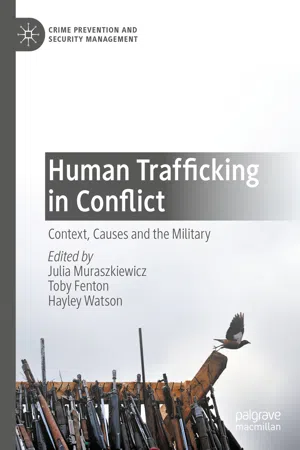
This edited book ?examines the different forms of human trafficking that manifest in conflict and post-conflict settings and considers how the military may help to address or even facilitate it. It explores how conflict can facilitate human trafficking, how it can manifest through a variety of case studies, followed by a discussion of the reasons why the military should include a stronger consideration of human trafficking within their strategic planning given the multiple scenarios in which military forces come into contact with victims of human trafficking, and how this ought to be done. Human Trafficking in Conflict draws on the expertise of scholars and practitioners to develop the existing conversations and to offer multiple perspectives. It includes a discussion of existing frameworks and perspectives including legal and policy, and whether they are configured to address human trafficking in conflict.
eBook - ePub
Human Trafficking in Conflict
Context, Causes and the Military
- English
- ePUB (mobile friendly)
- Available on iOS & Android
eBook - ePub
Human Trafficking in Conflict
Context, Causes and the Military
About this book
Information
© The Author(s) 2020
J. Muraszkiewicz et al. (eds.)Human Trafficking in Conflict Crime Prevention and Security Managementhttps://doi.org/10.1007/978-3-030-40838-1_11. Introduction
Julia Muraszkiewicz1 , Toby Fenton1 and Hayley Watson1
(1)
Trilateral Research, London, UK
We have seen clearly that war acts as a potent catalyst to human trafficking. It breaks down institutional and social protections. And it leaves masses of people vulnerable to traffickers. It is startlingly obvious therefore that greater focus by the international community on preventing conflicts, and stopping their reoccurrence, will have a direct impact on human trafficking.
Mr. Tim Mawe
Deputy Permanent Representative of Ireland Security Council Chamber
Keywords
Human traffickingMilitaryHuman securityJulia Muraszkiewicz
is a Senior Research Manager at Trilateral Research in the Applied Research and Innovation team and was the research lead of Project Solebay looking at risk assessment methodologies for human trafficking in conflict. She has a publication with Palgrave Macmillan on protecting trafficked persons from liability. Julia in her spare time volunteers with NGOs that directly help victims of human trafficking and labour exploitation. She has a PhD in Law from Vrije University of Brussels.
Toby Fenton
is an associate product manager at Trilateral Research, where he works to understand the perspectives and needs of decision-makers and other stakeholders in the defence and security sectors to support innovation, applied research and technology development. From 2018–2019 he worked on Project Solebay which developed a proof-of-concept risk assessment to support the UK military’s response to modern slavery and human trafficking (MSHT) as a human security issue. Fenton’s background lies in research and consultancy within the defence and security space. He holds a BSc in International Relations and an MA in International Peace & Security.
Hayley Watson
is Senior Practice Manager at Trilateral Research, managing business units around Applied Research & Innovation and the provision of interdisciplinary technical and research services to support data-driven decision making. Hayley’s core background lies in social research that examines the positioning of citizens in relation to security-related issues. She has conducted research on the public’s response to security issues (including crises), public vulnerabilities stemming from the impact of security-related issues, considerations for improving the resilience of the public, among other research projects. Hayley has a PhD in Sociology from the University of Kent.
Introduction
The United Nations Convention Against Transnational Organised Crime (also called the Palermo Convention) was adopted through UN Resolution 55/25 (2001) with the objective of combatting transnational organised crime around the world. Within this resolution, the Protocol to Prevent, Suppress and Punish Trafficking in Persons, Especially Women and Children (henceforth the Palermo Protocol ) laid the foundation for novel legislative reform for protecting victims of human trafficking, preventing the crime and prosecuting the perpetrators. Further, the protocol included an agreed definition of human trafficking (see the definition below) and aimed to put an end to state differences as to what the crime entails. Despite the undisputable legislative progress achieved following the adoption of that agreed definition, to this day much remains unresolved regarding combatting human trafficking (Reiley 2006). There is, for instance, a worrying lack of attention paid to the issue of human trafficking in conflict. Since UN Resolution 55/25, subsequent anti-human trafficking documents and policies at the regional level, such as the EU Directive 2011/36 on Preventing and Combating Trafficking in Human Beings and Protecting Its victims , have largely neglected to focus on human trafficking in conflict. This is despite the fact that human trafficking is prevalent in conflict, as recognised, for instance, by United Nations Security Council (UNSC) Resolution 2331. Resolution 2331 calls upon governments, the international community and all other organisations and entities that deal with conflict and post-conflict, disaster and other crisis and emergency situations to address the heightened vulnerabilities of (particularly) women and girls to human trafficking and exploitation, and also stresses the close associations between human trafficking, sexual and gender-based violence, terrorism and transnational organised crime.
The phenomenon of human trafficking in conflict is as old as conflict itself, and it has been epitomised recently in the exploitation of the minority Yazidi community in Iraq and Syria by the Islamic State (also referred to as ISIS or ISIL); or in the manner in which the ISIS in Iraq and Syria and Boko Haram in Nigeria commit yet further violations of international law (Patel 2014) through openly advocating the use of human trafficking and enslavement practices. The use of child soldiers by ISIS (the so-called “cubs of the Caliphate”) or by Columbia’s armed groups (see Chap. 6 for more detail), the trade in trafficked women that sprang up overnight outside the gates of UN and NATO (North Atlantic Treaty Organisation) compounds in the Balkans, the kidnaping and enslavement of school girls by Boko Haram in Nigeria and armed militias’ use of forced labour to plunder rich natural resources in places such as the Democratic Republic of the Congo (DRC) provide further examples of human trafficking in conflict. The multiple manifestations of this phenomenon in a context where traditional legal, policy and law enforcement responses are likely to be inadequate—if not entirely absent—calls for concerted efforts to better understand the problem and foster context-appropriate solutions and responses. Of course, the exact number of victims of human trafficking in conflict and crisis situations remains unknown; in reality, it is incredibly difficult to calculate due to a lack of data and ineffective research methods (Weitzer 2014). Nonetheless, numerous accounts and testimonies provide ample impetus to the quest for a much stronger understanding of the nexus between human trafficking and conflict, including, importantly, the potential role of the military, who are often one of the few actors able to operate with greater degrees of agency within complex conflict environments. More broadly, the phenomenon of human trafficking in conflict and crisis warrants a stronger consideration of the potential impact of human trafficking upon multi-stakeholder efforts to promote and sustain human security, safeguard human rights, foster development and advance peace and pre−/post-conflict stabilisation.
It should be acknowledged that during conflict and crisis situations, the gap in anti-human trafficking legislation has, to an extent, been increasingly addressed by certain military actors through selected military soft law and related policy. Notably, in 2004 the North Atlantic Treaty Organisation (NATO ) adopted a Zero-Tolerance Policy on Combating Trafficking in Human Beings. That policy commits NATO members and other troop-contributing nations participating in NATO-led operations to reinforce efforts to prevent and combat human trafficking. This, according to the policy, can be achieved through the agreement “that all personnel taking part in NATO-led operations should receive appropriate training to make them aware of the problem of trafficking and how this modern-day slave trade impacts on human rights, stability and security, as well as being informed of their own responsibilities and duties and the respective responsibilities of International Organisations in this field” (NATO 2004).
Of course, whether any existing guidance and/or policy has had a meaningful impact on the operations and planning considerations of military forces requires further study towards which this book strives, at least in part, to contribute. Indeed, this book seeks to address what is a largely understudied topic within the human trafficking literature, with few studies having sought to contemplate the broader role of the military within anti-human trafficking efforts. Scholars, policymakers and civil society recognise that conflict increases the numbers of refugees and displaced persons, and aggravates poverty, amongst other issues, thus making conflict-afflicted areas a breeding ground for human trafficking. Observers note, for instance, that existing violence leads to high rates of forced labour and sexual exploitation, and they recognise the “egregious treatment inflicted by armed and terrorist groups in areas where conflict is ongoing, the different forms of exploitation emerging in that context and the large number of people who are made vulnerable by conflicts and who are forced to flee them” (UNODC 2018). Nevertheless, the military all too often remains on the periphery of anti-human trafficking discussions, whether concerning the protection of victims, the prevention of the crime itself or the prosecution of its perpetrators. That said, there is an increasing emphasis within military thinking on understanding and addressing the range of human security issues that exacerbate, and are exacerbated by, conflict and crisis—human trafficking included. This development reflects the broader shift from a traditional state-centric conceptualisation of ...
Table of contents
- Cover
- Front Matter
- 1. Introduction
- Part I. Understanding Human Trafficking in Conflict and How Conflict Facilitates Human Trafficking
- Part II. Trafficking in Conflict: Exploring How Human Trafficking Manifests in Conflict Through the Use of Case Studies
- Part III. Addressing Human Trafficking in Conflict and Dealing with the Aftermath
- Back Matter
Trusted by 375,005 students
Access to over 1.5 million titles for a fair monthly price.
Study more efficiently using our study tools.
Frequently asked questions
Yes, you can cancel anytime from the Subscription tab in your account settings on the Perlego website. Your subscription will stay active until the end of your current billing period. Learn how to cancel your subscription
No, books cannot be downloaded as external files, such as PDFs, for use outside of Perlego. However, you can download books within the Perlego app for offline reading on mobile or tablet. Learn how to download books offline
Perlego offers two plans: Essential and Complete
- Essential is ideal for learners and professionals who enjoy exploring a wide range of subjects. Access the Essential Library with 800,000+ trusted titles and best-sellers across business, personal growth, and the humanities. Includes unlimited reading time and Standard Read Aloud voice.
- Complete: Perfect for advanced learners and researchers needing full, unrestricted access. Unlock 1.5M+ books across hundreds of subjects, including academic and specialized titles. The Complete Plan also includes advanced features like Premium Read Aloud and Research Assistant.
We are an online textbook subscription service, where you can get access to an entire online library for less than the price of a single book per month. With over 1.5 million books across 990+ topics, we’ve got you covered! Learn about our mission
Look out for the read-aloud symbol on your next book to see if you can listen to it. The read-aloud tool reads text aloud for you, highlighting the text as it is being read. You can pause it, speed it up and slow it down. Learn more about Read Aloud
Yes! You can use the Perlego app on both iOS and Android devices to read anytime, anywhere — even offline. Perfect for commutes or when you’re on the go.
Please note we cannot support devices running on iOS 13 and Android 7 or earlier. Learn more about using the app
Please note we cannot support devices running on iOS 13 and Android 7 or earlier. Learn more about using the app
Yes, you can access Human Trafficking in Conflict by Julia Muraszkiewicz, Toby Fenton, Hayley Watson, Julia Muraszkiewicz,Toby Fenton,Hayley Watson in PDF and/or ePUB format, as well as other popular books in Social Sciences & Civil Rights in Law. We have over 1.5 million books available in our catalogue for you to explore.