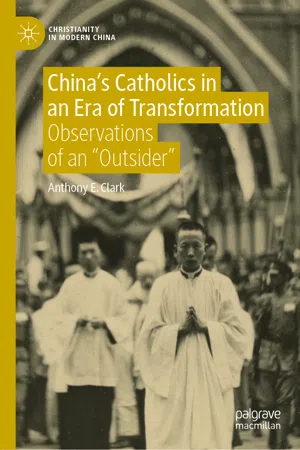
This book features a collection of essays on China's modern Catholic Church by a scholar of China-West intellectual and religious exchange. The essays and reflections were mostly written in China while the author was traveling by train, or staying in villages or large cities near to Roman Catholic cathedrals or other important historical sites during research trips to the country. It is clear that Clark's understanding of Catholicism in China evolved from the first entry to the final ones in 2019. The essays included in this compendium were written in disparate contexts and in response to different events. As such, there is no obvious theme or order to the content. However, despite this, the book provides valuable insights for readers wishing to gain a better understanding of the complex topography of Catholic history in China, the contours of which have undergone stark transformations with each dynastic, political, and ecclesial transition. The information presented serves to highlight and explain the lives of Catholic people and the events that have punctuated one of the most significant dimensions of China's long history of friendship, conflict and exchange with the West.
eBook - ePub
China’s Catholics in an Era of Transformation
Observations of an “Outsider”
- English
- ePUB (mobile friendly)
- Available on iOS & Android
eBook - ePub
About this book
Information
Topic
Theology & ReligionSubtopic
Chinese History© The Author(s) 2020
A. E. ClarkChina’s Catholics in an Era of TransformationChristianity in Modern Chinahttps://doi.org/10.1007/978-981-15-6182-5_11. Introduction
Anthony E. Clark1
(1)
Whitworth University, Spokane, WA, USA
Keywords
Catholicism in ChinaSinologyChina studiesChinese ChristiansMissionary historyWhen I landed in Beijing in the 1990s to study modern and classical Chinese at the Central University for Nationalities (Zhongyang minzu daxue), the streets were crowded with rusty black Flying Pidgeon bicycles, men in blue Mao jackets, and mule carts brimming with cabbage from nearby villages, hot peppers from Sichuan, and old newspapers. People were still discussing the Tian’anmen incident of 1989 in hushed tones and my dorm room was in a derelict building designed by the famous Chinese architect, Liang Sicheng (1901–1972). Motorcades of motorcycle police and black cars ushered Deng Xiaoping (1904–1997) through the main avenues surrounding the Forbidden City. Now in the twenty-first century, Mercedes and BMWs have replaced the bicycles and mule carts, Mao jackets are only seen in old films, the Liang Sicheng buildings at the Central University for Nationalities are replaced by towering, modern classrooms and administrative offices, and Deng Xiaoping is consigned to history books, described as the “father of China’s economic miracle.” China as it appears today would have been unimaginable to me when I arrived in Beijing for the first time. An industry of memoirs by academics, journalists, and former Maoists has burgeoned in recent decades; those who “were in China when …” have written much to describe the contours of China’s “vanished past.” One can easily find traditional histories of China’s former eras, but as the Victorian English novelist George Meredith (1828–1909) once wrote, “Memoirs are the backstairs of history.”1
The bookshelves near my desk contain a large number of memoirs, such as the delightful reminiscences of the eccentric American ex-patriot, George N. Kates (1895–1990), who lived in the previous wax storehouse near the Forbidden City where imperial eunuchs had managed the candles for the emperor’s palace. Kates occupied China’s capital while its imperial eon was issuing its last breath; I first occupied that city when the last vestiges of the “Long March cadres” were finishing their final years.
I have not penned here a memoir such as George Kates’ hallowed, The Years That Were Fat: The Last of Old China, or John J. Espey’s (1913–2000) recollections of an upbringing in a Presbyterian missionary household in a long-extinct Shanghai, Minor Heresies: Reminiscences of a Shanghai Childhood.2 This book consists, rather, of a number of essays—many were penned as research notes—written while traveling through China’s remote Catholic villages, meeting with bishops and clergy who are either quite elderly or have now passed to eternity. These writings were sometimes inspired after receiving news from a Chinese source regarding an extraordinary event related to the contemporary history of Catholicism in China as it passes again into a period quite unlike the previous era. Some of the following short compositions in this compilation of essays related to my research on Sino-mission history were drafted after conducting research in one of the many Roman Catholic archives I have inhabited while preparing manuscripts that later became published books, though some of these essays were later rewritten for publication in popular media venues such as the London-based Catholic Herald and Catholic World Report. For several years now, colleagues, students, and academic publishers have recommended that I compile these essays that span several decades of Catholic history in China into a single volume. With the support of several research assistants who have gathered and transcribed my essays—of various levels of scholarly and literary quality—such a collection is finally assembled into a single work.
The scholarly value of this collection of essays lies in the fact that so many of the places, events, and people discussed have either greatly changed under the weight of China’s economic and cultural transformation, or have disappeared altogether from neglect and old age. Among the people discussed in this collection are three bishops of Guiyang, two of whom have died and all of whom have lived through and witnessed sweeping upheavals in the modern history of China’s Catholic community. In 2008 I met with and interviewed the “underground” bishop, Hu Daguo (1921–2011), who had suffered persecution and an imprisonment during the Maoist era (1949–1976), the “aboveground” bishop Wang Chongyi (1919–2017), who had also been imprisoned, and the recently appointed bishop of Guiyang, Xiao Zejiang, who still serves as the state-sanctioned leader of the diocese. The mainstay of the historian’s craft is typically the institutional archive, but to confine one’s sources only to what is held in repositories is imprudently myopic; the memories of such ecclesiastics as Hu, Wang, and Xiao provide important information and insight into the historical landscape of China’s post-1949 Catholic Church. To cite one example: when I asked, Bishop Wang about the history of Roman Catholics who lived during the Cultural Revolution (1966–1976), he responded, “China has many, many martyr saints who died for Christ during the Maoist era, but they are now forgotten to the world because there are no records of their lives.” Given the growing interest in China’s post-1949 religious history, these essays serve to fill in some of the lacunae that only oral interviews can mend, even if the details recast in such interviews can sometimes be imperfect or interlarded with pious expressions uncommon in most scholarly studies.
Several interviews with Shanghai’s famous state-friendly bishop, Jin Luxian (1916–2013), especially a meeting I had with him in 2010, will be of interest to present and later generations of scholars who research and write about the religious history of Shanghai during the 1950s through the 1990s. Jin Luxian was a masterful interlocutor, perhaps due to his classical Jesuit training in Shanghai and Rome, and unlike Bishop Wang, who shortly before his passing told me that now is the time to recount the turbulent history of Catholic suffering during the Cultural Revolution, Bishop Jin admitted that while, “During the Cultural Revolution many, many holy men and women suffered and were killed, … [now] is not a prudent time to discuss these things.” Both men had been imprisoned for being Catholic “ideological saboteurs” during the Maoist era, but they had learned to navigate the murky waters of political survival in different ways; Wang was willing to talk of government persecution, and Jin was more content to discuss the “benefits of government collaboration.” But the following essays are more diverse than recounting discussions with important figures in the modern history of Catholicism in China; a number of essays represent my own musings over the legacy of earlier persons and events such as the Jesuit polymath, Matteo Ricci (1552–1610), the life of China’s great diplomat who became the first ethnically Chinese Benedictine abbot, Lu Zhengxiang (1871–1941), and the dramatic accounts of Catholic martyrdom, such as the 1900 massacre of Franciscans at Taiyuan and the 1947 massacre of Trappist monks at Yangjiaping.
While this book is not a memoir, it is nonetheless a collection of essays by a scholar of China’s intellectual and religious history, and I have made little effort to couch the essays in the “objective and distant prose” of pure scholarly analysis. Neither is this a monograph or typical edited volume, as my other works have been, largely because these essays were written in China while on trains, or staying in villages, or cities near to Roman Catholic cathedrals, or other important historical sites. The vicissitudes of human living accompanied me while these essays were prepared. During my visit with the three bishops of Guiyang I contracted H1N1, the swine flu, perhaps one of the most miserable times of my life. While the unvarying bustle of Guiyang traffic and its crowded sidewalks eddied outside my window, the hotel manager made regular visits to my room to make sure his “foreign guest” was still alive. Readers of academic studies rarely imagine the real lives of academics as they produced those studies; much happens on the “backstairs” when research and writing occur, to borrow again from the words of George Meredith. Memoirs were often nearby as I drafted these essays: Theophane Maguire’s Hunan Harvest, about his life as a Passionist missionary in Hunan; Joseph Henkel’s My China Memoirs (1928–1951), which outlines his experiences as an American priest in China during the Japanese invasion and civil war between the Nationalists and communists; and Nicholas Maestrini’s My Twenty Years with the Chinese, an Italian missionary who observed the turbulent events of mainland China mostly from the island of Hong Kong where he lived.3 Exposure to the diurnal recollections of Catholic missionaries who witnessed firsthand the uneasy transition of China’s imperial culture to its communist state tempered my impulses to record my own scholarly observations without the unavoidable human responses to what those memoirs reveal of the human condition during an era of severe change.
I have entitled this collection “Observations of an ‘Outsider’” because throughout my decades of visiting an...
Table of contents
- Cover
- Front Matter
- 1. Introduction
- 2. Getting Oriented, 2005–2010
- 3. Making Friends and Mourning Losses, 2011–2013
- 4. Bishops, Priests, and Echoes from the Pews, 2014–2019
- 5. Conclusion
- Back Matter
Trusted by 375,005 students
Access to over 1.5 million titles for a fair monthly price.
Study more efficiently using our study tools.
Frequently asked questions
Yes, you can cancel anytime from the Subscription tab in your account settings on the Perlego website. Your subscription will stay active until the end of your current billing period. Learn how to cancel your subscription
No, books cannot be downloaded as external files, such as PDFs, for use outside of Perlego. However, you can download books within the Perlego app for offline reading on mobile or tablet. Learn how to download books offline
Perlego offers two plans: Essential and Complete
- Essential is ideal for learners and professionals who enjoy exploring a wide range of subjects. Access the Essential Library with 800,000+ trusted titles and best-sellers across business, personal growth, and the humanities. Includes unlimited reading time and Standard Read Aloud voice.
- Complete: Perfect for advanced learners and researchers needing full, unrestricted access. Unlock 1.5M+ books across hundreds of subjects, including academic and specialized titles. The Complete Plan also includes advanced features like Premium Read Aloud and Research Assistant.
We are an online textbook subscription service, where you can get access to an entire online library for less than the price of a single book per month. With over 1.5 million books across 990+ topics, we’ve got you covered! Learn about our mission
Look out for the read-aloud symbol on your next book to see if you can listen to it. The read-aloud tool reads text aloud for you, highlighting the text as it is being read. You can pause it, speed it up and slow it down. Learn more about Read Aloud
Yes! You can use the Perlego app on both iOS and Android devices to read anytime, anywhere — even offline. Perfect for commutes or when you’re on the go.
Please note we cannot support devices running on iOS 13 and Android 7 or earlier. Learn more about using the app
Please note we cannot support devices running on iOS 13 and Android 7 or earlier. Learn more about using the app
Yes, you can access China’s Catholics in an Era of Transformation by Anthony E. Clark in PDF and/or ePUB format, as well as other popular books in Theology & Religion & Chinese History. We have over 1.5 million books available in our catalogue for you to explore.