eBook - ePub
Artistic Research in Performance through Collaboration
- English
- ePUB (mobile friendly)
- Available on iOS & Android
eBook - ePub
Artistic Research in Performance through Collaboration
About this book
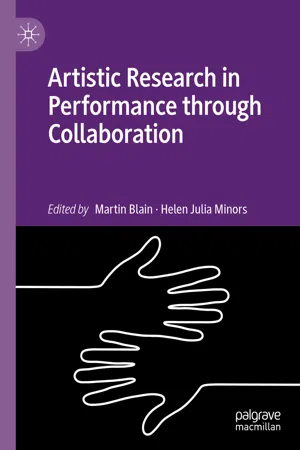
This volume explores the issue of collaboration: an issue at the centre of Performance Arts Research. It is explored here through the different practices in music, dance, drama, fine art, installation art, digital media or other performance arts. Collaborative processes are seen to develop as it occurs between academic researchers in the creative arts and professional practitioners in commercial organisations in the creative arts industries (and beyond), as well as focusing attention and understanding on the tacit/implicit dimensions of working across different media.
Information
Subtopic
Art GeneralPart ICritical Contexts
© The Author(s) 2020
M. Blain, H. J. Minors (eds.)Artistic Research in Performance through Collaborationhttps://doi.org/10.1007/978-3-030-38599-6_11. Introduction: Defining the Territory: Collaborative Processes, Issues and Concepts
Martin Blain1 and Helen Julia Minors2
(1)
Manchester Metropolitan University, Manchester, UK
(2)
Kingston University, London, UK
Keywords
CollaborationArtistic researchPerformanceDisseminationPartnershipEthicsIntroduction: Aims and Questions
Collaboration is an issue at the centre of Performance Arts Research for the collaborative arts practitioner-researcher, but its definition, application and recognition vary. It is understood differently in different practices. Collaborative processes may develop as it occurs between academic researchers in the creative arts and professional practitioners in commercial organisations in the creative arts industries (and beyond), or as it focuses attention and understanding on the tacit/implicit dimensions of working across different media. This edited collection draws on a wide range of creative arts which are all presented as performance (performed in the moment, live or through recorded media) and ensures to illustrate a wide range of definitions, which are combined in the ways in which we see collaboration as a bringing together of two or more artists, or two or more people (such as someone to commission the work, someone to produce the work, and someone to receive the work). This volume is unique in bringing together such a diverse range of disciplines spanning architecture, art and design, craft, dance, digital media, fine art, installation art, music and theatre. The combination of traditionally understood performance arts, as discussed in this volume (dance, music, theatre, digital media) with those understood as art works and artefacts existing in a less ephemeral manner (architecture, art and design, craft, fine art and installation art), brought to bear in the context of the act of performance is significant. It opens up new questions concerning collaboration which require investigation.
This book interrogates the processes of collaboration within Performance Arts Research with the arts understood in its broadest sense in order to encourage the debates surrounding arts practices to move beyond disciplinary boundaries and to develop a dialogue whereby practitioner-researchers1 can share their varied models of collaborative research practice. As such, this book aims to explore the diverse range of collaborative processes across the arts, with an emphasis not on the final product (such as the performance, the installation or the artefact) but on the politics and strategies of collaboration from the point of instigation, through the gestation of the work, to the critical reflection of the process. In so doing, it asserts that collaboration is always complex and challenging, and necessarily so. It affirms that collaboration is a bringing together of people, drawing on different skills, insights and perspectives in order to make something new which would not otherwise be possible. It challenges ideas of the lone practitioner-researcher as authority figure and presents contrasting models of why and how practitioners, in collaboration, gain something from analysing and disseminating their research findings.
Although each chapter raises its own issues, this book shares the following concerns:
- 1.What is collaboration for Performance Arts Practices? And, how do the differences in its definitions affect the resulting arts practice? Is collaboration reliant on a hierarchy or can there be an equal partnership between collaborators?
- 2.What models of collaborative research practice have been developed, and how do they help us critically assess the process? Do they also help us to reflect on and assess the final product? In Part One: Critical Contexts, we offer a critique of existing models of practice, and this is followed by a contextual framing of Artistic Research within a Higher Education context. This leads to the proposition of a new collaborative strategy for artistic researchers. This is followed, in Part Two: Collaborative Demonstrations in Practice, by a modelling of the processes and perspectives revealed in this collection via case studies. In this ground-breaking approach, we do not shy away from showing contradiction and rather seek to ask, why are there many models for collaboration and what do these different approaches tell us?
- 3.What ethical issues emerge during the making of collaborative work? For example, who owns the work? How is a collective authorship documented and acknowledged? When we discuss co-creation, and/or, collective production, what are we referring to which is different to collaboration, and does this somehow integrate the necessity for a particular ethical procedure? Moreover, beyond those creating the work, those assessing the work also need to be aware of the ethical processes and procedures for developing collaborative work. In producing collaborative Performance Arts Practice, we rely, work with and use people; people are a valuable resource, where their identity and insights must be respected. Who conducts the assessment of the collaborative Performance Arts Practice, and what is the criterion for that assessment? How do ethical concerns inform criteria? In asking these questions, this volume necessarily engages with the political, institutional context of the UK, incorporating UK Higher Education Institutions (HEIs), Independent Research Organisations (IROs) and National Portfolio Organisations (NPOs), and therefore, it also refers to Research Councils (RCs) and notably to the Arts and Humanities Research Council (AHRC).
- 4.What are the modes of dissemination? Or rather, how are the practice, research and practice as research outputs shared with a wider audience both within and beyond the academy? In order to ask these questions, we contextualise artistic research outputs and findings in relation to the three key concerns of HEIs within the UK, namely, REF (Research Excellence Framework), KEF (Knowledge Excellence Framework) and TEF (Teaching Excellent Framework).
Overview of the Book
This book is constructed from two parts. In Part One, Critical Contexts, we define, explore and theorise models of collaborative practice in the context of artistic research, as framed by an academic agenda towards wider dissemination and impact strategies. We challenge notions of collaboration in order to illustrate the social, cultural and political demonstrations of four key themes, which are later developed across the case studies. The four themes are understood as constituent elements of all creative collaborative processes and are explored in Chap. 2: The Place of Artistic Research in Higher Education. The four themes representing the place of Artistic Research in Higher Education are: Partnership, Ethics, Performance and Dissemination. Partnership concerns how artists (within both the academy and creative industries) exchange ideas and produce new works for mutual benefit. It sets out the research context, which supports and arguably privileges collaborative research and knowledge exchange, with reference to the strategies of UK funding bodies, institutional policies and necessarily to the UK’s Research Excellence Framework with which all research active HEIs engage. Ethics is explored here to q...
Table of contents
- Cover
- Front Matter
- Part I. Critical Contexts
- Part II. Collaborative Demonstrations in Practice
- Back Matter
Trusted by 375,005 students
Access to over 1.5 million titles for a fair monthly price.
Study more efficiently using our study tools.
Frequently asked questions
Yes, you can cancel anytime from the Subscription tab in your account settings on the Perlego website. Your subscription will stay active until the end of your current billing period. Learn how to cancel your subscription
No, books cannot be downloaded as external files, such as PDFs, for use outside of Perlego. However, you can download books within the Perlego app for offline reading on mobile or tablet. Learn how to download books offline
Perlego offers two plans: Essential and Complete
- Essential is ideal for learners and professionals who enjoy exploring a wide range of subjects. Access the Essential Library with 800,000+ trusted titles and best-sellers across business, personal growth, and the humanities. Includes unlimited reading time and Standard Read Aloud voice.
- Complete: Perfect for advanced learners and researchers needing full, unrestricted access. Unlock 1.5M+ books across hundreds of subjects, including academic and specialized titles. The Complete Plan also includes advanced features like Premium Read Aloud and Research Assistant.
We are an online textbook subscription service, where you can get access to an entire online library for less than the price of a single book per month. With over 1.5 million books across 990+ topics, we’ve got you covered! Learn about our mission
Look out for the read-aloud symbol on your next book to see if you can listen to it. The read-aloud tool reads text aloud for you, highlighting the text as it is being read. You can pause it, speed it up and slow it down. Learn more about Read Aloud
Yes! You can use the Perlego app on both iOS and Android devices to read anytime, anywhere — even offline. Perfect for commutes or when you’re on the go.
Please note we cannot support devices running on iOS 13 and Android 7 or earlier. Learn more about using the app
Please note we cannot support devices running on iOS 13 and Android 7 or earlier. Learn more about using the app
Yes, you can access Artistic Research in Performance through Collaboration by Martin Blain, Helen Julia Minors, Martin Blain,Helen Julia Minors in PDF and/or ePUB format, as well as other popular books in Media & Performing Arts & Art General. We have over 1.5 million books available in our catalogue for you to explore.