This book not only discloses and examines different functions and concepts of authorship in fiction and theory from the 1950s and 1960s to the present but it also reveals, at least implicitly, a trajectory of some of the modes and functions of the novel as a genre in the last few decades. It argues that the explicit terms of much of the theoretical and philosophical debate surrounding the concept of authorship in the moment of High Theory in the 1980s had already been engaged, albeit often more implicitly, in literary fictions by writers themselves. This book examines the fortunes of the authorship debate and the conceptualisations and functions of authorship before, during, and after the Death of the Author came to prominence as one of the key foci for the moment of High Theory in the 1980s.
- English
- ePUB (mobile friendly)
- Available on iOS & Android
eBook - ePub
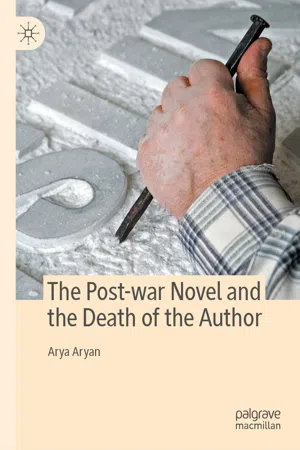
The Post-war Novel and the Death of the Author
About this book
Information
© The Author(s) 2020
A. AryanThe Post-war Novel and the Death of the Authorhttps://doi.org/10.1007/978-3-030-45054-0_11. The Rise of Theory and the Death of the Author
Arya Aryan1
(1)
Institute of English Language and Literatures, Eberhard Karls University of Tübingen, Tübingen, Germany
Introduction
When we consider that the war on totalities must be a war waged on the transcendental/impersonal subject through whose putative construction totalities emerge, it becomes clear that the great crises of postmodernism are crises of authorship even if they still disdain to announce themselves as such. (Burke 1995, xxix)
This book explores different functions and concepts of authorship in fiction and theory from the 1950s and 1960s to the present and reveals a historical trajectory of some of the modes and functions of the novel as a genre in the last few decades. Its main argument is that the explicit terms of much of the theoretical and philosophical debate around the concept of authorship in the moment of High Theory in the 1980s had already been engaged, although often more implicitly, in literary fictions by writers themselves. This book examines the concept of authorship and its debate before, during, and after the Death of the Author came to prominence in the moment of High Theory. It also argues that theory and practice are intertwined with some works already anticipating theorists of High Theory in their critiques of authorship and it therefore examines a selection of literary works which best represent the anticipation and interweaving. The primary sources covered in this book are Jorge Luis Borges’ “Partial Magic in the Quixote”, “The Garden of Forking Paths”, “The Library of Babel” and “Borges and I” (translated into English from 1948 to the early 1960s), Samuel Beckett’s The Unnamable (1953), Doris Lessing’s The Golden Notebook (1962), Vladimir Nabokov’s Pale Fire (1962), Sylvia Plath’s The Bell Jar (1963), John Fowles’ The French Lieutenant’s Woman (1969), Muriel Spark’s The Driver’s Seat (1970), Salman Rushdie’s Midnight’s Children (1981), J. M. Coetzee’s Elizabeth Costello (2003) and Hilary Mantel’s Beyond Black (2005). Therefore, in order to better grasp this trajectory of different modes and functions of authorship, it is necessary that we understand the key contributors of the Death of the Author debate that dominated Hight Theory in 1980s in philosophical and literary coteries.
It argues that there are writers who are precursors, carriers of and contenders against the Death of the Author debate. The selected writers can be categorised accordingly with Samuel Beckett, Jorge Luis Borges, John Fowles (whose writings predate the author debate of the late 1960s) as precursors, prefiguring in their novels the author debates that were soon to dominate literary theory; Sylvia Plath and Doris Lessing are precursors and carriers of the debate and at the same time early reaction against it while Lessing is also carrying some main concerns (influenced by her current Anti-psychiatry movement in the 1960s that considered mainstream psychiatric treatments such as electroconvulsive therapy and lobotomy dangerous, coercive and repressive) of the era; Muriel Spark reacts against the absence of female authorship in the critical debate and literature of authorship in the 1960s; Vladimir Nabokov too is a precursor of the debate while projecting the atmosphere of the ongoing paranoia of the Cold War era; Fowles indicates the novel in the age of Roland Barthes (under the influence of the Death of the Author debate) as a carrier of the debate; and finally Salman Rushdie, J. M. Coetzee and Hilary Mantel are contenders who reflect and react against the debate. The book also concerns the ways in which theory and practice are interlinked, rather than being totally separate spheres. The literary works in this book are selected to best represent and prefigure the dominant modes and concepts of authorship in discussion.
This book’s main purpose is to consider overlooked discussions around functions of authorship since the 1950s and therefore to leave sufficient scope for metamodernist (post-postmodernist) conceptions of authorship of the late twentieth and early twenty-first century which is highly unexplored. Therefore, fiction of the 1980s is intentionally excluded from the book for one reason that the selected works of the 1960s and 1970s here exemplify the type of fiction of High Theory era of the 1980s. For another, fiction of high postmodernism of the 1980s, well known to most readers, shows the same or similar preoccupations regarding conceptions of authorship. In other words, conceptions of authorship in fiction of high postmodernism fall in one of the categories of authorship-function pinpointed in this book. For example, Margaret Atwood’s The Handmaid’s Tale (1985) is not dissimilar to the selected works by female writers in this book in its preoccupation with women agency and authorship in a patriarchal society where the woman is reduced to a means of reproduction and denied authorship. Also, Alan Moore’s Watchmen (1986), similar to Pale Fire, speaks through the ongoing nuclear threat and mechanism of surveillance that generates paranoia in the Cold War era and takes as its focal point the function of authorship and storytelling as a repercussion of the centralisation of power as manifest in a “mad” journalist. Moreover, William Golding’s The Paper Men (1984) is preoccupied with the relation between an author and a critic at the time of High Theory when the author is paranoid about his ontological status and feels that the critic has taken way his identity and authorship.
In this chapter I argue that the 1960s, or more specifically 1967, could be regarded as the moment of the rise of the phrase “death of the author” which, as a critical concept, was associated predominantly with three key players—Roland Barthes, Jacques Derrida and Michel Foucault. These three key figures of the French intellectual scene challenged the foundation, as they saw it, on which modern intellectual Western history, at least since Descartes, had been built, including its assumptions concerning the subjective origins of the work of art in the mind of the artist or author. This Copernican revolution or the upsurge of “literary theory” as opposed to “literary criticism”, to use Patricia Waugh’s terminology in an introduction to Literary Theory and Criticism (2006), coincided with the moment which David Lodge has argued also saw the emergence of critics as creators, in his mapping of the historical relation between criticism and literature in “Literary Criticism and Literary Creation” (2002). In this essay, Lodge relates the historical moment of the emergence of the concept of the Death of the Author as coinciding with a moment where literary critics no longer see themselves as handmaids or explicators of the text, but instead had come to regard their relation to the text as one of a creative rewriting, a move that in effect meant positioning themselves as rivals of creative writers. It is the kind of writing that Vladimir Nabokov, for instance, is satirising in Pale Fire (1962), where the critic takes over, quite literally, in a bid to kill the author as literary creator or poet.
In contextualising the preoccupation in fiction of this period with questions around and challenges to the concept of authorship and creativity, understanding the historical direction and pressure of this critical moment in the rise of theory is of cardinal significance in recognising the specific conceptual frameworks of authorship provided by critics and theorists such as Barthes, Foucault and Derrida. Even before the critical debate emerged explicitly with questions of authorship at its centre, fictional writers had already begun to foreground a sense of threat to formerly secure conceptualisations grounded in liberal and Romantic concepts of subjectivity. This “revolution” in critical thinking engaged not only fundamental philosophical assumptions, but also equally crucial political questions around gender, ownership and identities that pointed towards what would become “postmodern ism.” The investigation of this theory revolution is also significant because it underscores the absence of gender issues in the theories of these key figures and makes the contemporary women writers’ preoccupation with madness as a gateway to authorship and agency very crucial.
Therefore, Chapter 2 concerns and explores questions of female authorship in the 1960s and argues that there was little specifically on female authorship as a problematic area until feminist debates of the 1970s. Yet writers as various as Doris Lessing, Sylvia Plath and Muriel Spark began to address such questions from the late 1950s and early 1960s onwards. It also contends that the 1960s theories of authorship are arguably still patriarchal in the sense that although they vehemently criticised authorship, none of them overtly addressed questions of gender and female authorship in spite of what concepts such as supplementarity and decentring would promise to shed light on the power relations that structure gender binaries. In other words, all ignored the existence of women as authors and women’s writing specifically as a critique of patriarchal conceptions of the author. I argue that almost coinciding with second-wave feminism, the Death of the Author debate was and has remained curiously male in orientation. It is hardly insignificant therefore that at precisely this historical moment, some women including Sylvia Plath, Muriel Spark and Doris Lessing set out to make their own voices heard and establish themselves as (female) authors. I also contend that these writers resort to hysteria and madness in their fiction to liberate it from its traditional, patriarchal association—biologically a “female disease”. They turn madness against itself and make it a gateway (thanks to its creative power) to agency and authorship and take the position of the Creator. The construction of female authorship and a female autonomous subject appears to be impossible without reworking madness.
In Chapter 3, I argue that Samuel Beckett and Vladimir Nabokov began to problematise the concept of authorship before the Death of the Author debate while John Fowles examined the question of what it is like to be an author in the age of Roland Barthes. The selected texts are an early manifestation of what later emerges as the post-structuralist critique of the humanist concept of the self and authorship. The book contends that in Beckett’s The Unnamable, the Unnamable’s voice-hearing experiences and attempts in writing them into fully fledged characters is to overcome the narrator’s existential insecurity in a universe that is constructed out of his own head and to dissipate the eeriness and uncanniness of the voice that is a consequence of unattributable and unlocatable features. I also argue that Fowles’ The French Lieutenant’s W...
Table of contents
- Cover
- Front Matter
- 1. The Rise of Theory and the Death of the Author
- 2. Women Writers, from Madness to Agency
- 3. Postmodernist Fiction, Madness and Agency
- 4. The Author in the Age of Risk Society
- 5. Conclusion
- Back Matter
Trusted by 375,005 students
Access to over 1.5 million titles for a fair monthly price.
Study more efficiently using our study tools.
Frequently asked questions
Yes, you can cancel anytime from the Subscription tab in your account settings on the Perlego website. Your subscription will stay active until the end of your current billing period. Learn how to cancel your subscription
No, books cannot be downloaded as external files, such as PDFs, for use outside of Perlego. However, you can download books within the Perlego app for offline reading on mobile or tablet. Learn how to download books offline
Perlego offers two plans: Essential and Complete
- Essential is ideal for learners and professionals who enjoy exploring a wide range of subjects. Access the Essential Library with 800,000+ trusted titles and best-sellers across business, personal growth, and the humanities. Includes unlimited reading time and Standard Read Aloud voice.
- Complete: Perfect for advanced learners and researchers needing full, unrestricted access. Unlock 1.5M+ books across hundreds of subjects, including academic and specialized titles. The Complete Plan also includes advanced features like Premium Read Aloud and Research Assistant.
We are an online textbook subscription service, where you can get access to an entire online library for less than the price of a single book per month. With over 1.5 million books across 990+ topics, we’ve got you covered! Learn about our mission
Look out for the read-aloud symbol on your next book to see if you can listen to it. The read-aloud tool reads text aloud for you, highlighting the text as it is being read. You can pause it, speed it up and slow it down. Learn more about Read Aloud
Yes! You can use the Perlego app on both iOS and Android devices to read anytime, anywhere — even offline. Perfect for commutes or when you’re on the go.
Please note we cannot support devices running on iOS 13 and Android 7 or earlier. Learn more about using the app
Please note we cannot support devices running on iOS 13 and Android 7 or earlier. Learn more about using the app
Yes, you can access The Post-war Novel and the Death of the Author by Arya Aryan in PDF and/or ePUB format, as well as other popular books in Literature & Literature General. We have over 1.5 million books available in our catalogue for you to explore.