This collection of essays explores the literary legacy of medieval England by examining the writers, editors and exemplars of medieval English texts. In order to better understand the human agency, creativity and forms of sanctity of medieval England, these essays investigate both the production of medieval texts and the people whose hands and minds created, altered and/or published them. The chapters consider the writings of major authors such as Chaucer, Gower and Wyclif in relation to texts, authors and ideals less well-known today, and in light of the translation and interpretive reproduction of the Bible in Middle English. The essays make some texts available for the first time in print, and examine the roles of historical scholars in the construction of medieval English literature and textual cultures. By doing so, this collection investigates what it means to recover, study and represent some of the key medieval English texts that continue to influence us today.
- English
- ePUB (mobile friendly)
- Available on iOS & Android
eBook - ePub
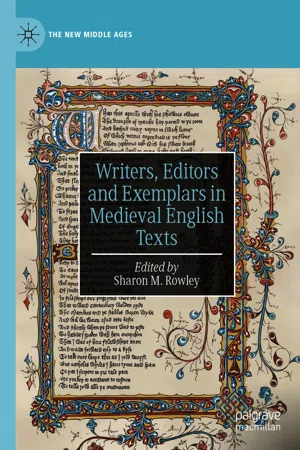
Writers, Editors and Exemplars in Medieval English Texts
About this book
Information
© The Author(s) 2021
S. M. Rowley (ed.)Writers, Editors and Exemplars in Medieval English TextsThe New Middle Ageshttps://doi.org/10.1007/978-3-030-55724-9_11. Introduction
Sharon M. Rowley1
(1)
Department of English, Christopher Newport University, Newport News, VA, USA
Keywords
Medieval manuscriptsTextual productionJohn WyclifChristina von NolckenScribeEditorExemplarIn her “Afterword” to The Medieval Manuscript Book, Kathryn Kerby-Fulton suggests that “[t]he Middle Ages may be over, but our work to understand its literary legacy has just begun” (2015, 244). Pointing out that “[i]n manuscript culture … authority, authenticity, textual stability, [and] posterity were sites of conflict — and also opportunity,” Kerby-Fulton highlights some key ways in which the study of medieval texts and literature has been changing (2015, 252). Over the last few decades, studies of medieval manuscript books as objects and processes, along with examinations of textual performance(s), and increasing awareness of the roles of scribes as active agents of composition and compilation have changed modern scholarly conceptions of medieval texts and textuality, thereby also changing our understanding of medieval literature and culture (for example, see Nichols and Wenzel 1996; Johnston and Van Dussen 2015; Mooney and Stubbs 2013). Professor Christina von Nolcken’s studies of medieval English texts, especially her work on Wycliffite textuality, its ideological underpinnings, transmission and editorial history, have contributed significantly to the work of understanding the contested sites and opportunities that form the literary legacy of the Middle Ages.
Starting in 1979, von Nolcken’s earlier publications, such as The Middle English Translation of the Rosarium Theologie: A Selection Edited from Cambridge Gonville and Caius MS 354/581 and “An Unremarked Group of Wycliffite Sermons in Latin,” made several Wycliffite texts available for the first time in a modern edition and sought to “allow” the lollards “fully to speak for themselves” (von Nolcken 1986, 233).1 Von Nolcken also endeavored to better understand John Wyclif and the reception of his thoughts in their cultural contexts, as demonstrated in her influential essay, “Another Kind of Saint: A Lollard Perception of John Wyclif.” According to von Nolcken, “our predecessors … had a Wyclif coated with many layers of varnish,” and that even in 1987 we still knew “more about the varnish than we [did] about the man” (von Nolcken 1987, 429). Despite the fact that scholars such as Anne Hudson had begun historicizing Wyclif, von Nolcken found that others still remained uncertain about what they saw. Her response, to clarify that uncertainty, helped to revitalize the study of Wyclif and the lollards. Through her careful examination of the “bottom layers of varnish, the ones that [told] us about Wyclif’s medieval English followers,” von Nolcken has helped to improve our understanding of Wycliffite discourse and textual culture, as well as to discover their impact on lay literacy and on major writers like Chaucer and Langland (von Nolcken 1987, 429; cf. von Nolcken 1998, 2009). From her early work on Wyclif to her current intellectual biography of John Manly and Edith Rickert, von Nolcken has explored the social contexts of literacy, interrogated how notions of sanctity have changed over time, and investigated how, when, and by whom books or texts were made available to readers or audiences.
The chapters collected here honor von Nolcken’s scholarship and teaching by exploring writers, editors and exemplars of medieval English texts; the collection also contributes to the project of understanding the literary legacy of the Middle Ages by paying close attention to cultural perspectives, textual production, the material book and memorialization. While models of sanctity, gender roles and textual cultures change over time, the study of the activities of any given scribe, redactor or editor in the production and dissemination of texts has tended to be separated from scholarly discussions of the literary and cultural effects of those texts. Rather than treating the production of both devotional and non-devotional texts—such as the Wycliffite Bible or The Canterbury Tales —separately from their reception and interpretation, the chapters in this collection recover and explore the activities and lives of writers and editors, combined with discussions of the social, theological, and cultural shifts and tensions that fostered literary and textual re-production, mediation, and editorial re-presentation. We explore what Jerome McGann calls the “complex network” of individuals, groups and institutions, as well as the “exchanges and investments both in and between the past and the present” that contribute to the production and meaning of medieval English texts (McGann 1985, viii–ix).
We have chosen the term “writers” to describe a key node in this complex network in order to blur distinctions between authors and scribes. As many of the chapters collected here illustrate, medieval English scribes acted not only as scriveners, but also as redactors, translators, and authors. They sometimes added commentaries and prefaces, framing and mediating the texts they were copying; some also selected, corrected, and compiled texts. In such cases, the scribes also acted as “editors”—another node in our network. Increased awareness of the complexity and significance of these blended activities has blurred the lines of authority, troubled questions of authenticity, and highlighted questions concerning textual stability over the last few decades. All of this, in turn, alters the task(s) of the modern editor seeking to bring medieval texts to modern audiences, whether digitally or in print. Beyond the long-standing optimist/recensionist debate and questions of common errors or variation (Boyle 1976), the creative adaptation of the text being copied transforms the concept of the “exemplar,” the third node in our network, into a contested site, through which we can glimpse McGann’s “exchanges and investments … in and between the past and the present” in action (McGann 1985, viii).
The first recorded use of the word “exemplar,” to mean “an individual copy of a text (esp. in manuscript); specifically one from which a new copy, version, or translation is or may be made,” dates to the 1382 Wycliffite Bible —the compiling, editing, and variations of which are key themes in Part II of this collection. More popularly, the term refers to “a person’s conduct, [or] practice … regarded as an object of imitation or an influence on the behaviour of others” (“exemplar, n.” OED Online). Arguably, one of the many reasons that “authority, authenticity, [and] textual stability” (Kerby-Fulton 2015, 244) matter to readers and scholars of medieval English texts is because biblical and literary exempla also provide or reflect models of behavior, whether positive or negative, that influence human performances of identity, whether saintly, gendered, or heroic (among others). Medieval English writers were profoundly aware of both the didactic function of literature and the “treachery” of transcription (Cerquiglini 1999, 4), along with the ambivalences and ideologies inherently embedded in exemplars. Rather famously, “Lenvoy de Chaucer” [Chaucer’s Envoy], at the end of The Clerk’s Tale , explicitly tells his audience not to imitate either Walter or Griselda (IV 1177–88).2 And at the end of Troilus and Criseyde , Chaucer prays: “that non myswrite the” [that none miswrite you (i.e. his poem)] (Book V 1795, trans. Irvin).
The chapters collected here engage and explore such questions and problems surrounding writers, editors and exemplars. Turning to the individual contributions, Part I, “Middle English Clerks, Books and Women,” begins with Susanna Fein’s “Reading Dreams, Casting the Future and Other Learned Mirths: The Harley Scribe as Proto-Chaucerian Clerk.” Fein’s study of the trilingual Harley scribe initiates many of the themes in this collection, from language, interpretation and writing, to biblical wisdom, sanctity, Old English saints’ lives (as remembered in Middle English), and exemplars—both textual and ideal. More specifically, Fein examines the record of the Harley scribe, including French and English texts he may have authored himself, to present a fuller picture of the man, his library and his interest in the arcane. Looking at the compilation of three specific manuscripts, Fein argues that the Harley scribe enacts an agency that is more than scribal. She also provides insight into the multiple interests of Chaucer’s clerks, both learned and comic, as well as into the complex internal dialectic of The Canterbury Tales project as a compilation. According to Fein, The Canterbury Tales come:
Such “recurring plot patterns” and “remodeled generic expectations” resonate with Ann W. Astell’s “Griselda as Mary: Chaucer’s Clerk’s Tale and Alanus de Rupe’s Marian Exemplum,” which reexamines Chaucer’s Griselda as “a failed Pietà.” Astell reexamines Griselda in light of an exemplum she has identified as Alanus de Rupe’s Griselda analogue. A transcription of the German text is published here for the first time by Anne Winston-Allen, who also provides an introduction and translation. Together, Astell and Winston-Allen’s essays, transcription and translation allow readers to see more clearly the scope, depth and complexity of the Griselda tales, along with the debates concerning her character as an exemplar circulating in the fourteenth and fifteenth centuries.in diverse parts that, taken together, project an internal dialectic and dynamic of extraordinary philosophic and psychological depth. Chaucer creates this world by means of remodeled generic expectations, recurring plot patterns, and subtle refocusings of linguistic terms—all features familiar to Chaucerians. (see below, 27)
Jenny Adams continues our clerical focus and exploration of Griselda with her essay “Chaucer’s Clerk(s) and the Value of Learning.” By looking at the way books were used as collateral by fourteenth-century scholars, Adams exposes the economic conditions that motivate Chaucer’s Clerk. She raises questions not only about the Clerk’s self-denial and devotion to learning, but also (potentially) our own. Combining a historical study of the value and use of books and medieval loan chests with a close analysis of the Clerk’s economic status (by referring to Avarice in Piers Plowman ), Adams calls attention to the ambivalences surrounding both the Clerk and Griselda as exemplars of scholarly devotion and female piety; she puts the characters into di...
Table of contents
- Cover
- Front Matter
- 1. Introduction
- Part I. Middle English Clerks, Texts and Readers
- Part II. The Lollards, Their Saints and Their Texts
- Part III. Old English and Its Afterlife
- Back Matter
Trusted by 375,005 students
Access to over 1.5 million titles for a fair monthly price.
Study more efficiently using our study tools.
Frequently asked questions
Yes, you can cancel anytime from the Subscription tab in your account settings on the Perlego website. Your subscription will stay active until the end of your current billing period. Learn how to cancel your subscription
No, books cannot be downloaded as external files, such as PDFs, for use outside of Perlego. However, you can download books within the Perlego app for offline reading on mobile or tablet. Learn how to download books offline
Perlego offers two plans: Essential and Complete
- Essential is ideal for learners and professionals who enjoy exploring a wide range of subjects. Access the Essential Library with 800,000+ trusted titles and best-sellers across business, personal growth, and the humanities. Includes unlimited reading time and Standard Read Aloud voice.
- Complete: Perfect for advanced learners and researchers needing full, unrestricted access. Unlock 1.5M+ books across hundreds of subjects, including academic and specialized titles. The Complete Plan also includes advanced features like Premium Read Aloud and Research Assistant.
We are an online textbook subscription service, where you can get access to an entire online library for less than the price of a single book per month. With over 1.5 million books across 990+ topics, we’ve got you covered! Learn about our mission
Look out for the read-aloud symbol on your next book to see if you can listen to it. The read-aloud tool reads text aloud for you, highlighting the text as it is being read. You can pause it, speed it up and slow it down. Learn more about Read Aloud
Yes! You can use the Perlego app on both iOS and Android devices to read anytime, anywhere — even offline. Perfect for commutes or when you’re on the go.
Please note we cannot support devices running on iOS 13 and Android 7 or earlier. Learn more about using the app
Please note we cannot support devices running on iOS 13 and Android 7 or earlier. Learn more about using the app
Yes, you can access Writers, Editors and Exemplars in Medieval English Texts by Sharon M. Rowley in PDF and/or ePUB format, as well as other popular books in Literature & European Medieval History. We have over 1.5 million books available in our catalogue for you to explore.