Peace and War: Historical, Philosophical, and Anthropological Perspectives is an accessible, higher-level critical discussion of philosophical commentaries on the nature of peace and war. It introduces and analyses various philosophies of peace and war, and their continuing theoretical and practical relevance for peace studies and conflict resolution. Using a combination of both historical and contemporary philosophical perspectives, the book is at once eclectic in its approach and broad in its inquiry of these enduring phenomena of human existence.
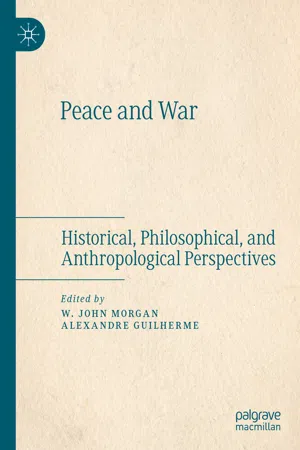
eBook - ePub
Peace and War
Historical, Philosophical, and Anthropological Perspectives
- English
- ePUB (mobile friendly)
- Available on iOS & Android
eBook - ePub
Peace and War
Historical, Philosophical, and Anthropological Perspectives
About this book
Information
Topic
PhilosophySubtopic
Ethics & Moral Philosophy© The Author(s) 2020
W. J. Morgan, A. Guilherme (eds.)Peace and Warhttps://doi.org/10.1007/978-3-030-48671-6_11. Introduction
W. John Morgan1 and Alexandre Guilherme2
(1)
Cardiff University, Cardiff, Wales, UK
(2)
Pontificia Universiade Católica do Rio Grande do Sul, Porto Alegre, Brazil
An earlier version appeared in Peace Review, Vol. 26, Issue 3, pp. 313–316.
End AbstractPhilosophy has a special relationship with other disciplines and not least with history and with anthropology, because of the many ways they connect over subject matter. By this we do not mean simply that philosophical methodology and theories are used by other disciplines; we mean also that when others consider problems of specific interest to their field fresh philosophical issues begin to emerge. Philosophers have, of course, written on peace and war historically. One of the most important examples is Immanuel Kant’s Perpetual Peace: A Philosophical Sketch (1795/1917: 134–135), an early manifesto for the idea of federalism with the fundamental aim of establishing peace in Europe. As Kant says:
The practicability or objective reality of this idea of federation which is to extend gradually over all states and so lead to perpetual peace can be shewn. For, if Fortune ordains that a powerful and enlightened people should form a republic—which by its very nature is inclined to perpetual peace—this would serve as a centre of federal union for other states wishing to join, and thus secure conditions of freedom among the states in accordance with the idea of the law of nations. Gradually, through different unions of this kind, the federation would extend further and further.
The essay was written as France and Prussia signed the Peace of Basel, establishing French sovereignty over the West Bank of the Rhine, but allowing Prussia, Russia and Austria to divide Poland. Kant’s motivation was indignation at what he saw as the absurdity of state foreign policy with its pursuit of peace using inadequate, selfish and (often) deceptive means. Kant set out six principles and three articles for a programme of perpetual peace among sovereign states, which resemble the foundational principles of the pioneers of European unity after the Second World War.
The six principles are:
- 1.No treaty of peace shall be held valid in which there is tacitly reserved matter for a future war.
- 2.No independent states, large or small, shall come under the dominion of another state by inheritance, exchange, purchase or donation.
- 3.Standing armies (miles perpetuus) shall in time be totally abolished.
- 4.National debts shall not be contracted with a view to the external friction of states.
- 5.No state shall by force interfere with the constitution or government of another state.
- 6.No state shall, during war, permit such acts of hostility which would make mutual confidence in the subsequent peace impossible such as the employment of assassins (percussores), poisoners (venefici), breach of capitulation and incitement to treason (perduellio) in the opposing state.
The three fundamental articles are:
- 1.The civil constitution of every state should be republican.
- 2.The law of nations shall be founded on a federation of free states.
- 3.The law of world citizenship shall be limited to conditions of universal hospitality.
The crux is that no “sovereign” state, whether large or small, should come under the dominion of another state and that national armies should be abolished. The fundamental articles are concerned with relations among individuals, founded on republicanism, on a federation of free states and on a humanity derived from the virtue of universal hospitality. Others, such as Thomas Hobbes, developed philosophies of war and confrontation. In Leviathan (1651/2009), written towards the end of the English Civil War, Hobbes takes the dreadful power of the sea-monster as a metaphor for the absolute power of the state (the title being a reference from The Book of Job, verse 41). He argues that:
Hereby it is manifest, that during the time men live without a common Power to keep them all in awe, they are in that condition which is called Warre; and such a warre, as is of every man, against every man. For, warre, consisteth not in Battell onely, or the act of fighting; but in a tract of time, wherein the Will to contend by Battell is sufficiently known and therefore the notion of time, is to be considered in the nature of Warre; … So the nature of War, consisteth not in actual fighting; but in the known disposition thereto, during all the time there is no assurance to the contrary. All other time is Peace. (Hobbes 1651/2009: 70)
Hobbes believed that humankind is naturally in a constant state of conflict which led him to advocate strong government, specifically absolutist monarchy, to keep this “natural state of war” in bounds. Hobbes’ Leviathan is in complete contrast with the republicanism and pacifism of Kant’s Perpetual Peace.
Philosophy may be a forum for other disciplines, a place where they find a unifying language for discussion of common problems. Arguably, this applies across all disciplines, from the arts and humanities to the hard sciences and, not least, to what concerns us here: the study of peace and war. It provides also an opportunity to use interdisciplinary approaches and to revisit neglected contributions. This is what is attempted in the present book from historical, philosophical, and anthropological perspectives.
There are, of course, outstanding contemporary scholars of peace, war and other conflict studies, such as Gene Sharp (2011) among others, and feminine scholars, such as Christine Sylvester (2013), again among others, as noted by Catia Cecilia Confortini in a comprehensive review article (Confortini 2020). Confortini argues that, by regarding all forms of violence as a continuum, feminists change the understanding of the concept of peace studies, and this makes women visible in both peace and conflict. This book does not seek to engage with such well-known work in any specific way. Instead, it presents a deliberately eclectic set of relatively neglected historical, philosophical, and anthropological perspectives on peace and war, explaining these profound aspects of the human condition.
We hope it will encourage readers to re-discover or to engage for the first time with important examples of the study of peace and war. We believe this is both important and timely, the book’s aim being to contribute to peace and conflict studies in an interdisciplinary way and to show it as a global field of study. It provides fresh historical, philosophical, anthropological and indeed educational approaches to peace and war that contribute to a nuanced understanding of the fundamental issues. It is this that gives the book its coherence and determines the logic by which the chapters are presented. The individual contributions shed light on important but often underserved theorists, and this provides the book with a common purpose and approach which is sensitive to different contexts.
Given the terrible impact of war on humanity and the seeming impossibility of establishing a perpetual peace among the nations, the guidance of scholarly reflection is fundamentally important if we are to make progress in achieving it. It was in such hope that Johan Galtung, a Norwegian, established the Peace Research Institute in Oslo in 1959. Galtung’s pioneering theoretical contributions include contrasting definitions of negative (such as the absence of violent conflict) and positive peace (such as that founded on collaborative relationships), as well as his “win-win” approach to peace mediation (in which both sides feel that they have “won”).
However, others, such as Julien Freund, the French sociologist who established the Institute of Polemology (Greek polemos = “war”) at Strasbourg in 1970, have focused directly on war studies (see Chap. 6 in this volume). From this perspective comes the idea of a “just war”. Michael Walzer in his seminal Just and Unjust Wars: A Moral Argument with Historical Illustrations (2015) affirms this. Considering perspectives such as those of Carl von Clausewitz’s On War (cf. von Clausewitz 1832/1984), Walzer says:
On the conventional military view, the only true aim in war is ‘the destruction of the enemy’s main forces on the battlefield’. Clausewitz speaks of ‘the overthrow of the enemy’. But many wars end without any such dramatic ending, and many war aims can be achieved well short of destruction and overthrow. We need to seek the legitimate ends of war, the goals that can rightly be aimed at. These will also be the limits of a just war. Once they are won, or once they are within political reach, the fighting should stop. Soldiers killed beyond that point die needlessly, and to force them to fight and possibly die is a crime akin to that of aggression itself. It is commonly said of just war theory, however, that it does not in fact draw this line at any point short of destruction and overthrow, that the most extreme military argument and the ‘moralist’ argument coincide in requiring that war be fought to its ultimate end. (Walzer 2015: 110)
The continuing relevance of history, philosophy, and anthropology to the study of peace and war is explained further by Leonardo Boff, a well-known Brazilian theologian and a founder of liberation theology. In Fundamentalism, Terrorism and the Future of Humanity (2006: 61) Boff argued that:
The prevalent global culture is presently structured around the desire for power. This is a desire that is fulfilled through the domination of nature, of the other, of people and of markets. This is a rationale of dinosaurs; it is a rationale that creates a culture of fear and of war. Of the 3400 years of human history that we can document, 3166 years have been of wars. The remaining 234 years were certainly not years of peace; they were years of preparation for war.
We turn now to the chapters of the present book:
Chapter 2, “Bartolomé de Las Casas’ Critique of War and Vision of Peace”, by David Thomas Orique, discusses a Dominican friar’s opposition to wars of co...
Table of contents
- Cover
- Front Matter
- 1. Introduction
- 2. Bartolomé de las Casas’ Critique of War and Vision of Peace
- 3. The Heart of the Daodejing: Nonviolent Personhood
- 4. The Augustinian Legacy of Divine Peace and Earthly War
- 5. Pacifism or Bourgeois Pacifism? Huxley, Orwell, and Caudwell
- 6. Julien Freund on War and Peace: Mitigated Realism
- 7. Revolutionary War and Peace
- 8. Catastrophe and Conversion: Culture, Conflict, and Violence in the Hermeneutics of René Girard
- 9. Learning for Peace: The Montessori Way
- 10. Peace and Violence in Poor Rural Schools in Post-Apartheid South Africa
- Back Matter
Trusted by 375,005 students
Access to over 1.5 million titles for a fair monthly price.
Study more efficiently using our study tools.
Frequently asked questions
Yes, you can cancel anytime from the Subscription tab in your account settings on the Perlego website. Your subscription will stay active until the end of your current billing period. Learn how to cancel your subscription
No, books cannot be downloaded as external files, such as PDFs, for use outside of Perlego. However, you can download books within the Perlego app for offline reading on mobile or tablet. Learn how to download books offline
Perlego offers two plans: Essential and Complete
- Essential is ideal for learners and professionals who enjoy exploring a wide range of subjects. Access the Essential Library with 800,000+ trusted titles and best-sellers across business, personal growth, and the humanities. Includes unlimited reading time and Standard Read Aloud voice.
- Complete: Perfect for advanced learners and researchers needing full, unrestricted access. Unlock 1.5M+ books across hundreds of subjects, including academic and specialized titles. The Complete Plan also includes advanced features like Premium Read Aloud and Research Assistant.
We are an online textbook subscription service, where you can get access to an entire online library for less than the price of a single book per month. With over 1.5 million books across 990+ topics, we’ve got you covered! Learn about our mission
Look out for the read-aloud symbol on your next book to see if you can listen to it. The read-aloud tool reads text aloud for you, highlighting the text as it is being read. You can pause it, speed it up and slow it down. Learn more about Read Aloud
Yes! You can use the Perlego app on both iOS and Android devices to read anytime, anywhere — even offline. Perfect for commutes or when you’re on the go.
Please note we cannot support devices running on iOS 13 and Android 7 or earlier. Learn more about using the app
Please note we cannot support devices running on iOS 13 and Android 7 or earlier. Learn more about using the app
Yes, you can access Peace and War by W. John Morgan, Alexandre Guilherme, W. John Morgan,Alexandre Guilherme in PDF and/or ePUB format, as well as other popular books in Philosophy & Ethics & Moral Philosophy. We have over 1.5 million books available in our catalogue for you to explore.