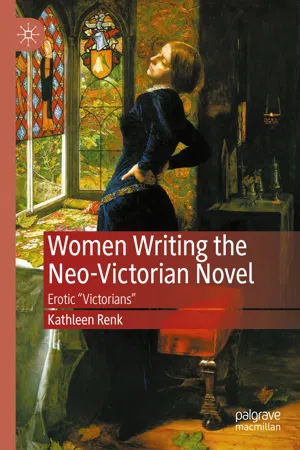
Women Writing the Neo-Victorian Novel: Erotic "Victorians" focuses on the work of British, Irish, and Commonwealth women writers such as A.S. Byatt, Emma Donoghue, Sarah Waters, Helen Humphreys, Margaret Atwood, and Ahdaf Soueif, among others, and their attempts to re-envision the erotic. Kathleen Renk argues that women writers of the neo-Victorian novel are far more philosophical in their approach to representing the erotic than male writers and draw more heavily on Victorian conventions that would proscribe the graphic depiction of sexual acts, thus leaving more to the reader's imagination. This book addresses the following questions: Why are women writers drawn to the neo-Victorian genre and what does this reveal about the state of contemporary feminism? How do classical and contemporary forms of the erotic play into the ways in which women writers address the Victorian "woman question"? How exactly is the erotic used to underscore women's creative potential?
- English
- ePUB (mobile friendly)
- Available on iOS & Android
eBook - ePub
About this book
Information
Topic
LetteraturaSubtopic
Critica letteraria europea© The Author(s) 2020
K. RenkWomen Writing the Neo-Victorian Novelhttps://doi.org/10.1007/978-3-030-48287-9_11. Introduction: “Erotic ‘Victorians’: Women, Neo-Victorian Fiction, and Creative Eros”
Kathleen Renk1
(1)
Northern Illinois University, DeKalb, IL, USA
Kathleen Renk
In the conclusion of Sarah Waters’s neo-Victorian novel Fingersmith , Maud, a young woman exploited by her uncle to transcribe Victorian pornography, announces to her love Sue her plan to write erotic fiction in her own way, suggesting that a Victorian woman might recreate and redefine the erotic. Intriguingly, in his The Other Victorians: A Study of Sexuality and Pornography in Mid-Nineteenth Century England, Steven Marcus suggests that, in contrast to Victorian male writers of pornography, women who wrote erotic literature did so differently. Instead of writing about male genital organs conquering supine females, these women writers wrote about relationships, “emotions…, contemplation, [and] conscious reverie” (281). While it seems unlikely that such a writerly act like Maud’s would frequently occur in the Victorian era, I find that contemporary women writers of the neo-Victorian novel, like these female Victorian counterparts, do redefine the erotic but in a distinctive way.1 In their re-envisioning of the Victorian novel, these women writers draw on various conceptions of the erotic from classical to contemporary, but, in addition, they gravitate toward the way Audre Lorde defines the erotic as “the lifeforce of women, [it is] creative energy empowered” (Lorde 55).
Lorde argues that:
This definition, which distinguishes the erotic from pornography, speaks not only to the exercise of sensuality but also to an attempt to empower women to awaken their creative potential and to realize themselves as full and complete human beings.[t]he erotic has often been misnamed by men and used against women. It has been made into the confused, the trivial, the psychotic, and plasticized sensation. For this reason, we have turned away from the exploration and consideration of the erotic as a source of power and information, confusing it with the pornographic. (55)
This interdisciplinary study focuses on the work of contemporary British, Irish, and Commonwealth women writers, such as A.S. Byatt, Emma Donoghue, Sarah Waters, Helen Humphreys, Margaret Atwood, and Ahdaf Soueif, among others, and their attempts to re-envision the erotic in neo-Victorian fiction. As we will see, in the classical sense, eros is defined as “destructive and acquisitive,” the desire and “will to possess” the beautiful (Soble xiii, Plato 43). I argue that women writing neo-Victorian fiction included in this study utilize classical concepts of eros but also highlight Lorde’s notion of creative eros. These writers invent female characters who demonstrate a “will to possess” themselves and thereby embolden and energize themselves as artists, writers, rogues/gender outlaws, spiritualists, and travelers/adventurers.2 As such, they defy what A.S. Byatt terms the “willed oblivion” of women in fiction (Byatt 1994, 120). They possess sexual and creative subjectivity.3 These female characters also embody the efforts of early feminists, not those who organized collectively, but those who individually defied social expectations, resisted patriarchy, and “self-authorized” in order to create “authentic selves” (Lerner 47). In doing so, these women writers pick up where Victorian women writers left off, as they ask and reformulate answers to the Victorian “Woman Question.”
Numerous scholarly studies have analyzed the phenomenon of neo-Victorian fiction, including such works as Louisa Hadley’s Neo-Victorian Fiction and Historical Narrative: The Victorians and Us (New York: Palgrave Macmillan, 2010), Simon Joyce’s The Victorians in the Rearview Mirror (Athens: Ohio Univ. Press, 2007), Cora Kaplan’s Victoriana. Histories, Fictions, Criticism (New York: Columbia Univ. Press, 2007), Kate Mitchell’s History and Cultural Memory in neo-Victorian Fiction: Victorian Afterimages (Basingstoke, England: Palgrave Macmillan, 2010), John Kucich and Dianne Sadoff’s edited collection, Victorian Afterlife: Postmodern Culture Rewrites the Nineteenth Century (Minneapolis: Univ. Minnesota Press, 2000), and Ann Heilmann and Mark Llewellyn’s Neo-Victorianism: The Victorians in the Twenty-First Century, 1999–2009 (New York: Palgrave Macmillan, 2010). In general, these studies have focused on narratology, the relationship between our era and the Victorian era, theories in regard to why the Victorian era is of interest to contemporary writers, and the ways in which the Victorian era is imagined.
Clearly, based on the high-level of scholarly interest, the neo-Victorian novel has obviously fascinated readers and scholars ever since the first neo-Victorian novels were written as either prequels to Victorian fiction, such as Jean Rhys’s Wide Sargasso Sea (1966), or postmodern renditions of the Victorian novel, such as John Fowles’s The French Lieutenant’s Woman (1969). Since the late 1960s and especially in the 1980s and 1990s, the neo-Victorian novel proliferated as writers sought to re-create/reform and or “replicate” the Victorian era.4 Various theories abound in regard to the neo-Victorian phenomenon, including regressive theories based on Margaret Thatcher’s ahistorical nostalgia for a supposed ideal Victorian past (Hadley 2010, 10), but also progressive ideas based on the ways in which the neo-Victorian novel often “challenges or critiques official historiographies [of the Victorian era]” (Mitchell 2010, 6). Often, these critiques present the reader with “different” versions of the Victorian world by “represent[ing] marginalized voices, new histories of sexuality, [and] post-colonial viewpoints” (Heilmann and Llewellyn 165). As such, according to Mark Llewellyn, the neo-Victorian novel contains a “democratizing impulse” (167). Kate Mitchell agrees in noting that the neo-Victorian novel “moved away from high culture and included features previously invisible or excluded: women, the working and criminal classes and non-Europeans” (2010, 165).5 Overall, neo-Victorian novels connect with the Victorian era by “self-consciously engag[ing] with” the Victorian era through a deliberate “act of (re)interpretation, (re)discovery, and (re)vision” (Heilmann and Llewellyn 4).
This engagement with the Victorian as an act of re-vision often takes the form of addressing the ways in which gender and sexuality are constructed in the Victorian era.6 And while Jeannette King in The Victorian Woman Question in Contemporary Feminist Fiction asks “[w]hy, in the last decades of the twentieth century, should so many women novelists have looked back a hundred years for the subject of their fiction? What is the interest of Victorian constructions of gender and sexuality for modern feminists?” (1), no study of the neo-Victorian novel has specifically focused on women writers nor on the ways in which the erotic is conceived in women’s neo-Victorian fiction, and how this re-conception relates to the interests of contemporary feminism.
As such, this book addresses the following questions: Why are women writers drawn to the neo-Victorian genre and what does this reveal about the state of contemporary feminism? As readers, are we attracted to this fiction merely because of our so-called prurient interests and our own era’s pre-occupation with sexuality and sexual liberation? How do classical and contemporary forms of the erotic play into the ways in which women writers address and answer the Victorian “woman question”? How exactly is the erotic used to underscore women’s creative potential? How and to what extent do these women writers write back/“talk back”7 to their Victorian counterparts, such as Charlotte Brontë, George Eliot, and Elizabeth Barrett Browning? How do these women writers conceive “new worlds of habitation” (a term used by Annis Pratt) for Victorian women where the creative erotic can be expressed?
Before considering how neo-Victorian women writers approach the novel and utilize classical and contemporary forms of eros, I’d like to clarify the approach to feminism that I take in this study. I agree with Judith Keegan Gardiner that feminism is best defined as “a utopian discourse of an ideal future, never yet attained” (2002, 10) and that “Neo-Victorianism and feminism … have always been related endeavors” (MacDonald and Goggin 1), particularly for women writers who still seek this unattained ideal. Yet in writing about women’s sexual and creative eros (what could be called sexual and creative subjectivity) in the Victorian era, these writers underscore the hidden histories of ordinary women, female “geniuses,”8 who sought to create themselves as artists, writers, rogues/gender outlaws, spiritualists, and travelers/adventurers, as well as to realize themselves as sexual subjects, not sexual objects.
With that said, I take a broad, transhistorical postfeminist approach that accounts for the multiple and varied debates about feminism since its inception (not just since the second wave, as argued by Stéphanie Genz and Benjamin Brabbon in Postfeminism: Cultural Texts and Theories (2009, 22)). Although postfeminism is a conflicted, somewhat contested term,9 I use it in a distinctive way, similar to how postcolonialism is sometimes defined. Akin to one definition of postcolonialism that defines postcolonialism as everything that comes after the moment of contact with the colonizers (Ashcroft et al. 1), postfeminism, in my view, can be defined as all feminist approaches and practices that came after the first feminist writings and actions; thus postfeminism encapsulates all femi...
Table of contents
- Cover
- Front Matter
- 1. Introduction: “Erotic ‘Victorians’: Women, Neo-Victorian Fiction, and Creative Eros”
- 2. “The Female Artist’s Erotic Gaze in Neo-Victorian Fiction”
- 3. Eros and the Woman Writer: Conversing with the Spirits of Elizabeth Barrett Browning, Charlotte Brontë, and E. Nesbit
- 4. Female Rogues and Gender Outlaws in the Neo-Victorian Novel
- 5. “In Other Dark Rooms: Eros and the Woman Spiritualist”
- 6. “Voyages Out: Postcolonial Desires and the Female Victorian Traveler/Adventurer”
- 7. Conclusion: Drawing a New Map of Love
- Back Matter
Trusted by 375,005 students
Access to over 1.5 million titles for a fair monthly price.
Study more efficiently using our study tools.
Frequently asked questions
Yes, you can cancel anytime from the Subscription tab in your account settings on the Perlego website. Your subscription will stay active until the end of your current billing period. Learn how to cancel your subscription
No, books cannot be downloaded as external files, such as PDFs, for use outside of Perlego. However, you can download books within the Perlego app for offline reading on mobile or tablet. Learn how to download books offline
Perlego offers two plans: Essential and Complete
- Essential is ideal for learners and professionals who enjoy exploring a wide range of subjects. Access the Essential Library with 800,000+ trusted titles and best-sellers across business, personal growth, and the humanities. Includes unlimited reading time and Standard Read Aloud voice.
- Complete: Perfect for advanced learners and researchers needing full, unrestricted access. Unlock 1.5M+ books across hundreds of subjects, including academic and specialized titles. The Complete Plan also includes advanced features like Premium Read Aloud and Research Assistant.
We are an online textbook subscription service, where you can get access to an entire online library for less than the price of a single book per month. With over 1.5 million books across 990+ topics, we’ve got you covered! Learn about our mission
Look out for the read-aloud symbol on your next book to see if you can listen to it. The read-aloud tool reads text aloud for you, highlighting the text as it is being read. You can pause it, speed it up and slow it down. Learn more about Read Aloud
Yes! You can use the Perlego app on both iOS and Android devices to read anytime, anywhere — even offline. Perfect for commutes or when you’re on the go.
Please note we cannot support devices running on iOS 13 and Android 7 or earlier. Learn more about using the app
Please note we cannot support devices running on iOS 13 and Android 7 or earlier. Learn more about using the app
Yes, you can access Women Writing the Neo-Victorian Novel by Kathleen Renk in PDF and/or ePUB format, as well as other popular books in Letteratura & Critica letteraria europea. We have over 1.5 million books available in our catalogue for you to explore.