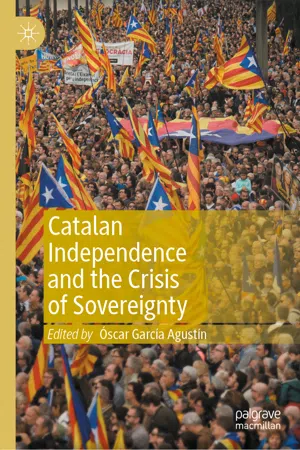
This book explores the conflict between the Catalan project to become independent and the Spanish state's opposition to any attempt of secessionism. The volume addresses some of the key political and academic issues of contemporary European societies: nationalism, separatism and sovereignty. The banned referendum in Catalonia in October 2017 unveiled the existence of multiple crises, from territorial to economic and political. Indeed, the Catalan issue is about the crisis of sovereignty: who holds legitimacy to make decisions, and who is in power legally and politically? The book is structured according to three themes: sovereignty and its people, where the realignment to independence, populism and the definition of the demos are discussed; collective identities and actions, to account for the shaping of 'us', the importance of collective memory and the cross-alliances forged during the referendum; and internationalization, focusing on Europeanisation, international media and comparative constitutional perspectives.
- English
- ePUB (mobile friendly)
- Available on iOS & Android
eBook - ePub
Catalan Independence and the Crisis of Sovereignty
About this book
Information
Subtopic
HistoriografíaPart IIntroduction
© The Author(s) 2021
Ó. G. Agustín (ed.)Catalan Independence and the Crisis of Sovereigntyhttps://doi.org/10.1007/978-3-030-54867-4_11. The Catalan Way to Independence and the Spanish–Catalan Conflict
Óscar García Agustín1 and Malayna Raftopoulos2
(1)
Department of Culture and Learning, Aalborg University, Aalborg, Denmark
(2)
Department of Politics and Society, Aalborg University, Aalborg, Denmark
Keywords
Catalan independenceSovereigntyNation statesConflict12 February 2019 represents a new important moment of tension between Catalonia and Spain, preceded and followed by hectic political activities. Twelve separatist leaders went on trial in Spain’s high court, charged for their involvement in the organization of the independence referendum held on the 1 October 2017 and the posterior unilateral declaration of independence. The twelve defendants were accused of rebellion, sedition and misuse of public funds (Jones 2019). Earlier in February 2019, 45,000 people demonstrated in Madrid against any kind of dialogue between the Spanish government, led by Pedro Sánchez as president, and the Catalan regional government, and instead pushed for new elections. The mass protest supposed the union of the centre-right parties, Popular Party (PP) and Ciudadanos (Cs), together with the far-right, Vox. The leader of PP, Pablo Casado, expressed euphorically that: “Today the reconquest of the hearts of the Spaniards, who have said ‘enough’, has started”. It did not matter for the protesters that the Sanchez’ government withdrew its proposal for dialogue with the separatist parties in the days prior to the demonstrations. According to the Spanish government the requirement for a binding referendum and the right to self-determination (Hernández 2019) hindered efforts to make progresses in the dialogue. The response from the separatist parties, which were supporting Sanchez’ minority government, became evident only one day after the beginning of the trial: both the conservative PdeCat and the centre-left Esquerra Republicana de Catalunya (ERC) voted against the budget. In consequence, the social-democratic government was pushed into an impossible situation if it wanted to continue in power. The solution came on 15th February when Sánchez announced fast elections, scheduled for 28 April 2019. Paradoxically, the claims in the streets for new elections were fulfilled rapidly but not (only) due to the pressure of the right-wing protesters but because of the decision of the Catalan pro-independence parties to stop their support for the the government of the Spanish Socialist Workers Party (PSOE) government, backed by the left-wing party Podemos.
Within very few days the extreme complexity of the situation of Spain and Catalonia was portrayed. Firstly, the constant judicialization of the Catalan issue. The massive protests in Catalonia, which reached their climax with the referendum of 1st October, led in their attempt to overcome the restrictions of the Spanish legislation to a reinforcement of the judicial way in which the space to discuss the Catalan independence was eliminated. The prolonged application of the article 155 of the Spanish Constitution and the imprisonment of separatist political and social leaders, as well as the forced decision of others to leave Spain, created a scenario with very few options to find political solutions. When the conservative leader Mariano Rajoy was replaced by Sánchez, the possibilities to recover trust and dialogue turned out to be quite weak. Secondly, the Catalan nationalist movement evolved towards an independence movement in which the recognition of the Catalan Republic was at the end the only feasible goal. This shift implied the expansion of the social basis supporting independence, particularly after 1st October, but also the difficulty of fitting the claim for independence with the Spanish legislation. However, the interconnectedness of Spanish and Catalan politics remains evident when Spanish nationalism has become strongly articulated and visible. The opposition to the Catalan independence was easily transformed into the defense of the Spanish unity. While the PP became insignificant in Catalonia, Cs was the most voted party in the Catalan regional elections of 2017 and Vox emerged as the first far-right party after the dictatorship. Although maintaining the division between left and right-wing blocs, the national issue became the main, if not the only, framework of Spanish politics. Finally, the international context plays an important role. Not far away from the Scottish referendum for independence, the Catalan separatist movement gained force in times characterized by the Brexit negotiations and the re-emergence of nationalism which frequently is mixed with populism all over the globe. International media’s suspicions of traits of Franquism in the Spanish use of force or application of restrictive legislation, the lack of European support for independence by the Catalan government or the use of the trial to reach a global audience to portrait the Spanish state as oppressor (Orihuela 2019) are clear examples of the difficulties in limiting the Catalan issue within the Spanish borders and not attend to its international dimension.
Tracing the Roots of Catalan Nationalism
The roots of Catalan nationalism can be traced back to its medieval past and is founded on a historical narrative which celebrates both Catalonia at its territorial and cultural height as well as its downfall at the cusp of the modern age (Varagas 2015). Catalonia’s long history and distinct cultural history, especially in linguistic terms, has allowed Catalan nationalism to justify its demands for enhanced autonomy and later outright independence in the twentieth and twenty-first centuries. Until the early eighteenth century, Catalonia had enjoyed a great deal of autonomy largely due to the union of Aragon in 1137 which recognized separate political identities and its rising international prominence and powerful Mediterranean empire built on its commercial success which emerged in the thirteenth and fourteenth centuries (Guibernau 2014). However, as Varagas notes, “just as other nations were becoming states the Catalan people found themselves subjugated to the accidental outcome of Castilian dynastic inheritance” (2015, p. 40). Triggered by the death of King Martin the Humane who died in 1410 without a successor, Catalonia suddenly found itself under the rule of Fernando de Antequera from the Castilian family of the Trastámara whose dynasty was later cemented in 1469 by the marriage of the King of Aragon, Ferdinand II, to his cousin Isabella, the Queen of Castile (Varagas 2015). The following centuries were marked by the gradual erosion of Catalonia’s traditional laws and repression. In 1621, Catalonia become caught up in the Count Duke Olivares, Felipe IV’s chief minister, Union of Arms policy which required each territory to send conscripts to the imperial army fighting the Thirty Years’ War, accumulating in 1640 in the Revolt of the Reapers which saw a full-scale Catalan uprising against a century of Castilian imposition. What would later become known as one of the first nationalist revolutions of Europe, marked an important turning point in Catalan history. The signing of the Peace if the Pyrenees in 1659 which brought the Thirty Years War to an end, saw Catalan speaking territory carved up among the French and Castillian royal rivals (Guibernau 2014; Varagas 2015). After the War of Spanish Succession, Catalonia found itself on the losing side and saw its political and cultural autonomy curbed as the Spanish crown sought a centralized model of power, dissolving Catalan political institutions and forbidding the use of the Catalan language (Dowling 2017, p. 9).
From 1808 to 1939, Spain’s priority was centred on constructing a Spanish nation that could maintain internal control and democratizing its emerging liberal order. Dowling argues that Catalanism during this period “represented a bifurcation: a state project for Spain and a cultural project for Catalonia” (2017, p. 10). The late nineteenth and early twentieth century saw the emergence of political Catalanism and a number of Catalan groups, including the powerful Lliga Regionalista in 1901 which functioned as a hegemonic conservative force. Political Catalanism, centred on achieving autonomy alongside promoting Catalan political leadership in Spain and protecting its industry, “sought in its initial phase for autonomy to be a tool in the modernization of the state” (Dowling 2017, p. 60). The intensification industrialisation in Catalonia and Catalan protectivism as well as the growth of anarcho-syndicalism by Catalan organized labour who were driving the political agenda, led to increased tensions with Madrid during this period (Dowling 2017). The early years of Francoism which followed the overthrow of the Spanish Second Republic would be marked by “the systematic destruction of all that represented a societal, political or cultural challenge to the new regime” (Dowling 2017, p. 17). This included the suppression of Catalan political institutions, the banning of the Catalan language and symbols of Catalan identity such as the Senyera flag and the national anthem, Els Segadors. The destruction of the historical nations within Spain by the Franco regime forced members of the Generalitat, political parties and the labour movement into exile and thousands were murdered including the President of the Generalita...
Table of contents
- Cover
- Front Matter
- Part I. Introduction
- Part II. Understanding Sovereignty and its People
- Part III. Understanding Collective Identities and Actions
- Part IV. Understanding Internationalisation
- Part V. Conclusion
- Back Matter
Trusted by 375,005 students
Access to over 1.5 million titles for a fair monthly price.
Study more efficiently using our study tools.
Frequently asked questions
Yes, you can cancel anytime from the Subscription tab in your account settings on the Perlego website. Your subscription will stay active until the end of your current billing period. Learn how to cancel your subscription
No, books cannot be downloaded as external files, such as PDFs, for use outside of Perlego. However, you can download books within the Perlego app for offline reading on mobile or tablet. Learn how to download books offline
Perlego offers two plans: Essential and Complete
- Essential is ideal for learners and professionals who enjoy exploring a wide range of subjects. Access the Essential Library with 800,000+ trusted titles and best-sellers across business, personal growth, and the humanities. Includes unlimited reading time and Standard Read Aloud voice.
- Complete: Perfect for advanced learners and researchers needing full, unrestricted access. Unlock 1.5M+ books across hundreds of subjects, including academic and specialized titles. The Complete Plan also includes advanced features like Premium Read Aloud and Research Assistant.
We are an online textbook subscription service, where you can get access to an entire online library for less than the price of a single book per month. With over 1.5 million books across 990+ topics, we’ve got you covered! Learn about our mission
Look out for the read-aloud symbol on your next book to see if you can listen to it. The read-aloud tool reads text aloud for you, highlighting the text as it is being read. You can pause it, speed it up and slow it down. Learn more about Read Aloud
Yes! You can use the Perlego app on both iOS and Android devices to read anytime, anywhere — even offline. Perfect for commutes or when you’re on the go.
Please note we cannot support devices running on iOS 13 and Android 7 or earlier. Learn more about using the app
Please note we cannot support devices running on iOS 13 and Android 7 or earlier. Learn more about using the app
Yes, you can access Catalan Independence and the Crisis of Sovereignty by Óscar García Agustín in PDF and/or ePUB format, as well as other popular books in Política y relaciones internacionales & Historiografía. We have over 1.5 million books available in our catalogue for you to explore.