eBook - ePub
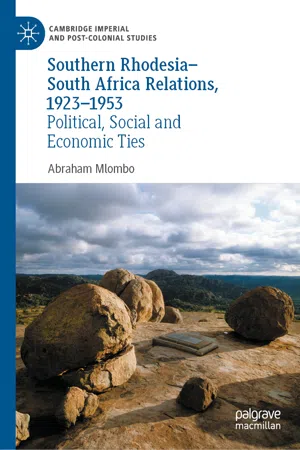
Southern Rhodesia–South Africa Relations, 1923–1953
Political, Social and Economic Ties
- English
- ePUB (mobile friendly)
- Available on iOS & Android
eBook - ePub
Southern Rhodesia–South Africa Relations, 1923–1953
Political, Social and Economic Ties
About this book
This book provides the first comprehensive study of the 'special relationship' between Southern Rhodesia and South Africa. While most studies approach this from the history of British and South African relations or the history of South African territorial expansion, this book offers new insights by examining Southern Rhodesia's relations with South Africa from the former's perspective. Exploring relations through the lens of settler colonialism, the book argues that settler colonialism in the region was marked by a competitive and antagonistic relationship between settler communities, particularly Afrikaner and English communities. The book explores the connections between these countries by examining (high) politics, economic links, and social and cultural ties, highlighting both instances of competition and cooperation. Above all, it argues that economic ties were the cornerstone of the relationship and that these shaped the rest of the ties between the two countries. Drawing on archival records from Britain, South Africa and Zimbabwe, as well as a number of secondary sources, it offers a much more nuanced perspective of this relationship than has been previously offered.
Information
Topic
HistoriaSubtopic
Historia económica© The Author(s) 2020
A. MlomboSouthern Rhodesia–South Africa Relations, 1923–1953Cambridge Imperial and Post-Colonial Studies Serieshttps://doi.org/10.1007/978-3-030-54283-2_11. Introduction: A History of Southern Rhodesia–South Africa Relations
Abraham Mlombo1
(1)
Bloemfontein, South Africa
On 1 October 1923, Responsible Government was officially granted to Southern Rhodesia after a referendum on the status of the country was held in October 1922. In an all-white vote with the options to go it “alone” or union with South Africa, the choice was the former. For a number of years prior to the referendum, the union between the two territories was regarded as inevitable. Southern Rhodesia’s early colonial history was closely tied to South Africa. Whites in Southern Rhodesia either came from or travelled through South Africa to settle in the country in the late nineteenth century. It is a result of this historical period that relations were established, and a shared and united future was envisioned. It is also a history upon which state-level relations continue to exist today between South Africa and Zimbabwe. South Africa and Zimbabwe enjoy what some authors and publications term a “special relationship” and it is assumed such a relation has always existed. D. Geldenhuys argues that the two neighbouring countries have enjoyed a special relationship born of geographical contiguity, historical ties, economic interdependence, racial solidarity, and shared political interests.1 It is a result of these continuing connections that the assumption of a special relationship exists.
This book, which makes a long, historical appraisal of Southern Rhodesia–South Africa relations, stretching back to the late nineteenth century, and argues that the relationship was far more complex and intricate. Focusing on the period of Responsible Government in Southern Rhodesia, Southern Rhodesia-South Africa relations, 1923–1953, provides the first comprehensive historical study of this relationship. It argues that a coherent overview of relations in the fields of (high) politics, trade, and migration, social and cultural ties demonstrates that the relationship was characterised by competition, contradiction, and antagonism and in some instances co-operation in their social, political, and economic interactions. It is this antagonistic, ambiguous relationship that this book significantly details and analyses. This book builds on the works of a number of scholars2 who have discussed aspects of this relationship, and though they do not primarily focus on the relationship, they offer the most significant contribution to the subject of this book.
Martin Chanock notes the “southern factor” in Southern Rhodesian history from the time of Rhodesia’s inception; again as an option rejected by the settlers in 1922; South African territorial expansionism hovers in the wings as a threat countered by Federation in the 1950s; and is on stage again after the Unilateral Declaration of Independence in 1965.3 This book investigates the complex nature of this relationship between Southern Rhodesia and the “southern factor”, South Africa. While this book takes a broad approach to investigate the nature of the relationship, it looks closely at political relations, economic links, social and cultural ties as well as African connections. It also examines Southern Rhodesia–South Africa relations through the lens of “settler colonialism”. Drawing upon the existing literature, this book marks settler colonialism as a distinct form of colonialism.4 Echoing the work of Veracini, this book argues that given the supposition that the “southern factor” was at the inception of Southern Rhodesia, and its development drew explicitly and implicitly from South African examples, in the process one country mirrored the other in terms of how society was organised, and settler dominance consolidated, i.e. there was similarity in the structure of the colonial project. Veracini has positioned (settler) colonialism as colonisation in which settlers neither exterminate nor assimilate the indigenes they moved. Among the former European colonies that exemplified this type are Algeria, Rhodesia, Kenya, South Africa, and Indonesia.5 Caroline Elkins and Susan Pedersen (eds.) provide important insight on settler colonialism for this book and the period it covers. In the situation where an alien population settles in a territory and makes its home and enjoys a materially privileged position in relation to the indigenous population, Elkins and Pedersen note that the settler colonial experience provides a particular circumstance. In countries like Southern Rhodesia and South Africa, where whites had settled, settlers were driven to create communities constructed on ethnic and racial terms in what they defined as virgin land.6 Therefore, if colonialism practiced by these settler societies is to be understood as a “relationship of domination” by which a foreign minority governs the indigenous majority, according to the dictates of a distant metropolis, it ought to be acknowledged that these settler colonies often sought to weaken metropolitan control.7 In such instances, settlers sought to consolidate their power by seeking to weaken metropolitan supervision over the colonial state. Settlers saw themselves as being better placed than the metropole in governing the colony. This was true for South Africa and Southern Rhodesia. A common feature of Southern Rhodesia and South Africa from 1923 to 1953 is that both territories were controlled by settlers. It is important to note that the label settler is a contested term and white South Africans would not see themselves as settlers given that whites have been in South Africa since the mid-seventeenth century.
In unpacking the settler nature of the relationship, this book introduces a new dimension to settler colonialism. This study argues that by studying Southern Rhodesia–South Africa relations, settler colonialism in the region was marked by a competitive and antagonistic relationship between settler communities, in particular Afrikaner and English. It is a relationship in which the persisting features of competition, contradiction, and antagonism permeated every aspect: social, political, and economic relations, themes this book engages with.
Southern Rhodesia and South Africa: A Shared Past
For much of Southern Rhodesia’s existence prior to 1923, it was believed by most of the settlers in both countries that amalgamation with South Africa was to be the final outcome for Southern Rhodesia, once the British South Africa Company’s (hereafter BSA Company) term in administering the territory had come to an end. Southern Rhodesia’s destiny had always been regarded by Britain and by much of southern Africa to be incorporated into a federated South Africa. This had been conceived by Cecil John Rhodes who sought to counter the Dutch-dominated Republics of the Transvaal and the Orange Free State and to secure for the British Empire the region of South Africa. Rhodes had never regarded Rhodesia as a country outside South Africa or as a black colony like Uganda or Nigeria. Rhodesia was destined to join the south.8 South Africa had made provision through the South Africa Act of 1909 for the incorporation of Southern Rhodesia. However, it was Jan Smuts, the second Prime Minister of the Union of South Africa established in 1910, who aggressively pursued amalgamation with the support of the British Government, the BSA Company and a section of the business community in Southern Rhodesia. Smuts considered Southern Rhodesia as the most important territory which, when incorporated, would accelerate South Africa’s territorial expansion. From South Africa’s point of view, territorial expansion was grounded on the notion that the Union of South Africa would take the form of a large political bloc, stretching well into the African interior and becoming what the United States had become for the American continent. Although the matter of union between the two countries was contested on either side of the Limpopo River, racial solidarity and settler colonial dominance over each territory was a point of convergence.
From a British Imperial perspective, Southern Rhodesia’s future was significant as it was seen as ensuring her sway in the region and South Africa in particular. As Palley has noted, Britain sought to retain influence in South Africa and thus create an Imperial Federation which would be pro-British.9 This period in Southern Rhodesia–South Africa relations was marked by intense contestation on either side of the border about political ties, as well as social and cultural links with Britain. In the years leading up to the Southern Rhodesian referendum of 1922, there emerged a distinct feature about white communities in both countries. It was remarked that white Rhodesians were typically English. In contrast, South Africa’s white population was Dutch/Afrikaner-dominated at this time and the newly established National Party (1914) was overtly republican and a critic of the idea of union. It sought to repudiate the prevailing capitalist policies in the Union of South Africa at the time, along with challenging British involvement in Union affairs. These issues of formal relations between the two neighbours, cultural identity, and divergence of interests are discussed throughout the book. Historical works that cover Southern Rhodesia–South Africa relations during the colonial period ought to be aware of the origins of Southern Rhodesia. When whites began to settle in the territory later known as Southern Rhodesia in 1890, almost all ...
Table of contents
- Cover
- Front Matter
- 1. Introduction: A History of Southern Rhodesia–South Africa Relations
- 2. Responsible Government in Southern Rhodesia: The South African Factor, 1914–1923
- 3. The First Decade of Responsible Government, 1923–1933: Competition and Interdependence
- 4. Trade, Customs Arrangement and Regional Implications, 1934–1939
- 5. The War Years, 1939–1945: War Economy and Military Engagement
- 6. A Period of Change, 1946–1953: Shifting Interests, Close Connections
- 7. Conclusion: Bound by History
- Back Matter
Trusted by 375,005 students
Access to over 1.5 million titles for a fair monthly price.
Study more efficiently using our study tools.
Frequently asked questions
Yes, you can cancel anytime from the Subscription tab in your account settings on the Perlego website. Your subscription will stay active until the end of your current billing period. Learn how to cancel your subscription
No, books cannot be downloaded as external files, such as PDFs, for use outside of Perlego. However, you can download books within the Perlego app for offline reading on mobile or tablet. Learn how to download books offline
Perlego offers two plans: Essential and Complete
- Essential is ideal for learners and professionals who enjoy exploring a wide range of subjects. Access the Essential Library with 800,000+ trusted titles and best-sellers across business, personal growth, and the humanities. Includes unlimited reading time and Standard Read Aloud voice.
- Complete: Perfect for advanced learners and researchers needing full, unrestricted access. Unlock 1.5M+ books across hundreds of subjects, including academic and specialized titles. The Complete Plan also includes advanced features like Premium Read Aloud and Research Assistant.
We are an online textbook subscription service, where you can get access to an entire online library for less than the price of a single book per month. With over 1.5 million books across 990+ topics, we’ve got you covered! Learn about our mission
Look out for the read-aloud symbol on your next book to see if you can listen to it. The read-aloud tool reads text aloud for you, highlighting the text as it is being read. You can pause it, speed it up and slow it down. Learn more about Read Aloud
Yes! You can use the Perlego app on both iOS and Android devices to read anytime, anywhere — even offline. Perfect for commutes or when you’re on the go.
Please note we cannot support devices running on iOS 13 and Android 7 or earlier. Learn more about using the app
Please note we cannot support devices running on iOS 13 and Android 7 or earlier. Learn more about using the app
Yes, you can access Southern Rhodesia–South Africa Relations, 1923–1953 by Abraham Mlombo in PDF and/or ePUB format, as well as other popular books in Historia & Historia económica. We have over 1.5 million books available in our catalogue for you to explore.