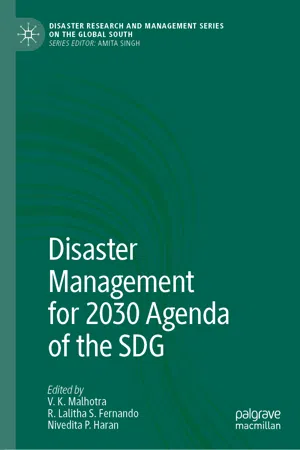
This book shows how specifically each goal of Sustainable Development Goals could be incorporated in country wise developmental programmes set to transform the world. It highlights how a combination of initiatives on mitigation of disasters and a robust progress could build a resilient society. The book discusses multidimensional processes such as administrative, financial and social challenges which can mitigate disasters and help in an advancement towards SDG Goals. It highlights the embeddedness of SDGs in disaster mitigation as they tend to be linked and interdependent. By linking sustainable development to disaster mitigation one gets a strong justification for investment into preparedness as a guarantee or insurance against loss and damages due to unforeseen disasters.
eBook - ePub
Disaster Management for 2030 Agenda of the SDG
- English
- ePUB (mobile friendly)
- Available on iOS & Android
eBook - ePub
Disaster Management for 2030 Agenda of the SDG
About this book
Information
Concerns Around Sectoral Policies
© The Author(s) 2020
V. K. Malhotra et al. (eds.)Disaster Management for 2030 Agenda of the SDGDisaster Research and Management Series on the Global Southhttps://doi.org/10.1007/978-981-15-4324-1_9Human Trafficking and Disaster Risk Reduction: A Cross Cutting Link in SDGs
Mondira Dutta1
(1)
Special Centre for Disaster Research, Jawaharlal Nehru University, New Delhi, India
Keywords
Disaster risk reductionHuman traffickingVictims of disasterVulnerabilityDisaster preparednessCommunity resilienceIntroduction
Trafficking in persons is a serious crime and a grave violation of human rights. Every year, thousands of men, women and children fall into the hands of traffickers, in their own countries and abroad. Almost every country in the world is affected by trafficking, whether as a country of origin, transit or destination for victims. The UNODC, as guardian of the United Nations Convention against Transnational Organized Crime (UNTOC) and the Protocols thereto, assists States in their efforts to implement the Protocol to Prevent, Suppress and Punish Trafficking in Persons (Palermo Protocol). Human Trafficking is a humanitarian concern for Governance, International Institutional Collaboration and of Law. It is a heinous crime involving exploitation of a person typically through force, fraud or coercion for the purpose of forced labour, involuntary servitude or commercial sexual exploitation.
The Trafficking in Persons (TIP) report annually measures the government efforts across four categories in terms of the 3P paradigm of prosecuting traffickers, protecting victims, and preventing the crime. These are Tier 1, Tier 2, Tier 2 Watch List and Tier 3. Although Tier 1 is considered as the highest rank, but it does not imply that those countries are free from human trafficking. These ranks only mean that the governments of the concerned countries recognizes the problem and are trying to address the issue of human trafficking with sincerity and do their bit. Every year, governments of each country needs to demonstrate that they have made significant progress in tackling the problem and maintaining their ranks. India currently has been put in Tier 2 in the TIP report of 2018 implying countries whose governments do not fully meet the Trafficking Victims Protection Act (TVPA) and do not qualify the minimum standards for the elimination of trafficking in persons (Trafficking in Persons Report 2018). However such of the countries are considered to be making significant efforts to bring themselves into compliance with those standards. There is a dearth and inconsistency in the overall victim identification and protection. The government sometimes have been found to be penalizing the victims by arresting them for crimes committed, rather than for being subjected to human trafficking. Moreover the government’s conviction rates has been abysmally low. So is the number of investigations, prosecutions and convictions in relation to the scale of trafficking happening in India especially in the cases of bonded and forced labour.
Disasters and human trafficking do not confine to the administrative borders, rather spills much beyond. The borders are just pure imaginary lines. Studies (Dutta 2011b; Samuels 2015) show that whenever there occurs a chaos such as civil war, natural calamity resulting in disasters, ethnic conflict, political instability or any unpredictability, the traffickers make the most out of such a situation. The best time for the traffickers to ‘make hay while the sun shines’ is a period when people are the most vulnerable. The more the community is unprepared, the better it is for the traffickers. Poverty, natural calamity, epidemic, despair, war, crisis and ignorance are all recognized as adding fuel to the fire resulting in human trafficking (Miko 2007). Any disaster paves a smooth path for the traffickers.
Human Trafficking enhances manifold when disasters occur. Disasters do not discriminate people rather it exacerbates the pre-existing vulnerabilities which are often ignored in the disaster risk reduction policies. One such vulnerability leads to human trafficking. Disaster and human trafficking are closely related but when it comes to research and actions they seem to be studied independently. Research studies on the two subjects seem like parallel lines complementing each other rather than supplementing the purpose. They are studied in a world of their own completely oblivion of the synergy of risks and danger that loom large over the community. Studied as a stand-alone subject, it defeats the very purpose of addressing the issue of human security, human rights and human trafficking. The UN protocols, conventions and MoUs need to synergize their efforts towards this grey area and address the links between the two. The inter links between disaster and human trafficking have been mostly a neglected field of study.
The already existing socio-economic conditions imply that disasters can lead to different outcomes even for demographically similar communities. Nonetheless the most vulnerable groups suffer the maximum. Researches (Miko 2007; Finn 2016; Dutta 2015) reveals that disasters reinforce, perpetuate and increase gender inequality, making bad situations worse for the women. The United Nations International Strategy for Disaster Reduction (UNISDR) Policy on Gender Mainstreaming in Disaster Risk Reduction ‘aims to provide clear guidance from UNISDR Senior Management on gender mainstreaming in disaster risk reduction (DRR), and to detail a set of actions required to implement the Hyogo Framework for Action (HFA)’. Unfortunately, the potential contributions that women can offer to the disaster risk reduction overbearing around the world are often overlooked and female leadership in building community resilience to disasters is frequently disregarded.
Several organizations (UNDP, IUCN and UNISDR) have now come together to synergize their effort towards this regard. The World Health Organization (WHO), has also expressed concern over the vulnerabilities especially when children get separated from their families and livelihood options for men and women start to deplete during a disaster, creating an ideal situation for traffickers to prey upon. Traffickers wait for such opportunities, and get tempted to specially target children orphaned or separated from their families, women in distress or even the men who are in search of livelihood options during a disaster. Such cases are rampa...
Table of contents
- Cover
- Front Matter
- Introduction: Disaster Management for the 2030—Agenda for SDG Disasters and Challenge of Achieving SDGs
- Concerns Around Law and Governance
- Concerns Around Sectoral Policies
- SDG and the Covid-19 Challenge
Trusted by 375,005 students
Access to over 1.5 million titles for a fair monthly price.
Study more efficiently using our study tools.
Frequently asked questions
Yes, you can cancel anytime from the Subscription tab in your account settings on the Perlego website. Your subscription will stay active until the end of your current billing period. Learn how to cancel your subscription
No, books cannot be downloaded as external files, such as PDFs, for use outside of Perlego. However, you can download books within the Perlego app for offline reading on mobile or tablet. Learn how to download books offline
Perlego offers two plans: Essential and Complete
- Essential is ideal for learners and professionals who enjoy exploring a wide range of subjects. Access the Essential Library with 800,000+ trusted titles and best-sellers across business, personal growth, and the humanities. Includes unlimited reading time and Standard Read Aloud voice.
- Complete: Perfect for advanced learners and researchers needing full, unrestricted access. Unlock 1.5M+ books across hundreds of subjects, including academic and specialized titles. The Complete Plan also includes advanced features like Premium Read Aloud and Research Assistant.
We are an online textbook subscription service, where you can get access to an entire online library for less than the price of a single book per month. With over 1.5 million books across 990+ topics, we’ve got you covered! Learn about our mission
Look out for the read-aloud symbol on your next book to see if you can listen to it. The read-aloud tool reads text aloud for you, highlighting the text as it is being read. You can pause it, speed it up and slow it down. Learn more about Read Aloud
Yes! You can use the Perlego app on both iOS and Android devices to read anytime, anywhere — even offline. Perfect for commutes or when you’re on the go.
Please note we cannot support devices running on iOS 13 and Android 7 or earlier. Learn more about using the app
Please note we cannot support devices running on iOS 13 and Android 7 or earlier. Learn more about using the app
Yes, you can access Disaster Management for 2030 Agenda of the SDG by V. K. Malhotra, R. Lalitha S. Fernando, Nivedita P. Haran, V. K. Malhotra,R. Lalitha S. Fernando,Nivedita P. Haran in PDF and/or ePUB format, as well as other popular books in Business & Management. We have over 1.5 million books available in our catalogue for you to explore.