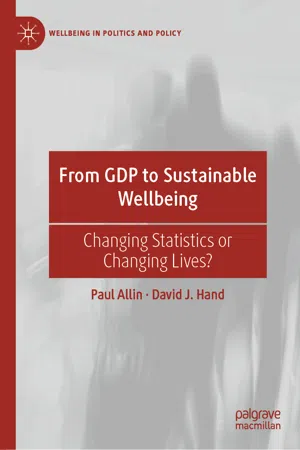
This book is about the function and use of official statistics. It welcomes the aspiration for official statistics to be an indispensable element in the information system of a democratic society, serving the government, the economy and the public with data about the economic, demographic, social and environmental situation. The book identifies the political role of official statisticians, who decided what gets measured as well as how it is measured. While thousands of official statistics are published every year, and some are quoted by politicians, used by policy-makers or reported in the media, the authors observe that, in the main, official statistics do not feature much in everyday lives of people and businesses. The book concludes with suggestions for more that should be done, especially in the context of improving wellbeing and helping meet the worldwide set of sustainable development goals set for 2030.
eBook - ePub
From GDP to Sustainable Wellbeing
Changing Statistics or Changing Lives?
- English
- ePUB (mobile friendly)
- Available on iOS & Android
eBook - ePub
About this book
Information
© The Author(s) 2021
P. Allin, D. J. HandFrom GDP to Sustainable WellbeingWellbeing in Politics and Policyhttps://doi.org/10.1007/978-3-030-53085-3_11. Setting the Scene
Paul Allin1 and David J. Hand1
(1)
Department of Mathematics, Imperial College London, London, UK
Abstract
This chapter begins with a discussion of what “progress” means, how it is defined and how it might be measured. This leads us on to examine the nature of statistical facts and of official statistics as the key indicators for monitoring change and progress within society, and we explore the protracted origins and evolution of these measures. One particularly important official statistic, certainly one which attracts a huge amount of attention, is a nation’s gross domestic product (GDP), and we look in detail at its measurement and use. However, GDP is but one measure. It is designed to be a measure of economic activity but displays a number of acknowledged weakneses in meeting that aim. Furthermore, it is clearly not a measure of a wider meaning of progress, other than in economic terms, despite also sometimes being taken as a measure of progress. In the final section of this chapter, we explore the beyond GDP agenda, which seeks to address all these issues.
Keywords
ProgressGDPBeyond GDP1.1 What Is Social Progress?
In everyday terms, talking of progress implies advancement and at least the expectation that this is towards something better. That might reflect a basic human ambition, perhaps driven by nature, nurture, or culture. It might entail defining a specific goal and plotting a course towards it. But, even within this book’s limitation to social or societal progress, that leaves a lot unsaid. That something is better, or has improved, implies a value judgement: that different conditions can be put in some kind of value order. Sometimes such ordering is straightforward: the human condition was improved by the discovery of general anaesthetics. But sometimes ordering can be questionable: a medical treatment which protects against one disease might increase the chance of another. The problem, of course, is the familiar one of measuring a complex phenomenon with multiple aspects.
All of this means that, for society as a whole, progress is probably best defined through indicators, especially where these relate to the things that matter: better education, improved health, enhanced transport networks, increased wealth permitting a wider choice of activities and lifestyle, and so on. Glossing over the difficulty of measuring them, they individually have relatively evident orders, so that improvement or progress is fairly clear for each of them. However, the fact that there are multiple indicators also means that there will be many different overall measures of progress, depending on which sets of indicators are chosen to reflect it.
A further complication, to which we return below, is that progress on the small scale or in the short term might be the opposite of that on the large scale or long term. We have witnessed many examples of this. One is the industrial revolution powered by fossil fuels improving the human condition over the twentieth century, only to realise the longer term, adverse consequences of anthropogenic climate change. Another is the dramatic improvement in a wide range of human activities through the use of plastics, ranging from better food preservation and hygiene to a vast range of manufactured products including medical equipment and clothes, only to experience longer term damage as microplastic pollution becomes universal. A third is the development of medicines to treat previously intractable diseases, only to witness the development of antibiotic resistant superbugs.
To summarise, these examples illustrate the importance of breadth of scope and the simultaneous use of multiple indicators when evaluating progress. It is not simply a question of optimising one indicator. Different indicators work in different directions, and can sometimes even be opposed, so that focusing on just one indicator is likely to be misleading. Worse still, the dynamic nature of social progress means that the relevance of indicators can wax and wane—sometimes even as a result of the use of those indicators themselves, in a feedback process. For example,
…the infant mortality rate (IMR) is often used as an indicator of health levels in preindustrial societies, where high rates are an important concern, and where reductions can be relatively easily achieved. As infant mortality declines, however, a law of diminishing returns begins to apply, and further reductions require increasingly large expenditure of resources. As the numerator becomes smaller, it also becomes less representative as an indicator of the health of the broader population. (McDowell & Newell, 1996, p. 11)
This point about the need for a range of indicators is important because traditionally social progress has been described in purely financial terms. In particular, as we explore below, GDP (gross domestic product) is the most widely cited measure. Unfortunately, as a measure of wider social progress and welfare, GDP is seriously deficient.
Indicators of social progress are constructed by aggregation of data from or about individuals. While this is increasingly done by private organisations, their primary interest is their customer base. Wider measures of society as a whole are typically the domain of official statistics, as created, collated, and published by government agencies or other public bodies. The aim of these statistics is to inform governments, commercial organisations, charities, and citizens. That is, to enable all these stakeholders to see the state of society and how it is changing, and ultimately to benefit the public.
1.2 What Are Society’s Facts?
Historian Mary Poovey begins her 1998 book A History of the Modern Fact by asking “What are facts? Are they incontrovertible data that simply demonstrate what is true? Or are they bits of evidence marshalled to persuade others of the theory one sets out with? Do facts somehow exist in the world like pebbles, waiting to be picked up? Or are they manufactured and thus informed by all the social and personal factors that go into every act of human creation?” (Poovey 1998, p. 1). In short, she asks, are facts immutable and incontrovertible truths, or are they malleable according to the circumstances and aims?
The notion of fact as an objective truth is certainly attractive. It means we are at least standing on common foundations. As Daniel Patrick Moynihan put it “Everyone is entitled to his own opinion but not to his own facts” (Weisman 2010, p. 2). Objectivity means impartiality and lack of bias and prejudice, but also reproducibility (very topical at the time of writing, when there is an ongoing discussion about reproducibility in science). It means that the value of a measurement taken here, now, by her can, at least in principle, be duplicated when taken there, then, by him. More than this, however, the value of measurements can be communicated, to tell you what you would obtain were you to take the measurement. (All this has qualifications about “other things being equal” or “under identical conditions”).
The Royal Statistical Society was founded on the belief in objective fact. It supposed that it was possible to collect data, that is facts, devoid of contamination from “opinion”—or, as one might say, of theory or interpretation. The Society’s Prospectus said it “will consider it the first and most essential rule of its conduct to exclude carefully all Opinions from its transactions and publications – to confine its attention rigorously to facts” (RSS 1934, p. 22). This position was partly due to historical accident around the creation of the Society. At the third meeting of the British Association for the Advancement of Science, held in Cambridge in 1833, the Association had somewhat grudgingly accepted the creation of a new statistical section. Its reservations were based on a concern that the new section’s activities might drift from the scientific to the political.
When this new section met, it decided that more was needed and that a permanent statistical body should be established: “Following up the spirit of the instructions received by the Committee at Cambridge, it is advisable to take immediate steps to establish a Statistical Society in London, the object of which shall be the collection and classification of all facts illustrative of the present condition and prospects of Society…” (RSS 1934, p. 10). In a public meeting held in March 1834, one of the attendees, Charles Babbage, proposed “That a Society be established in the name of the Statistical Society of London, the object of which shall be the collection and classification of all facts illustrative of the condition and prospects of Society…”. They moved quickly, and the newly formed Society met on 18 April 1834, and then again on 3 May 1834. (The Statistical Society of London became the Royal Statistical Society in 1887).
The prospectus of the Society describes its aims as the “procuring, arranging, and publishing ‘Facts calculated to illustrate the Condition and Prospects of Society’” (Hill 1984, p. 131). The words condition and prospects are almost synonyms for wellbeing and progress. And then, emulating the constraints adopted by the earlier statistical section of the British Association, the prospectus gave the passage quoted above, that “The Statistical Society will consider it to be the first and most essential rule of its conduct to exclude carefully all Opinions from its transactions and publications”. It further continued “and, as far as it may be found possible, to facts which can be stated numerically and arranged in tables”. Numbers in particular are often seen as prime examples of facts. Again, Poovey: “Numbers have come to epitomize the modern fact, because they have come to seem preinterpretive or even somehow noninterpretive” (Poovey 1998, p. xii).
Pure numbers certainly do have an intrinsic objectivity and unambiguity. A 3 is a 3, and nothing more than a 3. It is only within the darker realms of numerology and mysticism that properties and values are attached to numbers beyond the fundamental property of quantity. However, when a number is used to describe something, then more than simply the numerical value of the number is being used. At the least it summarises the results of a (possible variable and ambiguous) process of assigning the number, so that the simple objectivity of the number is lost. This should always be borne in mind: facts represented as numbers are more than pure numbers.
More generally than numbers, a doubt that facts can exist out of the context of some theory was early realised: it is “impossible to frame a Statistical exhibition of the present subject [crime] for practically useful purposes, without theorizing” (Proceedings of the Statistical Society of London, Vol 1, p. 194, 1836; quoted in Hill 1984). A comment in the Sixth Report, of 1838–1840, said “it was not to perfect the mere art of ‘tabulating’ that it [the Society] was embodied:- it was not to make us hewers and drawers to those engaged on any edifice of physical science;- but it was that we should ourselves be the architects of a science of or sciences, the perfecters of some definite branch or branches of knowledge, which should do honour to ourselves and to our country…” (Statistical Society of London 1840).
In a paper in the London and Westminster Review, published in 1838, G. Robertson, a deputy editor, commented on this constraint of the Society to “facts”:
Opinion is what is most wanted where truth is the object, it is the parent and precursor of truth – opinion is carefully excluded by the Statistical Council … the process of seeking and sifting new opinions is the progress of science – to avoid this process is the most essential rule of the Statistical Council. (Robertson 1838, p. 49)
The exclusion of opinions is the exclusion...
Table of contents
- Cover
- Front Matter
- 1. Setting the Scene
- 2. Using Statistics to Assess Progress
- 3. Statistics and Public Policy
- 4. Wider Audiences for New Measures of Progress
- 5. Inputs and Outputs: Data Science and the Role of Media
- 6. Conclusion
- Back Matter
Trusted by 375,005 students
Access to over 1.5 million titles for a fair monthly price.
Study more efficiently using our study tools.
Frequently asked questions
Yes, you can cancel anytime from the Subscription tab in your account settings on the Perlego website. Your subscription will stay active until the end of your current billing period. Learn how to cancel your subscription
No, books cannot be downloaded as external files, such as PDFs, for use outside of Perlego. However, you can download books within the Perlego app for offline reading on mobile or tablet. Learn how to download books offline
Perlego offers two plans: Essential and Complete
- Essential is ideal for learners and professionals who enjoy exploring a wide range of subjects. Access the Essential Library with 800,000+ trusted titles and best-sellers across business, personal growth, and the humanities. Includes unlimited reading time and Standard Read Aloud voice.
- Complete: Perfect for advanced learners and researchers needing full, unrestricted access. Unlock 1.5M+ books across hundreds of subjects, including academic and specialized titles. The Complete Plan also includes advanced features like Premium Read Aloud and Research Assistant.
We are an online textbook subscription service, where you can get access to an entire online library for less than the price of a single book per month. With over 1.5 million books across 990+ topics, we’ve got you covered! Learn about our mission
Look out for the read-aloud symbol on your next book to see if you can listen to it. The read-aloud tool reads text aloud for you, highlighting the text as it is being read. You can pause it, speed it up and slow it down. Learn more about Read Aloud
Yes! You can use the Perlego app on both iOS and Android devices to read anytime, anywhere — even offline. Perfect for commutes or when you’re on the go.
Please note we cannot support devices running on iOS 13 and Android 7 or earlier. Learn more about using the app
Please note we cannot support devices running on iOS 13 and Android 7 or earlier. Learn more about using the app
Yes, you can access From GDP to Sustainable Wellbeing by Paul Allin,David J. Hand in PDF and/or ePUB format, as well as other popular books in Politik & Internationale Beziehungen & Sozialphilosophie. We have over 1.5 million books available in our catalogue for you to explore.