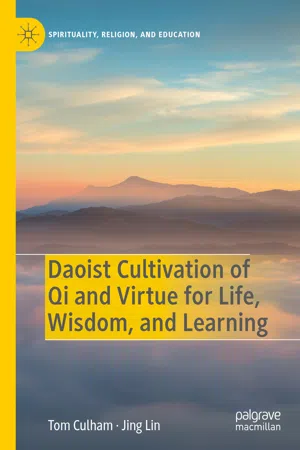
This book explores Daoist philosophies of qi and virtue through inquiry into their potential as technologies for cultivating good among individuals and society within educational settings, as well as in the modern world. The first part of the book, authored by Jing Lin, examines Daoist cosmology, axiology, and epistemology. She illuminates qi cultivation's reliance on the accumulation of virtues, leading to transformation of the body and even—extraordinarily—the abilities of Daoist masters to transcend physical limitations to achieve health, longevity, and immortality. The second part of the book, authored by Tom Culham, establishes an understanding of qi and virtue as a technology within the Daoist paradigm, outlining the benefits of its cultivation while illuminating how contemporary Western philosophy and science support this paradigm. Both authors explore new forms of education to incorporate Daoist wisdom in schooling.
- English
- ePUB (mobile friendly)
- Available on iOS & Android
eBook - ePub
Daoist Cultivation of Qi and Virtue for Life, Wisdom, and Learning
About this book
Information
© The Author(s) 2020
T. Culham, J. LinDaoist Cultivation of Qi and Virtue for Life, Wisdom, and LearningSpirituality, Religion, and Educationhttps://doi.org/10.1007/978-3-030-44947-6_11. Introduction: Why This Book Is Relevant and Critical Today
Tom Culham1 and Jing Lin2
(1)
Beedle School of Business, Simon Fraser University, Burnaby, BC, Canada
(2)
University of Maryland, College Park, MD, USA
Many problems we have in our world today are based on a narrow vision about life that attends to the short term, the self only, or for our family or community only. People are driven by selfish desires and take power and wealth as indicators of our life’s worth. The intellect and mind are given priority above all other ways of knowing cutting us off from our origins and the richness of our humanity. We see people, nature, and the cosmos as separate. Nature is seen as a resource, where possession of a large quantity of material things is perceived to give us power and value. Virtues are taken as moral options, wherein as long as we do not violate laws we can do what we want to benefit ourselves. The consequences of this perspective are all around us. Degradation of the environment, interpersonal and global conflicts, excessive levels of stress and over medication, and unhappiness despite wealth accumulation are strikingly prevalent around the world.
The world we live in calls for a new ontology, axiology, and epistemology that works to maintain the order and functioning of the universe and human society. Virtues in Daoism are not simply moral rhetoric, but are vital for understanding the mechanism sustaining the cosmos; they are vital for the individuals’ cultivation of good health, longevity, personal success, and achievement of immortality. At the collective level, virtues enable the structuring of a society working for the common good through which everyone gives up something and also gains something.
Individually, Daoist cultivation of qi and virtues is deemed as technology for knowing the self and the universe. Qi is the energy and spirit that permeates all existence and interconnect all existence; virtue is the mechanism for qi in everything and in every being to resonate and collaborate with each other. There are subtle energy networks on earth and in the cosmos that sustain each other, including the constellations, the stars, and the life system on earth. Because qi is subtle and invisible to the naked eyes, it takes opening our inner vision and elevating the capacities of our body’s sensory system; and this requires reducing the distractions in our life and turning inward to experience this subtle and yet powerful information/energy in all existence. Therefore, while everything is moving and vibrating, achieving a deep level of tranquillity is essential. Daoism holds that through cultivating tranquillity we become returned to our root, Dao, which is the primordial energy among all existence. Tranquillity is obtained not just in tuning or shutting down the sensors and sitting quietly; most importantly it is to contain our desires and to expand our resonance with other existence by doing good and virtuous deeds. In Daoism, virtues are methods which harmonize, regulate, attract, or dispense qi. Qi flows to those who nurture life and serve others, who are humble and soft, as Laozi posits in Dao De Jing. Virtuous deeds accumulate qi and those who want to have good health and attain immortality must have accumulated a lot of virtues hence a vast amount of qi. Qi can be built up in the body for good health, career success, and longevity, and be refined to give birth to the “inner child”, or spiritual child, who is one’s Immortal Self.
The pathway to Dao is an intensive process of meditation and aligning one’s body, heart, mind, and spirit with virtues. The Daoist cultivation gives practitioners direct experience knowing qi and how it works in the cosmos as well as in one’s daily life. This has a great implication for our world today. We want the best for ourselves and our families; we want good health and career success; if possible, we would give everything to achieve immortality. We also want the ecological system to be healthy and sustainable, and the world to have peace, but we are reluctant to let go of old habits and change ourselves. A deep understanding of the relationship between qi and virtues in Daoist cultivation urges us to take doing virtuous deeds as following the natural laws of the universe, and the mutual cultivation of qi and virtues as technologies which we can practice and master to achieve our goals.
The Daoist philosophy and practice may provide solutions to our world’s dire problems. Instead of engaging in fierce competition for the limited resources on earth, we can enhance our heart’s capacity for loving and caring for others as our qi can connect with and impact other beings in multiple levels, physically, emotionally, morally, and spiritually. Daoists have committed themselves to the exploration of the deep secrets of life and the cosmos for thousands of years. They take the human body as an experimental site, and refine and optimize its function through infusing it with vital life energy qi, and they have found virtues to be technologies for harnessing qi and transforming qi; in the simultaneous cultivation of qi and virtues, sages were born (Lin, 2018).
Daoism aims to achieve what is considered impossible, that is, immortality. Before achieving immortality, Daoists go through intensive efforts to: strengthen their body; adjust their heart and mind; calm their emotions; elevate their vision, and engage in the life-long process of “doing good”. These are all techniques to cultivate longevity and immortality. This process enables Daoists to build strong connections with all beings and existence so that in giving and serving, without thinking about the return for their actions, they receive the support of the powerful primordial energy qi. In other words, they become connected to Dao, which is the inexhaustible energy, the unfathomable spirit, and the all-pervasive consciousness behind everything and binding everything in the whole universe.
Qi is invisible to the flesh eyes, but can be experienced, through reactions in one’s body, and through deep knowing emerging from within when one is in touch with Dao. Qi moreover can be refined to be extremely powerful and used to affect changes in the world and nature positively (Lin, Culham, & Oxford, 2016; Lin, 2018, 2019). In our education and daily life, cultivation of qi can enhance the learners’ physical, moral, emotional, and spiritual development. It can develop an ecological consciousness that links all existence to enter a state of interbeing.
In this book, we explore the relationship between qi and virtues and examine Daoist ways to arrive at deep knowing about life and the universe. We hope this book leads to:
- An ecological and cosmic consciousness that sees connection and interdependence as vital for our survival and for the harmony of an intelligent and moral universe ;
- A new understanding of virtues as a natural mechanism and hence we frame new organizational ethos of our world;
- A world view connecting “doing good” with our wellness in body, mind, h...
Table of contents
- Cover
- Front Matter
- 1. Introduction: Why This Book Is Relevant and Critical Today
- Part I. Daoist Aspiration for Immortality through Cultivating Qi and Virtues
- Part II. Daoism as a Holistic Paradigm: A Unity of Spirit and Science
- Part III. Education Insights
- Back Matter
Trusted by 375,005 students
Access to over 1.5 million titles for a fair monthly price.
Study more efficiently using our study tools.
Frequently asked questions
Yes, you can cancel anytime from the Subscription tab in your account settings on the Perlego website. Your subscription will stay active until the end of your current billing period. Learn how to cancel your subscription
No, books cannot be downloaded as external files, such as PDFs, for use outside of Perlego. However, you can download books within the Perlego app for offline reading on mobile or tablet. Learn how to download books offline
Perlego offers two plans: Essential and Complete
- Essential is ideal for learners and professionals who enjoy exploring a wide range of subjects. Access the Essential Library with 800,000+ trusted titles and best-sellers across business, personal growth, and the humanities. Includes unlimited reading time and Standard Read Aloud voice.
- Complete: Perfect for advanced learners and researchers needing full, unrestricted access. Unlock 1.5M+ books across hundreds of subjects, including academic and specialized titles. The Complete Plan also includes advanced features like Premium Read Aloud and Research Assistant.
We are an online textbook subscription service, where you can get access to an entire online library for less than the price of a single book per month. With over 1.5 million books across 990+ topics, we’ve got you covered! Learn about our mission
Look out for the read-aloud symbol on your next book to see if you can listen to it. The read-aloud tool reads text aloud for you, highlighting the text as it is being read. You can pause it, speed it up and slow it down. Learn more about Read Aloud
Yes! You can use the Perlego app on both iOS and Android devices to read anytime, anywhere — even offline. Perfect for commutes or when you’re on the go.
Please note we cannot support devices running on iOS 13 and Android 7 or earlier. Learn more about using the app
Please note we cannot support devices running on iOS 13 and Android 7 or earlier. Learn more about using the app
Yes, you can access Daoist Cultivation of Qi and Virtue for Life, Wisdom, and Learning by Tom Culham,Jing Lin in PDF and/or ePUB format, as well as other popular books in Social Sciences & Education General. We have over 1.5 million books available in our catalogue for you to explore.