eBook - ePub
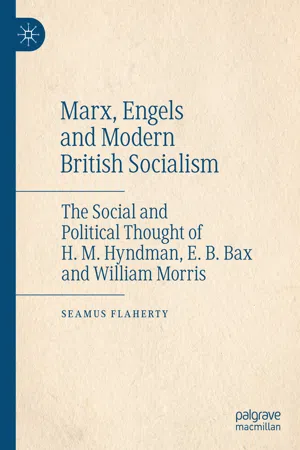
Marx, Engels and Modern British Socialism
The Social and Political Thought of H. M. Hyndman, E. B. Bax and William Morris
- English
- ePUB (mobile friendly)
- Available on iOS & Android
eBook - ePub
Marx, Engels and Modern British Socialism
The Social and Political Thought of H. M. Hyndman, E. B. Bax and William Morris
About this book
This book is a reception study of Karl Marx's and Friedrich Engels' ideas in Britain during the late nineteenth century and a revisionist account of the emergence of modern British socialism. It reconstructs how H. M. Hyndman, E. B. Bax, and William Morris interacted with Marx and 'Marxism'. It shows how Hyndman was a socialist of liberal and republican provenance, rather than the Tory radical he is typically held to be; how Bax was a sophisticated thinker and highly influential figure in European socialist circles, rather than a negligible pedant; and it shows how Morris's debt to Bax and liberalism has not been given its due. It demonstrates how John Stuart Mill, in particular, was combined with Marx in Britain; it illuminates other liberal influences which help to explain the sectarian attitude adopted by the Social Democratic Federation towards organised labour; and it establishes an alternative genealogy for Fabian socialism.
Information
© The Author(s) 2020
S. FlahertyMarx, Engels and Modern British Socialismhttps://doi.org/10.1007/978-3-030-42339-1_11. Introduction: The Remaking of British Socialism
Seamus Flaherty1
(1)
School of History, Queen Mary University of London, London, UK
Socialism ‘Since the Dying-out of Owenism’
The truth is this: during the period of England’s industrial monopoly the English working-class have, to a certain extent, shared in the benefits of the monopoly … And that is the reason why, since the dying-out of Owenism, there has been no Socialism in England.1
This was the view propounded by Friedrich Engels in an article written for Commonweal, the recently established newspaper of the Socialist League (SL ), in 1885. In 1892, Engels reproduced the content of that article, in full, in the preface to a new English edition of his youthful account of the consequences of the ‘Industrial Revolution’, The Condition of the Working Class in England. Overall, Engels believed that his journalistic assessment was still apposite. He had, he insisted, ‘but little to add’ to the original text.2 Yet, despite his reticence, Engels did include a qualification—a qualification, one might add, of no small moment. ‘Needless to say’, Engels acknowledged,
that today ‘there is indeed “Socialism again in England”, and plenty of it—Socialism of all shades: Socialism conscious and unconscious, Socialism prosaic and poetic, Socialism of the working-class and of the middle-class, for verily, that abomination of abominations, Socialism, has not only become respectable, but has actually donned evening dress and lounges lazily on drawing-room causeuses’.3
Engels’s proviso was not overstated. By 1892, socialism had indeed re-entered British intellectual and political life in earnest. The Independent Labour Party (ILP) had not yet been formed, but the Fabian Society, the Social Democratic Federation (SDF), and the SL, among other socialist groups, were all operative in the decade preceding 1893. The idea of socialism drew other, often high-profile, advocates too: the statesmen, Joseph Chamberlain and Charles Dilke, the Positivist Frederic Harrison, and the novelist and playwright Oscar Wilde, for instance, all spoke sympathetically about it.4
According to Engels, however, neither the ‘momentary fashion among bourgeois circles of affecting a mild dilution of Socialism’, nor even ‘the actual progress Socialism has made in England generally’, matched in terms of political magnitude ‘the revival of the East End of London’.5 What Engels meant by this was the emergence of the ‘New Unionism’. He described it as ‘one of the greatest and most fruitful facts of this fin de siècle’.6 The ‘New Unionism’ constituted therefore a second, more important, proviso and Engels censured the revolutionary socialists in Britain who ignored it.
The Materialist Conception of History
Engels’s views were contentious. More often than not they were not echoed by British socialists in the 1880s and 1890s. Yet, despite the partiality of Engels’s arguments, and the tenuous historical credibility of his claims, these judgements have proven remarkably influential with historians. In fact, it is no exaggeration to say that the figure of Friedrich Engels casts a very long shadow indeed over the historiography of British socialism. This can be seen in two principal ways.
Firstly, historians have followed Engels’s periodisation of socialism’s shifting fortunes. More specifically, until only relatively recently the historiography had been dominated by a number of distinguished historians who reproduced Engels’s very model of interpretation. These historians identified with a method of historical research inaugurated by Karl Marx, which diagnosed ‘social being’ as the chief determinant of ‘social consciousness’. That is to say, they adhered to the so-called materialist conception of history, or historical materialism.7 What that meant in practice was a commitment to four basic beliefs.
First, these historians cleaved to a conception of the ‘Industrial Revolution’ (comparable to that of the French) endowed with the force of a revolutionary event—the begetter of the ‘proletariat’ as Engels had depicted it in Condition of the Working Class.8 Second, the period of history between the decline of Chartism and the ‘revival’ of socialism was seen to necessitate an explanation as the site of a ‘non-event’, namely the failure of the proletariat to perform the revolutionary role assigned to it in ‘Marxist’ theory.9 Third, historians maintained Engels’s distinction between ‘utopian’ socialism and its ‘scientific’ Marxian successor.10 And fourth, in addition to the ‘arrested development’ of the practical movement of the working class in Britain, these historians held that indigenous socialist theory was, in consequence, also ‘abnormally’ weak.11
This remained the state of play in the historiography of British socialism until the 1980s. During that decade, however, the project of inferring political affinity from social class was increasingly vacated. In its place, historians began to adopt a non-referential conception of language, which eventually led to a new appreciation of the autonomy (or primacy even) of the political as a causal category.12 By the 1990s this new approach dominated. Yet, if the main beliefs informing the work of the historians of the previous generation had been extirpated, a number of minor prejudices remained, continuing to outlive the historiographical tradition that once sustained them. And here, too, the shadow of Engels is discernible.
Engels and British Socialists
Secondly, then, Engels also influenced the historiography of British socialism through his assessments of the ‘revival’s’ foremost personalities and groups. The same historians responsible for advancing Engels’s methodological assumptions were also culpable of reproducing his distorted evaluations of British socialists. The exponents of non-Marxian socialism were thus discharged as ‘uninteresting’ and ‘quite unimportant’.13 The socialists most sympathetic to Marx were, likewise, condemned as ‘intellectually negligible’.14 This at least was the view advanced by a number of combative young historians—principally Perry Anderson and Tom Nairn—writing for the New Left Review in the 1960s.15 Other historians associated with a different tradition of ‘Marxist historiography’ were, however, more cautious. Eric Hobsbawm and E. P. Thompson were less categorical in their disregard of British socialist intellectuals.16 Yet William Morris was the only socialist presumed to identify with the tradition purportedly bequeathed by Marx to receive complete exoneration.17 Moreover, what was given with one hand was taken away with the other; for the historians responsible for the exoneration of Morris were guilty of entrenching even further Engels’s judgements of the other socialists receptive to Marx.18
Part of the reason for this was political. Indeed, to revisit this section of the historiography, which traversed the period between the formation of the Communist Party Historians Group in 1946 and the...
Table of contents
- Cover
- Front Matter
- 1. Introduction: The Remaking of British Socialism
- Part I. Origins
- Part II. Hyndman
- Part III. Bax
- Part IV. Morris
- Back Matter
Trusted by 375,005 students
Access to over 1.5 million titles for a fair monthly price.
Study more efficiently using our study tools.
Frequently asked questions
Yes, you can cancel anytime from the Subscription tab in your account settings on the Perlego website. Your subscription will stay active until the end of your current billing period. Learn how to cancel your subscription
No, books cannot be downloaded as external files, such as PDFs, for use outside of Perlego. However, you can download books within the Perlego app for offline reading on mobile or tablet. Learn how to download books offline
Perlego offers two plans: Essential and Complete
- Essential is ideal for learners and professionals who enjoy exploring a wide range of subjects. Access the Essential Library with 800,000+ trusted titles and best-sellers across business, personal growth, and the humanities. Includes unlimited reading time and Standard Read Aloud voice.
- Complete: Perfect for advanced learners and researchers needing full, unrestricted access. Unlock 1.5M+ books across hundreds of subjects, including academic and specialized titles. The Complete Plan also includes advanced features like Premium Read Aloud and Research Assistant.
We are an online textbook subscription service, where you can get access to an entire online library for less than the price of a single book per month. With over 1.5 million books across 990+ topics, we’ve got you covered! Learn about our mission
Look out for the read-aloud symbol on your next book to see if you can listen to it. The read-aloud tool reads text aloud for you, highlighting the text as it is being read. You can pause it, speed it up and slow it down. Learn more about Read Aloud
Yes! You can use the Perlego app on both iOS and Android devices to read anytime, anywhere — even offline. Perfect for commutes or when you’re on the go.
Please note we cannot support devices running on iOS 13 and Android 7 or earlier. Learn more about using the app
Please note we cannot support devices running on iOS 13 and Android 7 or earlier. Learn more about using the app
Yes, you can access Marx, Engels and Modern British Socialism by Seamus Flaherty in PDF and/or ePUB format, as well as other popular books in History & British History. We have over 1.5 million books available in our catalogue for you to explore.