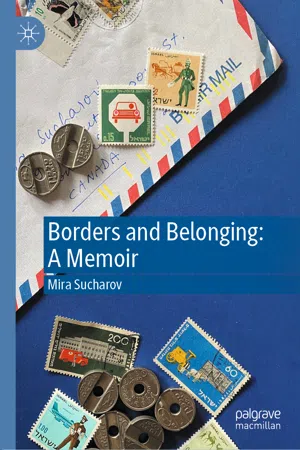
In this gripping and honest memoir, Mira Sucharov shows what a search for political and emotional home looks like. Sucharov suffered from childhood phobias triggered by her parents' divorce, and she sought emotional refuge in Jewish summer camp. But three years spent living in Israel in her twenties shook her to her core. Ultimately, encounters with colleagues, students, friends and lovers force her to confront what it means to be able to write, advocate and teach about Israel/Palestine in a way that balances affirmation with authenticity.
- English
- ePUB (mobile friendly)
- Available on iOS & Android
eBook - ePub
Borders and Belonging: A Memoir
About this book
Information
© The Author(s) 2021
M. SucharovBorders and Belonging: A Memoirhttps://doi.org/10.1007/978-3-030-53732-6_11. Posters & Flags
2011
I’ve arrived at Rabin Square, in central Tel Aviv, half an hour early.
The year I lived in Tel Aviv, in the mid-nineties, the square was called Malchei Israel, Kings of Israel. That April during the Passover holiday, I had dragged myself out of my apartment near trendy Sheinkin Avenue, walked across town, and traversed the square to see the latest Woody Allen movie as my roommates traveled for the holiday and the city streets were eerily quiet.
Four months after I returned to Canada to begin a Master’s degree, Prime Minister Yitzhak Rabin was gunned down by a right-wing Israeli extremist. That afternoon, I spoke for hours on the phone with Steve, the boyfriend who would later become my husband; he at his parents’ house in Vancouver, and I in my apartment in downtown Toronto. As my roommate and I shifted our house party planned for that night to an impromptu vigil, we tried to absorb the hateful politics of it all. That night, we all sat on hand-me-down furniture and watched CBC news on our small TV until late. Soon after, the Tel Aviv square was renamed in Rabin’s honor.
Tonight there is a buzz in the air. Clusters of men and women, my age or younger, are milling about. Some are wearing baby slings; others are holding signs and cigarettes. All are dressed casually: in jeans, shorts, sandals, or sneakers. The sun is starting to set, taking the edge off the stifling June heat.
A few days earlier, I’d seen a peace march advertised on Facebook. “Will you be there?” I asked Omri. He, a fellow scholar in my field, and his wife Abigail, another academic, had generously offered to host me for a few days in their apartment so I could continue the research trip I had planned.
Steve and our two kids had left Israel a few days earlier and returned to Ottawa, after a family trip where we traversed the country in our rental car and fought locals for parking spots, sipped frozen nana lemonade at the local cafe, let the fish nibble our toes in the Sachna pools, watched the falafel guy in Afula toss crunchy chickpea balls high into the air before catching them in a waiting pita pocket, and tracked a turtle in the desert while our four-year-old son’s hat flew off his head into the hot wind.
We had visited my kibbutz family on their kibbutz a kilometre from the Gaza border, where my “kibbutz dad” had set up a splash pad for our kids in his front yard. We had visited the shuk in the town of Sderot, the one that is so often in the news when Hamas launches rockets into Israel’s southern area. There, our mind wandered from threats and bomb shelters as we loaded fresh strawberries into a pink plastic bag and picked out a blue and white knitted kippa for my son. We visited my aunt and uncle in the north, where we adults drank homemade limoncello with lemons from their trees as my daughter played snakes and ladders, and I stared across the Green Line toward the Palestinian village of Jenin.
We’d passed by the apartment my husband and I shared the first year we were married, when I was doing research for my dissertation, and that year we would walk every week through the sun and rain to a local pottery studio where we took classes, before stopping at the makolet to buy rugelach and returning to our apartment to sip mint tea and watch Ally McBeal with Hebrew subtitles. We’d bargained with the vendors in the Jerusalem shuk and bought tiny keychains with our kids’ Hebrew names. We’d gone to the Kotel, where my seven-year-old daughter balked at the gender segregation and I promised her we’d donate to Women of the Wall. And on the day I gave a talk at Tel Aviv University, my husband had driven the kids across the length of the country to visit his cousin in Haifa, who gave our son and daughter two ice cream cones each: one for each hand.
“Yeah, we’ll come to the march,” Omri said. “We’ll put the baby in the stroller and we can all walk over from our apartment together.”
But the rush of domestic life got in the way of them attending. So I’m here on my own, and the march helps distract me. I usually enjoy the thrill of traveling alone. But when I bid Steve and our kids farewell, with another week ahead of me, I feel a sudden curtain of sadness.
I’d once thought I might settle in Israel. It would just be a matter of activating the legal right I have to immigrate, as a Jew, under Israel’s Law of Return. Spending weekends on a kibbutz in the northern Negev with my “kibbutz family” in my young twenties, the family that each of us, in our youth group, were assigned for the year as we spent weekends in the small desert community while studying at Hebrew University during the week, helped me picture my own possible adult life in the country. That, and my own extended family, including an aunt and uncle who had made aliya from Winnipeg in the early seventies, and distant cousins who had been here for generations, made it seem possible. Once I met my Canadian Jewish husband and discovered he had a dozen Israeli cousins—relatives on his father’s side who had settled in Israel from Romania in the late 40s, as Europe was rebuilding and Israel was being born, the circle felt even more complete.
Experiencing the country again, as a parent now—even for a short couple of weeks, with my kids hearing Hebrew from the mouths of others, and not only from mine like they are used to in Canada where I speak only Hebrew to them, left me wanting more. That afternoon, after Steve and the kids left in a taxi for the airport, I wandered with Omri through a pocket of the redesigned neighborhood of south Tel Aviv, thinking to myself that my kids would have enjoyed riding the stuffed horses on wheels dotting the public courtyard.
The slogans on the signs around me remind me why I’m here. Peace Now. Jews and Arabs Refuse to Be Enemies. End the Occupation. And the signs of political parties, the ones on the left end of the Israeli political spectrum: Meretz. Hadash. Tonight I’m marching for peace, just like I’d be doing if I were a regular Israeli, my kids in tow, handing them a bag of Bamba, the peanut-butter-flavored snack food, as a reward for their patience. But I’m also reminded that I’m not actually Israeli.
I can recite many of the names of the members of Knesset who occupy the party lists, and my younger cousin is hoping to run for one of those parties in the next election, and I even spent a few months years ago interning in the Knesset—but I have no vote. Still, I feel attached and invested. And I want my voice to matter.
Unlike at Israeli marches of this sort, where “peace” is one of the central demands, the campus activism signs I see back home rarely include the word peace. It’s even become a dirty word in some circles. When I was growing up in the Jewish community in Western Canada we sang all manner of Hebrew songs about peace. “Shalom al Yisrael” (Peace upon Israel), “Shir la Shalom” (Song for Peace), “Nolad’ti la’shalom” (I was Born for Peace). But some Palestine solidarity activists these days say that calling for peace is simply a way of whitewashing the Palestinian experience. They say that calling for peace is like demanding that an enslaved person remain quiet in their shackles. Solidarity, anti-oppression, anti-racism, resistance, summud—steadfastness in the face of Israeli aggression: to these Palestine solidarity activists, those are the words that matter.
But peace is the word that still animates the Israeli left—or whatever is left of it—so tonight I embrace it, alongside the crowd that has gathered. I’ll code-switch as needed, choosing the right words for the right audience. Or at least I’ll try to.
A young man shouts into a megaphone and the crowd tightens. My early arrival means I’ve secured a spot near the front. A young woman to my right hands me a slim pole. I glance upwards along the wooden shaft and see the familiar Israeli peace flag. It resembles the blue and white Israeli flag, but instead of the Star of David is the word Shalom, in Hebrew letters. I nod to her and grasp the flag with a sense of purpose. Soon we are advancing, a throng of dozens and then hundreds, and then eventually a few thousand, down Ibn Gvirol street. I realize I am among those leading the charge, waving my flag.
Through the megaphone come Hebrew chants. They remind me of my decade at Hebrew summer camp, with our team songs and cheers accompanying our marching. “Plugateinu, yesh lanu ruach … !” (Our team, we’ve got spirit!). A pang of longing shoots through me, as it always does when I recall my years at Hebrew summer camp. The intensity of the nostalgia soon gives way to a jolt of electricity as I embrace the moment of being surrounded by Israelis speaking Hebrew. I am partly of the group and partly not.
It doesn’t take long for the chants to turn salty: “Sara, tell Bibi you won’t fuck him until he stops fucking up the country!”
I alternate between chanting without moving my lips and moving my lips without chanting. I’m a little uncomfortable using swear words in Hebrew around Israelis. Partly it’s my Canadian accent that I try hard to mask with my best rolled R’s. But my general uneasiness goes deeper. It’s a citizen’s protest, and yet I know very well that while I feel highly attached to Israel, speak only Hebrew to my kids, and listen to Israeli vintage rock music when I need a pick-me-up, I am not a citizen. I have no vote in this protest against the government that represents everyone else here.
When the media announces the numbers, will I be compromising the data? If they report that five thousand people marched for peace, will I need to raise my hand—write a letter to the editor, post on social media—to issue a correction? Um, not 5,000 citizens. 4,999, actually.
And if the news cameras were to pan over to me marching, and if my Israeli relatives were to see me on the evening news, would they confront me? How dare you challenge our government to take actions that affect us, that jeopardize our security, we, who actually live here, while you sit comfortably in your Canadian city, working in the Canadian university where you don’t have to have your bag checked by security guards when you enter your campus, you who are raising Canadian children who won’t ever have to be drafted? You, who already live in peace?
Of course, they wouldn’t actually say “how dare you.” They’d ask me quietly probing questions, under the guise of just wanting to understand.
Fifteen years ago, I was at my aunt and uncle’s house on their kibbutz, visiting for the weekend. That year, I was living with friends in Tel Aviv. To help bankroll my nine months in the country between university degrees, I was conducting research for two professors back in Canada. One of the projects entailed interviewing European officials and Palestinian officials about the political economy of Palestinian state-building. Since I had no office of my own—I used my apartment telephone and public pay phones along the way to make appointments—I had given out my aunt’s fax number for the times I needed to receive documents.
One evening, as I was preparing for bed, my aunt said, “There’s something we’d like to talk to you about.” She was holding a shiny piece of paper. It looked like a fax.
I felt my cheeks get hot.
“We got this today. It says it’s from the Palestinian National Authority. And your name is on it.” Her voice rose. “Have you been giving my fax number to the PLO?”
“Oh, that.” I looked at it and saw that it was some follow-up information from an interview I’d done with a Palestinian official over mint tea at the American Colony Hotel in East Jerusalem.
“I’m doing research for a professor back in Canada,” I explained. “I, uh, have to interview political figures about the political economy of the emerging Palestinian government, since the peace deal was signed. Sometimes I interview European diplomats. And sometimes I interview Palestinian officials too. It’s just research. I gave out your fax number. I hope that’s okay.” I looked away.
“We don’t want our fax machine used for this. We could get in trouble.”
“What kind of trouble?”
“The government, you know.” She trailed off.
I silently calculated whether to engage in political debate with her or just apologize for the fax and get the matter over with.
“Sorry. About the fax. I don’t have a machine of my own so I thought …” My heart was pounding.
“The fax is one thing,” my aunt says. “But what we really want to know is, whose side are you on?”
I knew they were thinking not only about my research interests, my plans to continue on to graduate school to study Israeli–Palestinian relations. I knew they were thinking about Jabir. They hadn’t met him, but they had heard about him from my mom. Jabir, a fellow student at McGill in Montreal, was Arab. He’d recently broken up with me—a decision, he had explained in a letter he’d written to me in Vancouver, that was spurred by political pressure from his friends and colleagues. I was still feeling heartbroken.
Whose side are you on?
Sucking in a deep breath, I said, “I’m on the side of peace.”
“Peace. Wouldn’t that be nice,” my uncle said. “We all want peace. But this is a tough neighborhood. Peace won’t come until they accept our right to exist.”
“But Rabin and Arafat exchanged mutual letters of recognition,” I said. “I even cut the letters out of the newspaper and scotch-taped them to my wall last year in —.”
My uncle interrupted me. “Do you really think those letters are worth the paper they’re written on?”
“Well, they were written under the watch of the international community. Reputation matters,” I said. I was invoking concepts I’d learned in my international relations courses. Too dry, I figured. So I tried another tack. “Peace with the Palestinians is gonna help everyone. And part of making peace is to make sure the Palestinians are in good financial shape. They need to create a state, and that means getting the economic infrastructure in place. It’s a global effort.” I was speaking quickly now. “That’s what this research project is about. That’s all it is. My professor even has a grant from the Social Sciences and Humanities Research Council for it. SSHRC, we call it, Shirk. It’s research. It’s completely legitimate. Just like any other research, really. Like cancer research. Biographical, historical research.” I was fingering the place mats nervously and I knew I was starting to drone on.
“Look, Mira. We want peace as much as the next person. But the Palestinians are still Israel’s enemies. They would wipe us off the map if they could.”
Two years earlier, I had sat at this same table the morning after making my way back to my aunt and uncle’s house from the apartment of a twenty-seven-year old kibbutznik, a post-army service guy on whom I had a big crush. We had spent most of the night playing cards with his friends, and I felt cool and special, a part of this little Israeli world, on a kibbutz at the foothills of the Gilboa. But I had neglected to tell my aunt where I was, and as the night wore on, she was understandably worried.
“I’m so sorry for not calling. I didn’t realize,” I had said the next morning, touched by her concern. “I guess this is what it would have felt like to grow up here as a teenager.” I laughed. “To attend the American school.” Their kibbutz hosted an eleventh-grade program aimed at North American teens. I had seriously considered attending it, but in the end felt frightened about losing my high school social network—which already felt tenuous and subject to the whims of shifting peers and alliances.
“Actually, I was a really square teenager. I always made curfew!” We both smiled, and I felt the warm glow of their loving embrace, as I helped myself to another piece of my aunt’s date roll-ups, baked especially for me.
Israeli culture had long connected my aunt and me. When I was ten, I visited my aunt and uncle for three weeks, with my grandmother. In tenth grade, when I was balancing high school social life angst and desperately missing camp, my aunt mailed cassettes of Israeli music to me in Vancouver. I played them on a loop, eager to absorb the songs of Shlomo Artzi, Arik Einstein, and Yoni Richter. Those tunes had connected us, forming a straight line from the brown polyester Israeli rock band T-shirt, with the face of Izhar Cohen, the singer of the winning Eurovision song “A-ba-Ni-Bi,” that she had given me when I was six.
I wonder how my extended family expected anything different: connect me with Israel and send me Israeli folk rock music and send me to the kibbutz school when I am in fifth grade and invite me to spend weekends on the kibbutz when I’m twenty and be proud that I am attending Hebrew University and pick me up from the airport soon after the 1992 elections with Meretz swag in the backseat and generally get me so connected to the place that I actually care. That I actually want to do something about the injustice that I see.
Now, I advance with the crowd toward the sea, clutching the peace flag, and watch the fabric ripple in the light breeze.
A few blocks later, as we are snaking through a side street, counterprotesters shout from their apartment balconies. “Am Yisrael Chai!” they yell. “The nation of Israel lives!” Now I’m making another mental association with summer camp, where, during the camp-wide Maccabiah competition, we belted out our respective team chants, the j...
Table of contents
- Cover
- Front Matter
- 1. Posters & Flags
- 2. Carpets
- 3. Fallujah
- 4. Re/Intermarriage
- 5. Moles
- 6. Cabins
- 7. Peace, Love, and Conflict
- 8. Orange Kinley
- 9. Buses and Cars
- 10. Razors
- 11. Panic
- 12. Tents
- 13. My Wadi
- 14. Cancel Culture
- 15. Dreams
Trusted by 375,005 students
Access to over 1.5 million titles for a fair monthly price.
Study more efficiently using our study tools.
Frequently asked questions
Yes, you can cancel anytime from the Subscription tab in your account settings on the Perlego website. Your subscription will stay active until the end of your current billing period. Learn how to cancel your subscription
No, books cannot be downloaded as external files, such as PDFs, for use outside of Perlego. However, you can download books within the Perlego app for offline reading on mobile or tablet. Learn how to download books offline
Perlego offers two plans: Essential and Complete
- Essential is ideal for learners and professionals who enjoy exploring a wide range of subjects. Access the Essential Library with 800,000+ trusted titles and best-sellers across business, personal growth, and the humanities. Includes unlimited reading time and Standard Read Aloud voice.
- Complete: Perfect for advanced learners and researchers needing full, unrestricted access. Unlock 1.5M+ books across hundreds of subjects, including academic and specialized titles. The Complete Plan also includes advanced features like Premium Read Aloud and Research Assistant.
We are an online textbook subscription service, where you can get access to an entire online library for less than the price of a single book per month. With over 1.5 million books across 990+ topics, we’ve got you covered! Learn about our mission
Look out for the read-aloud symbol on your next book to see if you can listen to it. The read-aloud tool reads text aloud for you, highlighting the text as it is being read. You can pause it, speed it up and slow it down. Learn more about Read Aloud
Yes! You can use the Perlego app on both iOS and Android devices to read anytime, anywhere — even offline. Perfect for commutes or when you’re on the go.
Please note we cannot support devices running on iOS 13 and Android 7 or earlier. Learn more about using the app
Please note we cannot support devices running on iOS 13 and Android 7 or earlier. Learn more about using the app
Yes, you can access Borders and Belonging: A Memoir by Mira Sucharov in PDF and/or ePUB format, as well as other popular books in Politics & International Relations & International Relations. We have over 1.5 million books available in our catalogue for you to explore.