This book explores the unsettling ties between colonialism, transnationalism, and anarchism. Anarchism as prefigurative politics has influenced several generations of activists and has expressed the most profound libertarian desire of Southern Mediterranean societies. The emergence of anarchist and anti-authoritarian movements and collective actions from Morocco to Palestine, Algeria, Tunis, Egypt, Lebanon, Syria and Jordan has changed the focus of our attention in the last decade. How have these anarchist movements been formulated? What characteristics do they share with other libertarian experiences? Why are there hardly any studies on anarchism in the South of the Mediterranean? In turn, the book critically reviews the anti-authoritarian geographies in the South of the Mediterranean and reassesses the postcolonial status of these emancipatory projects. Colonialism, Transnationalism, and Anarchism in the South of the Mediterranean invites us to revisit the necessity of decolonizing anarchism, which is enunciated, in many cases, from a privileged epistemic position reproducing neocolonial power relations.
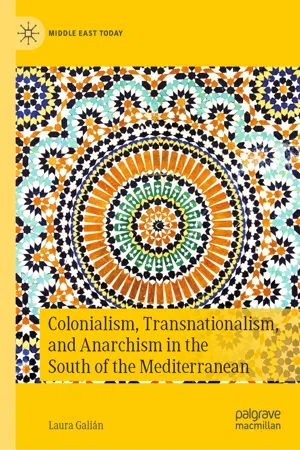
eBook - ePub
Colonialism, Transnationalism, and Anarchism in the South of the Mediterranean
- English
- ePUB (mobile friendly)
- Available on iOS & Android
eBook - ePub
Colonialism, Transnationalism, and Anarchism in the South of the Mediterranean
About this book
Information
© The Author(s) 2020
L. GaliánColonialism, Transnationalism, and Anarchism in the South of the MediterraneanMiddle East Todayhttps://doi.org/10.1007/978-3-030-45449-4_11. Toward a History of Southern Mediterranean Anarchism
Laura Galián1
(1)
University of Granada, Granada, Granada, Spain
Keywords
AnarchismSouth of the MediterraneanTransnational historyAnarchist historyWhy Anarchism in South of the Mediterranean?
In November 2019, a recently founded anarchist movement Kafeh! (Fight!) issued a manifesto where it declared its total support for the Lebanese revolution. According to its manifesto, the group is an anarchist movement whose goal is to achieve a decentralized and non-authoritarian society and considers that the ongoing Lebanese revolution represents the philosophy of anarchism: it exercised direct decision making, it is decentralized, non-hierarchical and anti-authoritarian. It rejects sectarianism, racism and bureaucracy. It is against the “authoritarian and patriarchal system in Lebanon and the existing dominant organization” (Kafeh 2019) and supports absolute freedom. According to its writing and manifesto, Kafeh! sees itself to be at the forefront of the revolution, a revolution that is considered to represent the same anarchists ideals that they uphold. The emergence of Kafeh! and its anarchist ideology and discourse on the ongoing Lebanese revolution should not come as a surprise. Since the spark of the social uprisings in the South of the Mediterranean in 2011, anarchists from the South of the Mediterranean have continuously assured the anarchist hallmarks of these revolutions and their experience of anarchism through them.
Seven years ago on the Second Anniversary of the 25th January revolution in Egypt a group of hooded youth who identified themselves as the Egyptian Black Bloc emerged in the country. The appearance, performance and visibility of these new identities with new repertoires of contentious politics, unseen in the region until the Arab revolutions but closely related to the political culture of anarchism of the West, attracted a lot of attention from the media and from Western anarchists and activist circles.
Joshua Stephens (2013a, 2013b) wrote an interesting article entitled “Representation and the Egyptian Black Bloc: The Siren Song of Orientalism?” where he critically questioned the media coverage and activist’s interest in the West on this newly emerged tactic that reflected and repeated some of the well-known practices of the Black Block (that as a reminder appeared in Germany in the 1980s) and how some circles were already debating the existence of anarchist ideologies in the Arabic-speaking countries. It was the first time anarchism was a question on the political and ideological spectrum in the societies of the South of the Mediterranean. This newly emerged tactic posed important questions on whether their attention was due to an orientalist symptom or a real revival or reemergence of anarchism in the South of the Mediterranean. There were some questions that needed to be answered: Was there an ideology as such of anarchism in the South of the Mediterranean? Or as Joshua Stephens underlined, was it an “Orientalist Siren”? Was it momentum for anarchism, and if so, how was this political philosophy understood and experienced?
The practice of anarchism as prefigurative politics has influenced a whole generation of young activists and has expressed the most profound libertarian desire of Southern Mediterranean societies. If the Islamist agenda or a supposed “authoritarianism”, endemic to the Arab societies, marked the sociopolitical agenda until 2011, the emergence of the Black Bloc and other anarchist groups and antiauthoritarian repertoires of collective actions from Morocco to Palestine going through Algeria, Tunisia, Egypt, Lebanon, Syria, Palestine and Jordan, have changed the focus and have attracted a great deal of interest in academic, journalist and activist spheres. Despite all of that, and despite the archival evidence of the existence of anarchist movements, groups and thought in the South of the Mediterranean since the end of the nineteenth century, as well as a growing literature about this anti-authoritarian and transnational history, the voices of these forgotten activists are still missing from the main reference books on the history of ideas and the history of anarchism. Why is that the case?
The emergence of anarchism as a political philosophy and a self-declared ideology and its history in the South of the Mediterranean is deeply rooted in the creation of the first capitalist economies and their relation with the economic peripheries. The first anarchists arrived in North Africa throughout the colonial project, carrying with them their emancipatory and civilizational claims. The need of specialized workers to create and develop the industrial fabric of the European colonial project attracted a great deal of Spanish, Italian, Greek and French workers to the Southern shore at the end of the nineteenth century. These workers and political exiles who were mostly but not exclusively men helped spread and disseminate anarchist and socialist propaganda from the First International. In Tunisia and Egypt, this political philosophy emerged with the settlement of activist and workers from Italy and Greece in the coastal and industrial cities (Khuri-Makdisi 2010; Gorman 2010). In Algeria, Republican Spanish political exiles in collaboration with French anarchists were instrumental in the creation of a local and anti-colonial Algerian movement (Porter 2011). In Lebanon and Syria, Arabic publications and transregional editorials echoed the importance of the events related to anarchism and libertarian thought in the Mediterranean societies and Latin America. ‘Propaganda by the deed’ was not the only repertoire used by these activists. Their propaganda mostly focused on disseminating the ‘idea’ through ‘propaganda by the word’ by founding journals, educational clubs and intuitions such as the L’Università Popolare Libera in 1901, especially important in promoting the educational program of Francisco Ferrer’s Escuela Moderna (Gorman 2005).
Despite the pioneering work these activists achieved in developing anarchist political thought in the Arabic speaking countries, historians have not paid the necessary attention to this ideological and social phenomenon. An overview of anti-authoritarian literature and anarchist thought in the South of the Mediterranean shows the lack of studies that analyze and reconstruct these narratives, but moreover, the reluctance of many European activists to name them as such.
Where is it possible to find the traces of this history? How can we reconstruct the history of the anti-authoritarian experiences and cultural expressions in the South of the Mediterranean? How have these anarchisms been formulated? What characteristics do they share with other libertarian experiences? Why are there hardly any studies on anarchism in non-Western contexts and, specifically, in Arab-speaking contexts, despite their trans-Mediterranean connections? Does this historiographical gap respond to exclusive historical factors?
I ask these and other questions in this book. Its aspiration is twofold: to critically review the anti-authoritarian geographies in the South of the Mediterranean, from Morocco to Palestine and to rethink the postcolonial condition of emancipatory projects such as anarchism, which is still often enunciated from a white-privilege hetero-normative epistemic position that reproduces colonial power relations. This brings us to the book’s main imperative: decolonizing anarchism.
The unfinished decolonization of anarchism has led the anarchist canon to ignore non-Western anti-authoritarian and anarchist narratives, which are not always and not only enunciated as a self-declared ideology. Hence, the libertarian, anti-authoritarian and decentralized emancipation projects that arise in the Arab societies of the South of the Mediterranean have not been integrated into most histories of anarchism, despite sharing many similarities with the European political philosophy. The anti-authoritarian experiences presented in the book, that range from 1860 to 2019 are multiple, diverse in form and content and glocal, that is, they are at the same time global and local. All of them emphasize form as political praxis and in many cases have been and are the alternative to Marxism, and they are built in rhizomatic networks. These projects become political proposals to rethink the main thesis of the book: Anarchism is still pertinent but it needs to be decolonized.
What We Talk About When We Talk About Anarchism?
Anarchism means different things for different people. It might be defined as a body of shared ideas and experiences. Among these shared ideas and experiences is the imperative to be cognizant of our collective and individual privileges and the power relations that we establish in every aspect of our lives. Anarchism is a way of living with oneself and with others. It is, as Alfredo Bonanno stated in his famous book The Anarchist Tension (1996, p. 4) “a state we must play, day after day”. Anarchism cannot be defined for once and for all. It is not definitive and is being continuously defined by those who are part of its philosophy.
What is and what is not anarchism? What does it mean to be an anarchist and why? These questions have been answered variously by different people along its history, sometimes with contradictory and opposite answers. Those definitions have varied along its history, the geographical and socio-political position of those who define it as w...
Table of contents
- Cover
- Front Matter
- 1. Toward a History of Southern Mediterranean Anarchism
- 2. Decolonizing Anarchism
- 3. Mediterranean Anarchist Meeting: The Unresolved Postcolonial Question
- 4. Al-Anarkiyya bel ‘Arabiyya: Arabic from Theory to Practice as the Language of Anarchism
- 5. Mapping the South of the Mediterranean
- 6. Conclusions: Anarchism Is Still Pertinent
- Back Matter
Trusted by 375,005 students
Access to over 1.5 million titles for a fair monthly price.
Study more efficiently using our study tools.
Frequently asked questions
Yes, you can cancel anytime from the Subscription tab in your account settings on the Perlego website. Your subscription will stay active until the end of your current billing period. Learn how to cancel your subscription
No, books cannot be downloaded as external files, such as PDFs, for use outside of Perlego. However, you can download books within the Perlego app for offline reading on mobile or tablet. Learn how to download books offline
Perlego offers two plans: Essential and Complete
- Essential is ideal for learners and professionals who enjoy exploring a wide range of subjects. Access the Essential Library with 800,000+ trusted titles and best-sellers across business, personal growth, and the humanities. Includes unlimited reading time and Standard Read Aloud voice.
- Complete: Perfect for advanced learners and researchers needing full, unrestricted access. Unlock 1.5M+ books across hundreds of subjects, including academic and specialized titles. The Complete Plan also includes advanced features like Premium Read Aloud and Research Assistant.
We are an online textbook subscription service, where you can get access to an entire online library for less than the price of a single book per month. With over 1.5 million books across 990+ topics, we’ve got you covered! Learn about our mission
Look out for the read-aloud symbol on your next book to see if you can listen to it. The read-aloud tool reads text aloud for you, highlighting the text as it is being read. You can pause it, speed it up and slow it down. Learn more about Read Aloud
Yes! You can use the Perlego app on both iOS and Android devices to read anytime, anywhere — even offline. Perfect for commutes or when you’re on the go.
Please note we cannot support devices running on iOS 13 and Android 7 or earlier. Learn more about using the app
Please note we cannot support devices running on iOS 13 and Android 7 or earlier. Learn more about using the app
Yes, you can access Colonialism, Transnationalism, and Anarchism in the South of the Mediterranean by Laura Galián in PDF and/or ePUB format, as well as other popular books in Politics & International Relations & African Politics. We have over 1.5 million books available in our catalogue for you to explore.