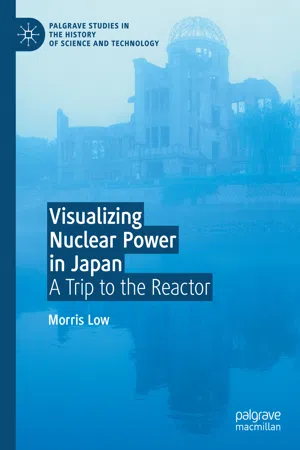
This book explores how Japanese views of nuclear power were influenced not only by Hiroshima and Nagasaki but by government, business and media efforts to actively promote how it was a safe and integral part of Japan's future. The idea of "atoms for peace" and the importance of US-Japan relations were emphasized in exhibitions and in films. Despite the emergence of an anti-nuclear movement, the dream of civilian nuclear power and the "good atom" nevertheless prevailed and became more accepted. By the late 1950s, a school trip to see a reactor was becoming a reality for young Japanese, and major events such as the 1964 Tokyo Olympics and 1970 Osaka Expo seemed to reinforce the narrative that the Japanese people were destined for a future led by science and technology that was powered by the atom, a dream that was left in disarray after the Fukushima nuclear disaster in 2011.
- English
- ePUB (mobile friendly)
- Available on iOS & Android
eBook - ePub
About this book
Information
© The Author(s) 2020
M. LowVisualizing Nuclear Power in JapanPalgrave Studies in the History of Science and Technologyhttps://doi.org/10.1007/978-3-030-47198-9_11. Introduction: Visualizing Nuclear Power in Japan
Morris Low1
(1)
School of Historical and Philosophical Inquiry, University of Queensland, Brisbane, QLD, Australia
Background
The Fukushima nuclear disaster that began on 11 March 2011 was a critical moment in Japanese history. It prompted many people throughout the world to ask why the Japanese people had embraced nuclear power and maintained faith in the energy source, despite having experienced its destructive force in Hiroshima and Nagasaki. This book seeks to answer that question by examining how the Japanese people have seen nuclear power. Atomic energy is not easily visible to the eye unless it is used in some way. We can certainly see its destructive force in the form of a mushroom cloud. It can also be seen in the emblem of the International Atomic Energy Agency (IAEA) which was established in 1957 to promote “atoms for peace”: an atom encircled by laurels. The IAEA symbol tends to underplay the death and destruction associated with the bomb, portraying the uses of atomic energy in terms of a simplistic binary opposition.
In the wake of the Fukushima nuclear disaster and amid revelations that components of nuclear weapons have secretly been stored at American bases in Japan in the past, we have come to appreciate how the Japanese people have been encouraged to see nuclear power in a positive light to facilitate the introduction of civilian nuclear power in Japan and at the same time to ensure that Japan has some technical know-how should it ever seek to arm itself with nuclear weapons. This book is about that journey which culminated in the introduction of British and American nuclear reactor technology and Japanese efforts to make nuclear power its own.
This book seeks to make a contribution to the history of science and the emerging fields of sensory history1 and visual politics.2 The story of Plato’s cave reminds us how contingent our perceptions can be and the danger of equating what we see with reality. It is this illusion of authenticity that makes the visual so powerful and lends itself to appropriation by government discourses that purport to make knowledge claims. This book highlights the active role of the visual in understanding post-war Japanese history. It was not only through hard work and effort that Japan was rebuilt but also through the senses that the Japanese people grappled with the new post-war world. Any study of visuality must pay heed to not only what was seen but also what was hidden.
Outline of Chapters
Chapter 2 examines how visuality was a consideration in the use of the atomic bomb on Japan. The US government helped shape public perceptions of who in Japan was to blame for the war and the use of the atomic bomb on Hiroshima and Nagasaki was meant to send a strong visual message to Japan, providing the emperor and wartime leaders with a moral justification for surrender. A narrative quickly took hold among the Japanese people that linked deficiencies in science and technology to Japan’s defeat in 1945. During the US-led Allied Occupation of Japan (1945–1952), critique of the use of the atomic bomb was discouraged. Physicists such as Yukawa Hideki3 possessed the specialist knowledge that could make the workings of the atom visible but they were the exception. Anyone who has seen photographs of the effects of the atomic bomb in Hiroshima and Nagasaki would be aware of their affective power. The disfigured and dead bodies of the victims are difficult to view without a sense of horror and revulsion. But the ordinary Japanese person would not see such images of human suffering until the Occupation was well and truly over. Not long after the bombs were dropped, how the Japanese saw the atom was heavily controlled. The suppression of photographs and film footage of the human toll at Hiroshima and Nagasaki shows how politically sensitive representations of nuclear power could be. Censorship of public discussion in the mass media4 occurred alongside Occupation attempts to re-educate the Japanese in a highly visual manner using exhibits to promote various narratives of how the Japanese would live in a new, more democratic and scientific Japan. Despite censorship, the Occupation was marked by a boom in the publication of popular science magazines.5 As a result, the atomic bomb was seen more abstractly and more in terms of the power of the atom and how it might be harnessed. Occupation efforts and post-war campaigns to promote US-Japan relations and atoms for peace were effective, given the relative absence of images that reminded the public of the cost to human life.
This book differs from previous accounts of the history of nuclear power in Japan in terms of the attention given to exhibitions, events and representations. While some readers may be familiar with aspects of that story, this book introduces readers to two hitherto neglected figures who throw light on the role of the USA. The first is Frances Baker who worked in the Exhibits Branch, Information Division, Civil Information and Education Section, General Headquarters (GHQ), Supreme Commander of the Allied Powers (SCAP). After the Occupation, Baker worked from the US Embassy in Tokyo for the US Information Agency (USIA) or US Information Service (USIS) as it was known in Japan. In 1954, she married and became known as Frances Blakemore. Her activities provide a window to how the mass media, exhibitions, films and major events helped shape public attitudes towards US-Japan relations, “atoms for peace” and more broadly towards the role of science and technology in Japan’s future. The second little-known figure is Clark D. Goodman, an American physicist who went to Japan initially on a Fulbright Fellowship, 1954–1955 and then visited again in 1956 and 1957. Goodman’s reports provide a valuable window to the development of nuclear power in the 1950s.
The Japanese were actively encouraged after the war to see civilian nuclear power in a positive light and to dismiss concerns about its safety in an earthquake-prone nation. This book reveals how Japanese attitudes were actively shaped by the Japanese, the USA and British governments, as well as by scientists, media, business figures and industry to view the peaceful atom as inextricably linked to Japan’s future. All these players gave the peaceful atom meaning. Although official discourses were contested by concerned citizens, artists and scholars, it is nevertheless striking how the Japanese people have, when surveyed in the past, distinguished between civilian and military nuclear power as if the two were unconnected. By examining forms of visual display which were used to construct knowledge about the atom and how reactors worked, we will come to understand how the Japanese public were actively manipulated. There is a direct relationship between what people know and what they are shown. This book has the simple premise that what people were permitted to see after World War II shaped public attitudes towards the use of civilian nuclear power.
This book argues that public attitudes to nuclear power were shaped by strong interactions between representations and discourses. Despite continuing anxieties about nuclear weapons, a narrative formed that Japan would turn its back on nuclear weapons (the bad atom) and embrace civilian nuclear power. The scientific nature of the discourse around nuclear power created an illusion that it was objective and that nuclear power was safe. It was also part of an American-inspired dream where science could lead Japan. One prime example of how exhibitions promoted US-Japan relations was the 1950 America Fair which Baker helped plan. It is discussed in Chap. 2. The America Fair reflects how after the war, the USA strived to help Japan rebuild its economy and to ensure that its future was aligned with theirs.
The fair which was held in Nishinomiya city, near Kobe and Osaka, permitted Japanese to gain a taste of what it would be like to descend from a Pan Am plane in New York City and see the Statue of Liberty, albeit in scaled-down form. The fair was a milestone in the post-war Americanization of Japan, presenting the Japanese with reproductions and imitations of well-known monuments, historic sites and scenes. Those who visited the imitation White House at the Fair and saw a replica of Mount Rushmore knew what they saw was not the real thing but they were willing to momentarily suspend disbelief and entertain the idea that they could enjoy and live the American dream in Japan. It is the contention of this book that how nuclear power was made visible to the Japanese people also involved a suspension of disbelief which shaped how they saw themselves, their future and the atom.
Exhibitions helped project images of the new Japan. The Japan Trade and Industry Fair known as the Kobe Fair was also held in 1950. It highlighted how Japan had made progress in foreign trade and industry. In the Culture Hall, visitors would learn about the Atomic Age and the contributions made by Japan’s first Nobel laureate in physics, Yukawa Hideki. And in the following year, Frances Baker was involved in the “Democratization of Japan” exhibition held in San Francisco in September 1951 on the occasion of the signing of the peace treaty.
At the same time as Frances Baker was producing wartime propaganda in Hawaii and then overseeing American-sponsored exhibitions in Japan, we see in Chap. 3, how the Japanese artist Akamatsu Toshiko illustrated patriotic children’s books in Japan and then started painting the famous Hiroshima panels with her husband Maruki Iri from the late 1940s. The mural-sized painting decried war and the use of nuclear weapons at Hiroshima and Nagasaki. They toured the nation and would also be exhibited throughout the world.
Chapter 4 explains how as early as 1950, some American politicians sought to link the development of atomic energy and economic aid. In both Japan and the USA, there were calls for helping Japan to exploit atomic energy given what the Japanese had experienced at Hiroshima and Nagasaki. US President Dwight D. Eisenhower’s “Atoms for Peace” speech at the UN in December 1953 flagged a new policy for the promotion of peaceful applications of nuclear technology which the Japanese government was eager to take advantage of. “Atoms for Peace” was not just a construct but a reflection of how many Americans, including politicians and physicists, saw atomic energy as an “agent of redemption”6 that could enable the atomic bomb to become a source of energy and prosperity for the peoples of the world.
In Chap. 5, we examine how a sense of victimhood was exacerbated in the aftermath of the Lucky Dragon Incident in March 1954 when crew members on a tuna fishing boat were exposed to radioactive fallout. The ensuing controversy and panic about contaminated tuna incited nationwide concern about the dangers of radiation and nuclear weapons. It was a turning point, heralding more discussion of the dangers of the bomb. At the same time, though, focus on the Lucky Dragon served to hide the fate of other fishermen on other vessels that had also been affected. In the aftermath of the incident, we can point to strong efforts to promote US-Japan relations and “atoms for peace” through films, trade fairs and exhibitions which served to influence public attitudes by structuring and organizing how the Japanese people saw nuclear power. The Family of Man exhibition that toured Japan in 1956 emphasized the universality of humanity and sought to downplay what had occurred at Hiroshima and Nagasaki.
The Japanese public avidly consumed the spectacle of atomic energy at the Atoms for Peace exhibits that toured Japan in 1955 and 1956. The exhibitions used models, artefacts, films and information panels to provide immersive settings in which people could learn about nuclear power. Combined with extensive press coverage, there was an air of excitement created about what the peaceful atom could offer Japan. In this way, the Japanese and US governments, media outlets and business men delineated what the Japanese people saw and didn’t see. In the background, though, was knowledg...
Table of contents
- Cover
- Front Matter
- 1. Introduction: Visualizing Nuclear Power in Japan
- 2. Before and After Hiroshima
- 3. Picturing Hiroshima
- 4. The Beginnings of Atoms for Peace in Japan
- 5. Nuclear Testing in the Pacific: The Lucky Dragon Incident and the Family of Man
- 6. Living in Fear: Nuclear Films
- 7. Making Atomic Dreams Real: 1956–1958
- 8. Seeing Reactors at Tōkai-mura, Trade Fairs, Department Stores and in Films: 1957–1971
- 9. Shaping the National Narrative: From Hiroshima to Fukushima and Beyond
- 10. Conclusion
- Back Matter
Trusted by 375,005 students
Access to over 1.5 million titles for a fair monthly price.
Study more efficiently using our study tools.
Frequently asked questions
Yes, you can cancel anytime from the Subscription tab in your account settings on the Perlego website. Your subscription will stay active until the end of your current billing period. Learn how to cancel your subscription
No, books cannot be downloaded as external files, such as PDFs, for use outside of Perlego. However, you can download books within the Perlego app for offline reading on mobile or tablet. Learn how to download books offline
Perlego offers two plans: Essential and Complete
- Essential is ideal for learners and professionals who enjoy exploring a wide range of subjects. Access the Essential Library with 800,000+ trusted titles and best-sellers across business, personal growth, and the humanities. Includes unlimited reading time and Standard Read Aloud voice.
- Complete: Perfect for advanced learners and researchers needing full, unrestricted access. Unlock 1.5M+ books across hundreds of subjects, including academic and specialized titles. The Complete Plan also includes advanced features like Premium Read Aloud and Research Assistant.
We are an online textbook subscription service, where you can get access to an entire online library for less than the price of a single book per month. With over 1.5 million books across 990+ topics, we’ve got you covered! Learn about our mission
Look out for the read-aloud symbol on your next book to see if you can listen to it. The read-aloud tool reads text aloud for you, highlighting the text as it is being read. You can pause it, speed it up and slow it down. Learn more about Read Aloud
Yes! You can use the Perlego app on both iOS and Android devices to read anytime, anywhere — even offline. Perfect for commutes or when you’re on the go.
Please note we cannot support devices running on iOS 13 and Android 7 or earlier. Learn more about using the app
Please note we cannot support devices running on iOS 13 and Android 7 or earlier. Learn more about using the app
Yes, you can access Visualizing Nuclear Power in Japan by Morris Low in PDF and/or ePUB format, as well as other popular books in History & Japanese History. We have over 1.5 million books available in our catalogue for you to explore.