This book illustrates the importance of conflicting narratives in understanding and dealing with crime, based on a variety of cutting-edge research. Offenders tell stories about crime and punishment, as do policemen, judges and defence lawyers, but so do politicians and the media. Each tells them very differently and only some stories are believed, while others are rejected as implausible leading to conflict. This book explores how these conflicts are carried out and what relationships exist between (often unquestioned) master narratives and (sometimes loud, sometimes silent) counter-narratives? These are questions of central importance for criminology which have thus far received little attention.
This edited collection is international and interdisciplinary in scope, providing empirical insights from such diverse contexts as (social) media, newspapers, comics, police interrogations, social and criminal justice settings, and museum exhibitions. By including contributions froma wide spectrum of academic disciplines and using different methodological approaches, it is of particular interest to students and researchers in criminology and sociology, as well as to scholars of socio-legal studies.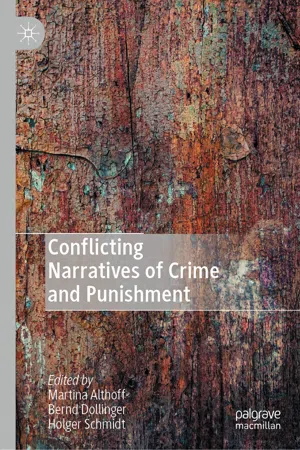
eBook - ePub
Conflicting Narratives of Crime and Punishment
- English
- ePUB (mobile friendly)
- Available on iOS & Android
eBook - ePub
Conflicting Narratives of Crime and Punishment
About this book
Information
© The Author(s) 2020
M. Althoff et al. (eds.)Conflicting Narratives of Crime and Punishmenthttps://doi.org/10.1007/978-3-030-47236-8_11. Fighting for the “Right” Narrative: Introduction to Conflicting Narratives of Crime and Punishment
Martina Althoff1 , Bernd Dollinger2 and Holger Schmidt3
(1)
Department of Criminal Law & Criminology, University of Groningen, Groningen, The Netherlands
(2)
Department of Education & Psychology, University of Siegen, Siegen, Nordrhein-Westfalen, Germany
(3)
Department of Social Education, Adult Education and Early Childhood Education (ISEP), TU Dortmund University, Dortmund, Nordrhein-Westfalen, Germany
Introduction
Narratives are a constitutive part of the talk of crime. Whenever an event is interpreted as “crime” and reactions to it are determined, stories are established. Events are described, responsibilities ascribed, justifications sought, alternative interpretations evaluated, etc. In other words, crime is contested by devising and rejecting narratives. Narratives are linguistic and cultural patterns of the construction of crime that organise the production of crime. By “patterns” we mean that narratives do not simply exist. They are established and negotiated in social and institutional processes. Some narratives can be established in these processes in the longer term, others will be forgotten or wither. This is a conflictual process. But what exactly it means to link narratives and conflicts in the context of criminality and punishment has hardly been examined in detail so far, and this is what this volume seeks to illuminate.
Narratives
Our starting point is the observation that for a narrative understanding of crime it is necessary to consider conflicts or questions of hegemony and subversion to a greater extent than has hitherto been the case. In order to explain this more closely in the following, we first describe our view on narratives, then we go into more detail on conflicts or rather the question of what can or should be regarded as hegemonic or subversive.
So what do we understand by narratives? First, it should be noted that there is little consensus on this term (Ryan 2008a). Narratives are understood very differently. Nevertheless, key points that are often associated with narratives can be stated, such as that they are a special form of linguistic (or textual) communication. To place narratives (or stories, as used synonymously here) at the centre of analysis follows a linguistic turn that does not merely see communication as a representation of a non-verbal reality, but ascribes a particular intrinsic value to narratives (Nash 1990). The currently growing interest of criminologists in stories and storytelling goes back to the assumption that narratives create a specific form of crime reality: they are to be taken seriously because they constitute crime as such or at least make it communicable without simply depicting it (Presser 2009). Accordingly, crime is not spoken about, but crime is spoken. There may be “objective” events, e.g. physical actions that lead to the injury of one person by another. However, such events only become “violence” or “crime” if they are related in a special way. This relation concerns form and content:
In formal terms, certain conditions must be met for crime to be narrated. Events must be given a certain form so that they can be narratively understood and represented as crime. With reference to narrative theories (e.g. Bruner 1991; De Fina and Georgakopoulou 2012; Ewick and Silbey 1995; Polletta et al. 2011) we emphasise three formal aspects: relationally connected participants, activities, and characteristics; a relatively high communicative value, and a temporal sequence.
Firstly, narratives of crime provide relationally connected participants including peculiarities attributed to them such as responsibility, motives, and actions (Dollinger 2020): perpetrators harm others, victims suffer, policemen investigate. Offenders bear responsibility, victims do not. Offenders have a motive, victims usually do not. Without such actors, activities and characteristics, one can hardly speak of “crime” (Watson 1976). Secondly, narratives mark an event with these participants and attributes as something special, because the event is worth telling. Narratives assign events a value of “tellability” (Ryan 2008b): minor events are not told, but dealt with as routine or they are—at most—reported, but not related to as a story; if there is a story for an event, it has to be of interest to a more or less large circle of people. Something has happened that is worth becoming the subject of a story. Criminality often has a particularly high tellability; in media and politics, crime is a recurring theme (e.g. Greer 2005; Simon 2007; Surette 2011). Thirdly, as a narrative, an event is given the form of a temporal course (Labov and Waletzky 1967). If no change over time becomes apparent, it would not make sense to speak of a story; it is the most important formal characteristic for identifying narratives. Narratives imply movement or change, whereby in the case of crime the time-bound actions of people (sometimes of organisations or institutions) are communicated: something is stolen; someone is murdered, deceived, injured, lied to, aborted, betrayed, and much more. What these very different forms of action have in common is the assumption of a temporal sequence. The situation before the narrated event is different from the situation after the event, because, in the meantime, according to the narrative, an offence has occurred.
In addition to formal features, crime narratives can be identified by their content. The formal roles, activities and characteristics of the participants mentioned can vary in their content depending on the respective story. Sometimes it is assumed that there is a given set of narratives with specific roles. According to this view, the limited cultural spectrum of possibilities to tell stories can only be varied by individual narratives, while the core stories themselves are fixed. In relation to crime and especially to perpetrators, Youngs and Canter (2012) mention four possible narrative roles of a perpetrator: as a powerful revenger who fights against external resistance; as a tragic hero struggling with fate; as an actor driven by external circumstances and alienated from other persons; as a powerful and professional actor. Other scholars reject the idea of a limited, culturally predetermined set of narratives. They instead derive from the assumption that narratives are situation- and context-dependent constructions which therefore need to be reconstructed from the respective interactions of a narrative process (c.f. De Fina and Georgakopoulou 2012; Sacks 1995). The focus here is on how people are indicating to each other that they are telling a story, which, furthermore, has a specific meaning for them. Depending on the context of a narration, different contents are negotiated, whereby in the case of “crime” the violation of criminal law norms always becomes a topic. For this reason, the relevant stories usually contain (at least) perpetrators and victims as well as a related, temporally aligned actions of these two role holders. The evaluation of this action—or non-action, if applicable—is usually unambiguous: crime is something forbidden, i.e. the narrated actions are evaluated negatively. The pejorative meaning can be modified in individual cases, for example if crime is understood as a kind of resistance, as fun or emotional stimulation (e.g. Ferrell et al. 2015; Katz 1988). Nevertheless, this ascription only varies the underlying narrative scheme, according to which crime itself is to be assessed negatively. Crime narratives therefore do not have any arbitrary content—and yet crime can be told in very different ways (Dollinger 2020). What is meant by “crime” varies greatly according to historical and cultural conditions. Moreover, there are often different versions of an event at a certain place at a certain time.
In view of these differences and (possible) conflicts, the credibility of stories must be justified and negotiated (Nünning 2015). Whoever speaks of crime is confronted with the task of convincing others of a certain course of action, of assigning roles (of perpetrators, victims, witnesses, etc.), of attributing responsibilities, etc. This can take place in “small” informal publics, such as in an everyday conversation, or in highly formalised contexts such as a court hearing. In any case, what “really” happened must be told credibly and plausibly. Alternative ways of telling an event must be delegitimised so that a particular story can be credible. Stories of crime have a special characteristic compared to many other stories: although crime is often the subject of controversy and there are numerous narratives of crime and punishment, there are still instances—despite all the contradictions and contingencies of relating crime—that make ultimate decisions about which narratives are “right” (Barrera 2019). Criminal justice has the authority to determine which actions can be identified as crime and should be sanctioned. Judges act as decision-makers on the truth of narratives, even if they are controversial and although it is clear that people in court present their story with special interests because they want to influence a trial in their favour (Komter 1998).
The cultural embedding of crime stories d...
Table of contents
- Cover
- Front Matter
- 1. Fighting for the “Right” Narrative: Introduction to Conflicting Narratives of Crime and Punishment
- Section I. Foundation
- Section II. Popular and Everyday Narrations of Crime and Punishment
- Section III. Crime Narratives in Social and Criminal Justice
- Section IV. Media Outrages and Narrations of Gender, Crime and Migration
- Back Matter
Trusted by 375,005 students
Access to over 1.5 million titles for a fair monthly price.
Study more efficiently using our study tools.
Frequently asked questions
Yes, you can cancel anytime from the Subscription tab in your account settings on the Perlego website. Your subscription will stay active until the end of your current billing period. Learn how to cancel your subscription
No, books cannot be downloaded as external files, such as PDFs, for use outside of Perlego. However, you can download books within the Perlego app for offline reading on mobile or tablet. Learn how to download books offline
Perlego offers two plans: Essential and Complete
- Essential is ideal for learners and professionals who enjoy exploring a wide range of subjects. Access the Essential Library with 800,000+ trusted titles and best-sellers across business, personal growth, and the humanities. Includes unlimited reading time and Standard Read Aloud voice.
- Complete: Perfect for advanced learners and researchers needing full, unrestricted access. Unlock 1.5M+ books across hundreds of subjects, including academic and specialized titles. The Complete Plan also includes advanced features like Premium Read Aloud and Research Assistant.
We are an online textbook subscription service, where you can get access to an entire online library for less than the price of a single book per month. With over 1.5 million books across 990+ topics, we’ve got you covered! Learn about our mission
Look out for the read-aloud symbol on your next book to see if you can listen to it. The read-aloud tool reads text aloud for you, highlighting the text as it is being read. You can pause it, speed it up and slow it down. Learn more about Read Aloud
Yes! You can use the Perlego app on both iOS and Android devices to read anytime, anywhere — even offline. Perfect for commutes or when you’re on the go.
Please note we cannot support devices running on iOS 13 and Android 7 or earlier. Learn more about using the app
Please note we cannot support devices running on iOS 13 and Android 7 or earlier. Learn more about using the app
Yes, you can access Conflicting Narratives of Crime and Punishment by Martina Althoff, Bernd Dollinger, Holger Schmidt, Martina Althoff,Bernd Dollinger,Holger Schmidt in PDF and/or ePUB format, as well as other popular books in Social Sciences & Criminology. We have over 1.5 million books available in our catalogue for you to explore.