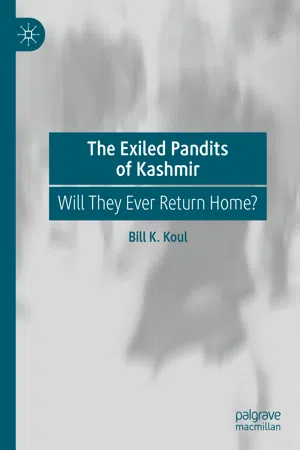
This book discusses all the questions related to Kashmiri Pandits and their relation and current issues regarding their return to Kashmir. The book explores the importance of return of Kashmiri Pandits for Kashmir and both major Kashmiri communities, especially those who really want to return home, out of their own volition and for all right reasons.
The book shows how to bring about a reasonable and realistic degree of practical and sustainable reconciliation between the two communities, whilst trying to make them stand in each other's shoes, understand each other's perspective and pain and then self-introspect sincerely, so that a bridge of mutual trust and acceptance is rebuilt between the two communities, which can then allow those Pandits who genuinely want to return cross over and be home.
- English
- ePUB (mobile friendly)
- Available on iOS & Android
eBook - ePub
About this book
Information
© The Author(s) 2020
B. K. KoulThe Exiled Pandits of Kashmirhttps://doi.org/10.1007/978-981-15-6537-3_11. Introduction
Keywords
ExodusConspiracyGeo-politicsBritish ExitArticle 370GenocidePower tussleVictims of an International Socio-religious Political Conspiracy
The world has not changed much since the human race came into existence about 200,000 years ago except that the human number increased significantly post the dawn of Industrial Age, during the last 400 years or so. Humans still eat, breed and hunt just like their ancestors did; the only difference being that their mannerism and weapons became more sophisticated and subtle over time. At no stage have humans lost their connivance. The current human sophistication may be just skin-deep. When it comes to power—social, religious, military and political—and competition, humans can be as or perhaps more dangerous than other animals.
In this day and age—with muscle, might and majority continuing to be right—if an ethnic community demographically comprises less than 5% of the population in their homeland, or around 0.06% of their country’s population and 0.01% of global population, would they make any difference to anyone other than themselves? Their numbers may be considered as traces and, therefore, insignificant, both in the country of their birth and elsewhere in the world. In anthropological and sociological domains, however, they may be considered as significant, as any ethnic group on the planet. But can they be considered important in statistical or political domains? Those members of the community, who know the answer to this question, silently strive on through individual endeavours and manage to survive wherever they exist, whereas others—a much smaller group—who don’t seem to know, or pretend not to know the answer, seemingly make futile noise for their human political rights. Who will listen to them? The situation of this community becomes exacerbated as they exist as individuals, or as individual families, dispersed across their country and globally elsewhere. Their individualistic survival skills, with shades of selfishness and high intelligence, may also have jeopardised their emergence as a forceful community to reckon with.
The community that we are talking about are the Pandits of Kashmir, commonly known as Kashmiri Pandits (KP), the indigenous people of the Kashmir. And they are endangered, given their low birth rate. They are the only people in the subcontinent who have historically been entitled to use the title Pandit (Pt) before their name (e.g. Pandit J.L. Nehru), which refers to a combination of virtues, such as being learned, educated, knowledgeable, wise and intelligent.
Until 1990, Kashmiri Pandits comprised just under 5% of the total population of Kashmir, as most of them are reported to have had converted to Islam over the last seven centuries, since about 1339—for a range of reasons—during the reigns of various non-Kashmiri Muslim rulers, as noted in Appendix A of this book, which provides a brief history of Kashmir.
Politically, Kashmir is administered in parts by three Asian nuclear powers: about one-half of Kashmir is administered by India, about one-third by Pakistan (PoK and Gilgit-Baltistan, since 1947) and about one-fifth by China (Aksai Chin and the Trans-Karakoram Tract, since 1962–1964). Geographically, Kashmir is thus situated within the world’s heaviest militarised zone.
On 31 October 2019, the Indian-administered Kashmir became a part of the Union Territory of Jammu and Kashmir. Prior to that, Kashmir was a part of the erstwhile State of Jammu and Kashmir (termed herein as the ‘State’), of which Ladakh was also a part. Historically, up to 26 October 1947, it was a princely state and not a part of independent India. Since 1954, the State had enjoyed a special status in the Union of India through the provision of Article 370 that featured in both the Constitution of India and the Constitution of Jammu & Kashmir, which empowered the State to have a separate constitution, a State flag and autonomy over its internal administration. In a sudden move, on 5 August 2019, the Government of India abrogated Article 370. Subsequently, on 31 October 2019, the Jammu and Kashmir Reorganisation Act was passed by the Indian parliament and the erstwhile State of Jammu and Kashmir was divided into two union territories: Union Territory of Jammu and Kashmir and Union Territory of Ladakh.
Kashmir has traditionally been known for its natural scenic beauty but, more recently, also for a volatile political environment and armed militancy. In the distant past, however, about a millennium and half ago, it was a world-renowned centre of learning of Kashmir Shaivism and the Buddhist philosophies.
The Kashmir valley (34.1667° N, 74.7500° E), about 135 km in length and 32 km in width, is located between the Great Himalayas and the Pir Panjal Range, at a height of about 1620 m above mean sea level. The valley is under the control of India. Geographically, it is bounded by:
- Xinjiang to the northeast
- Tibet to the east
- Pakistan to the west
- Afghanistan to the northwest
- Jammu to the south
As a result of an international socio-religious political conspiracy, which gave birth to an armed uprising in Kashmir in 1989–1990, hundreds of Kashmiri Pandits were killed by the militants and the remaining were coerced and forced to leave everything behind and flee—in extreme distress and confusion—to save their lives and honour in unfamiliar alien environment outside Kashmir. In essence, they became collateral victims of an international conspiracy that conceived, supported and fuelled an armed uprising against Indian interests in Kashmir.
It has been nearly three decades since they lost their home, but no one has ever claimed any responsibility for their loss or apologised to them. As always, politically, they remain insignificant. After their exodus, they dispersed around the world and became a global community. Given their global exposure, which is expected to have possibly caused a significant dilution and erosion of their culture—language, food and spiritual values—one can’t be very sure if they continue to be the Pandits that they used to be in the traditional sense of the word. However, it may be too early to conclude if Kashmiri Pandits have been an unfortunate community or their homeland has been unfortunate to have lost them. History will tell.
The Truth
There was a time, not very long ago, when the world was envious of Kashmiris and their peaceful living. Ladies, wearing gold ornaments, would walk home alone during the dead of night, without fear. In the early 1980s, Kashmir was one of the most peaceful places in the world. The author remembers the day, in the late 1970s, when he was in high school and the whole of Kashmir was stunned with shocking news of a stabbing-death incident, committed by a Nepalese domestic helper, which spread like a wild fire through the valley. Till then, Kashmir people had not heard about any murders in Kashmir. At the most, some ruffians would use Kashmiri kangris (a clay-pot, filled with burning charcoal, used in winter months, to warm one’s hands) or their foreheads as their weapon in late-night street brawls.
And it stayed like that until about the mid-1980s. Kashmir changed forever when armed militancy gripped the valley from the late 1980s.
How ironical is it that armed militants—or terrorists, when seen from the other side—who claim to fight for any cause or mission, howsoever noble or just that mission may be, cause and contribute to immense and irreparable damage to the mission and the image of their own community whom they claim to represent. They selfishly ignore the fact that there will always be serious repercussions from their violent acts, which their community members will have to bear. Violence has never been accepted or forgotten by people. As a psychological reaction, people tend to forever stereotype the members of the killer’s community, howsoever peaceful and humane they may be otherwise. In most cases, they also face ramifications for no individual fault of theirs. This sad irony of life goes on to prove that militants (or terrorists) are not friends of anyone, neither of their own community nor of the people they target.
The question now is not if and when Kashmiri Pandits can return home to their Kashmir valley; the question is how many of them will ever be ready to return to live there permanently, and not just visit their home for summer holidays. Another important question is why their return should be encouraged and facilitated.
Kashmir will live only if its spirituality and culture are revived. Its poets and mystics must be promoted at social, literary and political levels. It is important that Kashmiris take pride in their indigenous culture and literature and rediscover their rich cultural uniqueness and true identity. A country is characterised by its culture; if culture is eroded, the foundations of the country are eroded. For a while, its name may cover it as a shell, while imposters erode its core. In time, it will perish. A tree will wither away if its roots are not nourished.
Kashmir is India’s problem, and not its neighbour’s. India has been and shall remain responsible for the future of Kashmiri Pandits. Kashmiri Pandits and Kashmir are amongst India’s core issues.
If Kashmiri Pandits had been waiting for the abrogation of Article 370 in the Constitution of India, their return to their homeland is highly improbable considering the manner in which the Article was abrogated on 5 August 2019.
How
How can Mother Kashmir, called Maej Kasheer in common Kashmiri language, ever be complete without Kashmiri Pandits, her indigenous children? How long will the Kashmiri Pandits be miffed, muffled and deliberately side-lined from any socio-political talks about Kashmir, and their genuine human issues be used by various political parties and numerous selfish individuals for political leverages and material gains?
How can any everlasting and sustainable peaceful solution be devised and deemed to be successful without building trust and bringing closer the hearts of the people belonging to the two Kashmiri communities—the Muslims and the Pandits?
How can any solution be arrived at without considering the root causes—both indigenous and geopolitical—that have led to a continued strife in Kashmir since 1947, eventually forcing the Pandit community to leave their home suddenly in 1990 and thereafter?
How can one talk about solution(s) to both perceived and not so obvious politico-social and religious issues in Kashmir without knowing or having any kind of understanding about the people, as well as about the rich but complex history of this heavenly landlocked valley of Kashmir, which carries immense mythological, historical, spiritual, religious, educational, cultural, geopolitical significance?
Three Decades Since the Exodus
It is true that most Kashmiri Pandits were left with no choice but to leave their homeland in January 1990, and thereafter, for a number of reasons, which included:
- The failure of the Government of India,
- The failure of the State Government of Jammu and Kashmir,
- The failure of law and order in the State of Jammu and Kashmir and
- Inability of Kashmiri Muslims—neighbours, friends and colleagues—to instil confidence and a sense of security in their Pandit brethren community at a time when hundreds of members of the Kashmiri Pandit community were deliberately targeted and killed by the militants—of both foreign and local origins—as part of an ill-conceived scare campaign that was scripted, produced and directed across the LoC. It is true that many Kashmiri Muslims were also targeted for being perceived to have pro-India feelings and leanings. But for such violence, the recent history of Kashmir would undoubtedly have been different!
It has been nearly three decades since Kashmiri Pandits were uprooted from their native Kashmir. For political and technical reasons, they are being called Kashmiri migrants, and not refugees. Many of them have died in exile in the last three decades.
If the median age of Indians is 29 years, one could say that the younger half of the Pandit population was born after their exodus and shall be carrying only the transmitted memories about Kashmir from their elders, if at all. Add to that those Pandits who would have been less than 5 years old at the time of the exodus. That would, therefore, leave only upper 30 to 40% of the total Pandit population—estimated between 500,000 and 800,000 (Essa, 2011)—to be concerned about Kashmir and craving to return home.
But many Pandits don’t know how and when they can return; they have been waiting—in illusion—for successive governments in India to perform some magic and create safe and congenial conditions in the valley for their return. But in essence, no Indian government has sincerely cared or will ever care for their cause, purely because they don’t form any significant vote bank. Also, because they are an educated and intrinsically peaceful community, they don’t carry any nuisance value to attract any meaningful attention from the government. Any care, if at all, has just be been cursory, with some lip sympathy for political correctness.
Despite the reality of their political impotence, they have allowed themselves to be exploited by many politicians and the so-called leaders for personal political and financial leverages, which is completely baffling considering they have been considered as an intelligent and wise community.
It is important that Pandits are made aware about their disillusion and provided with the right advice about how they can help themselves and restore the original tapestry of Kashmir’s cultural fabric. This book aims to dispel their disillusion and guide them along a path of possible reconciliation, albeit on an individual basis, with their Muslim brethren for the greater good of all.
And why should Pandits seriously think about helping themselves and reconnect on their own with Kashmir and their Kashmiri Muslim brethren? Realistically, because it is only a matter of time—the next three decades at the most—during which they have the opportunity to reconnect with their native Kashmir. After that, not many Kashmiri Pandits and Kashmiri Muslims would be alive who would have any memories of one another and their historical coexistence in Kashmir. In that scenario, Kashmir will become completely bereft of Pandits. How unfortunate would it be that Kashmiri Pandits and Kashmiri Muslims will become total strangers for each other!
Time is of the essence, and they are fast running out of time. This community is truly endangered. Unless they help themselves sooner than later, they will remain Kashmiris only in name—without roots. Pragmatism is the need of the hour for all Kashmiris.
The onus is on this older group of Pandits—comprising the upper 50% of the population—to reconnect with Kashmir and preserve their unique identity and culture.
- They owe it to their ancestors who endeavoured hard to earn...
Table of contents
- Cover
- Front Matter
- 1. Introduction
- 2. About Kashmiri Pandits
- 3. Political Orphans?
- 4. Issues in Pandit Community
- 5. Main Challenges for Kashmir
- 6. The Way Forward?
- Back Matter
Trusted by 375,005 students
Access to over 1.5 million titles for a fair monthly price.
Study more efficiently using our study tools.
Frequently asked questions
Yes, you can cancel anytime from the Subscription tab in your account settings on the Perlego website. Your subscription will stay active until the end of your current billing period. Learn how to cancel your subscription
No, books cannot be downloaded as external files, such as PDFs, for use outside of Perlego. However, you can download books within the Perlego app for offline reading on mobile or tablet. Learn how to download books offline
Perlego offers two plans: Essential and Complete
- Essential is ideal for learners and professionals who enjoy exploring a wide range of subjects. Access the Essential Library with 800,000+ trusted titles and best-sellers across business, personal growth, and the humanities. Includes unlimited reading time and Standard Read Aloud voice.
- Complete: Perfect for advanced learners and researchers needing full, unrestricted access. Unlock 1.5M+ books across hundreds of subjects, including academic and specialized titles. The Complete Plan also includes advanced features like Premium Read Aloud and Research Assistant.
We are an online textbook subscription service, where you can get access to an entire online library for less than the price of a single book per month. With over 1.5 million books across 990+ topics, we’ve got you covered! Learn about our mission
Look out for the read-aloud symbol on your next book to see if you can listen to it. The read-aloud tool reads text aloud for you, highlighting the text as it is being read. You can pause it, speed it up and slow it down. Learn more about Read Aloud
Yes! You can use the Perlego app on both iOS and Android devices to read anytime, anywhere — even offline. Perfect for commutes or when you’re on the go.
Please note we cannot support devices running on iOS 13 and Android 7 or earlier. Learn more about using the app
Please note we cannot support devices running on iOS 13 and Android 7 or earlier. Learn more about using the app
Yes, you can access The Exiled Pandits of Kashmir by Bill K. Koul in PDF and/or ePUB format, as well as other popular books in Politics & International Relations & Asian Politics. We have over 1.5 million books available in our catalogue for you to explore.