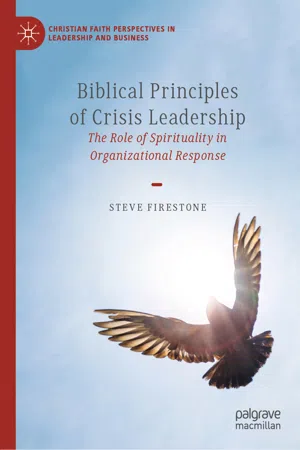
eBook - ePub
Biblical Principles of Crisis Leadership
The Role of Spirituality in Organizational Response
- English
- ePUB (mobile friendly)
- Available on iOS & Android
eBook - ePub
Biblical Principles of Crisis Leadership
The Role of Spirituality in Organizational Response
About this book
This book explores how spirituality can improve an organization's ability to respond to a crisis. It presents biblical examples of leading during a crisis to show how faith can be relied upon to lead during crisis situations. Further, it presents examples of leaders using their faith during trying times. In recent years, organizations have begun to prepare for crises, but scholarly research has not kept up with their efforts. Exploring topics such as communication, servant leadership, and resilience, this work stakes new ground in leadership theory and will foster future research into the role of spirituality during organizational crisis.
Information
© The Author(s) 2020
S. FirestoneBiblical Principles of Crisis LeadershipChristian Faith Perspectives in Leadership and Businesshttps://doi.org/10.1007/978-3-030-44955-1_11. Introduction
Steve Firestone1
(1)
Regent University, Virginia Beach, VA, USA
My Christian brothers, what good does it do if you say you have faith but do not do things that prove you have faith? Can that kind of faith save you from the punishment of sin? What if a Christian does not have clothes or food? And one of you says to him, “Goodbye, keep yourself warm and eat well.” But if you do not give him what he needs, how does that help him? A faith that does not do things is a dead faith. (James 2:14–17, New International Version)
Everyone who has existed on earth has experienced crisis. We should not forget that both birth and death are very real crises that we must go through. We all have also experienced crisis in the form of birth, death, injury, and pain to the ones we love. Just as everyone is unique, everyone’s response to crisis is different. Some respond to crisis by rushing at the problem and trying to solve any issues present, while others shrink from the challenges due to the overwhelmingness of them. Crisis response is much more than this “fight or flight” response. While we have all experienced crisis very few leaders have worked to better prepare for them. This book is intended to show leaders how their faith and an understanding of crisis leadership principles will help them deal with the inevitable crises that will come.
Think back to a time when you experienced a crisis. How did you respond? Were you ready for the events that followed the crisis? Did you have a plan to follow when the crisis hit? If you are like most people you answered no to these questions. The very fact that you found this book and opened it means you believe you could be better prepared for a crisis. My hope is that this book will provide you with the resources that will prepare you for the next crisis you face and will make you a better leader during a crisis.
Now think about the last time an organization you were a part of had a crisis. How did the organization respond? Was everyone ready for the events that followed the crisis? Was there a plan for the organization to follow when the crisis occurred? How did the leader respond to the crisis? It is this last question that is at the heart of this book. If in the last scenario you were the leader this book should be a great chance for you to review your leadership response during the crisis. If you were not the leader in the last scenario this book will provide you the foundation for being a Spiritual crisis leader who will be ready when the time comes.
Similar to how every person has experienced a crisis, every organization has experienced a crisis. Organizational crises range from the challenges seen during the organization’s creation to public relations missteps to personnel and financial challenges. Just like every person’s response to a crisis is different, an organization’s response to a crisis is just as varied. What is similar between the two is the typical lack of preparation for such crisis events.
Humans have experienced crises since the beginning of time. History tells us that since the earliest crisis, mankind has attempted to deal with these incidents, survive, learn from them, and be better for having survived them. Leadership theory dates to the mid-nineteenth century and the industrial revolution. While leadership theory has developed extensively since it was first begun, crisis leadership theory has not developed on pace with general leadership theory. Additionally, most of the books on leading during a crisis neglect to discuss how Christian leaders can use their faith to help their organizations through these difficult situations. This book is designed to provide the reader with an in-depth discussion of how they can better lead during a crisis by relying on their Christian faith. While many books on crisis leadership (and general leadership theory, as a whole) tend to focus on the individual as the key component, this book will focus on the Christian faith as the major point of emphasis.
Many people believe that the best preparation for a crisis is experience. Every day we get older we probably tend to agree with this emphasis on experience even more. While experience is important, it is not enough. We must prepare for crisis by using all of the resources available to us. In this book I will present a case for taking the time to prepare to better lead during a crisis. More importantly, I will show leaders how the Bible provides us a great deal of guidance on how they can better lead during the crises that come our way.
This book is intended to help leaders in all walks of life better prepare for crises. The emphasis here is on the broadest sense of the term leader. Leadership comes in a variety of shapes and sizes. When many people hear the word leader they think of a CEO, a president, commanding officer, or maybe a pastor. In this book the term leader is meant much broader and includes leaders at every level of an organization because leadership is present at every level and not just at the very top. Leadership is important in all the organizations present in the world not just the ones important to Wall Street or to Washington, DC. Leadership of the local church, Boy or Girl Scout Troop, or food kitchen is just as important. Going one step further, leadership at home in the family is just as important, if not even more, than the typical definition of a leader many people may have. This book is intended to help all leaders better deal with crisis. While many of the examples and stories included in this book will be aimed at leading a formal organization, the principles and techniques presented will work in every organization down to the smallest family unit.
The contents of this book are intentionally broad because there are many areas to be considered when we look at crisis leadership. The goal is to cover most, if not all, of the areas a Christian leader needs to consider when they prepare to lead their group through a crisis. Hopefully the material will cause leaders and researchers alike to reconsider their previous notions of crisis leadership and will cause them to spend more time on this important subject. Additionally, it is likely that the subjects included here will improve your leadership skills beyond just during times of crisis since many of the ideas presented are universal concepts of leadership that apply equally well during relatively calm times.
The Author’s Perspective
I think it is important that the reader understands where an author is coming from whenever they read their work. While the short biography included with most books can provide some insight into the mind and motivations of the author, it usually does not provide enough information to fully understand the author’s relationship with the subject matter. With this in mind I offer a brief summary of my experience with leadership and with crisis.
My interest in leadership began at an early age during team sports, Boy Scouts, and in Navy R.O.T.C. in college. While most of the examples of leadership I had were authoritarian leaders who tended to use a transactional style of leadership, I always felt called to lead with what I would later learn was a transformational style of leadership. My efforts were primarily based on trying to get the group to accomplish its goals. There was always an element of wanting the best for each individual but primarily I saw things from a transformational leadership perspective where I wanted everyone to be a valued part of the group. This made sense to me since I believed the team or group’s success would ensure each person’s individual success.
My move to more of a servant leadership style came during my early years in the Navy. As a young officer with twenty or more people working for me, I began to see how important the lives of each individual were and how their well-being really should be the focus of my leadership. I was constantly reminded by my superiors that if you “take care of your people, they will take care of you.” This very simple saying was enough to remind me that the needs of those following me should come first, even if the intent behind it still was not in keeping with servant leadership principles. As I studied servant leadership in my graduate studies, I began to see that my leadership style had many of the characteristics described of a servant leader but the key ingredient missing was intent. This intent came with the strengthening of my faith and it just began to seem obvious to me that we should be serving those following us.
This is not to say that servant leadership is easy to understand or to practice. Most of society today is telling us to act exactly the opposite of the way Jesus did as a true servant leader. While many organizations are starting to see the value of servant leadership and are embracing its principles it is still not generally accepted by most organizations who are more familiar with an authoritarian structure (Northouse 2019).
There may be some who read this book and wonder how they can lead with their faith in a secular organization. They may ask, “How can I be expected to lead from a Christian perspective when displaying faith in their workplace is either not allowed or is at least, highly discouraged?” I admit, it is easy for me, as an associate professor at a Christian university to suggest that our leaders should lead as Christians since I am encouraged to do so on a daily basis. I would offer that while it may be difficult at times to discuss your Christian principles, it should never be difficult to live them. As shown at the beginning of this introduction, scripture tells us very clearly in James 2:17 that “A faith that does not do things is a dead faith” (NIV). Our actions as leaders mean the most to our followers and there is nothing to stop us from leading as Christians, no matter where we work.
I would also offer that Christians today many times censor themselves in the workplace because of what they think the perception of Christians might be. I cannot remember one time during my 23 years in the Navy being told that I could not express my faith, but I can remember plenty of times when I did not express it for what I perceived would happen. I certainly am not advocating that people do things that will cause them to lose their jobs, but I do think we need to consider expressing ourselves more in the workplace when we can.
Intended Audience and Focus
This book is designed for Christian leaders in all organizations. The material will appeal to practicing Christians due to the advocacy of using faith during difficult times. It will certainly appeal to Christian leaders due to its reliance on practical leadership principles and examples that will help such leaders see the best methods for dealing with crises. Christian leadership scholars will be interested in the discussion of Spiritual leadership, organizational culture, and servant leadership in terms of leading during a crisis.
The main focus in Biblical Principles of Crisis Leadership is on how leaders can better lead during a crisis and what they can do to prepare themselves, and their organizations to successfully plan, prepare, and respond to these unplanned events. In recent years organizations have begun to prepare for such crises but scholarly research and discussion have not kept up with their efforts. My hope is to significantly close the gap between the practical and the theoretical understandings of crisis leadership. The content will be evenly split between practical advice on leading during a crisis and the scholarly aspects of crisis leadership. It is hoped that the provided information will have a lasting impact on leaders and will inspire additional scholarly research in this important subdiscipline.
I will discuss this more in Chapter 2 but I want to point out that the focus here is crisis leadership instead of crisis management. The distinction between the two is somewhat nuanced but is distinct enough that the emphasis needs to be pointed out. The distinction between the two is clear but the reader may notice a a slight amount of overlap between the two concepts in certain examples since there are some commonalities that both crisis leaders and crisis managers must accomplish when dealing with a crisis.
This book will also focus on how Spirituality can improve a leader’s, and an organization’s, ability to respond to a crisis. The importance of the leader’s Christian faith during a crisis will also be a focal point for this book. Biblical examples of leading during a crisis will be presented to show the reader how their faith can be relied upon to help them lead during crisis situations.
Summary
The intent of this book is to provide the leader the tools needed to be the best they can be before, during, and after a crisis while also encourage scholars to look into how Christian leaders can better respond to crises. In doing this I have broken down crisis leadership into ten separate topics. First, I will present an overview of what crisis leadership is and explain its relationship with organizational culture. Next, personal crisis and organizational crisis will be compared to see what leaders can learn from crises they have faced previously. Spiritual leadership and the reasons to rely on Christ will be discussed next to present how a leader can better lead from a Christian perspective and how this can improve their results during a crisis. Next the importance of communication during a crisis and a proposed method for dealing with a crisis will be presented followed by a discussion of how leaders can help their organizations to grow and develop enduring resilie...
Table of contents
- Cover
- Front Matter
- 1. Introduction
- 2. What Is Crisis Leadership?
- 3. Importance of Organizational Culture to Crisis Leadership
- 4. Personal Crisis and Its Relationship to Organizational Crisis Leadership
- 5. Spiritual Leadership and Crisis
- 6. Scripture as Guide and Comfort During a Crisis
- 7. Importance of Communication During a Crisis
- 8. Steps to Take During a Crisis
- 9. Growing and Improving from a Crisis
- 10. Crisis Leadership and Development of Organizational Resilience
- 11. Servant Leadership and Crisis Leadership
- 12. Conclusion
- Back Matter
Trusted by 375,005 students
Access to over 1.5 million titles for a fair monthly price.
Study more efficiently using our study tools.
Frequently asked questions
Yes, you can cancel anytime from the Subscription tab in your account settings on the Perlego website. Your subscription will stay active until the end of your current billing period. Learn how to cancel your subscription
No, books cannot be downloaded as external files, such as PDFs, for use outside of Perlego. However, you can download books within the Perlego app for offline reading on mobile or tablet. Learn how to download books offline
Perlego offers two plans: Essential and Complete
- Essential is ideal for learners and professionals who enjoy exploring a wide range of subjects. Access the Essential Library with 800,000+ trusted titles and best-sellers across business, personal growth, and the humanities. Includes unlimited reading time and Standard Read Aloud voice.
- Complete: Perfect for advanced learners and researchers needing full, unrestricted access. Unlock 1.5M+ books across hundreds of subjects, including academic and specialized titles. The Complete Plan also includes advanced features like Premium Read Aloud and Research Assistant.
We are an online textbook subscription service, where you can get access to an entire online library for less than the price of a single book per month. With over 1.5 million books across 990+ topics, we’ve got you covered! Learn about our mission
Look out for the read-aloud symbol on your next book to see if you can listen to it. The read-aloud tool reads text aloud for you, highlighting the text as it is being read. You can pause it, speed it up and slow it down. Learn more about Read Aloud
Yes! You can use the Perlego app on both iOS and Android devices to read anytime, anywhere — even offline. Perfect for commutes or when you’re on the go.
Please note we cannot support devices running on iOS 13 and Android 7 or earlier. Learn more about using the app
Please note we cannot support devices running on iOS 13 and Android 7 or earlier. Learn more about using the app
Yes, you can access Biblical Principles of Crisis Leadership by Steve Firestone in PDF and/or ePUB format, as well as other popular books in Business & Business Ethics. We have over 1.5 million books available in our catalogue for you to explore.