This book analyzes a significant group of contemporary historical fictions that represent damaging, even catastrophic times for people and communities; written "after the wreck," they recall instructive pasts. The novels chronicle wars, slavery, racism, child abuse and genocide; they reveal damages that ensue when nations claim an exalted, exceptionalist identity and violate the human rights of their Others. In sympathy with the exiled, writers of these contemporary historical fictions create alternative communities on the state's outer fringes. These fictive communities include where the state excludes; they foreground relations of debt and obligation to the group in place of individualism, competition and private property. Rather than assimilating members to a single identity with a unified set of views, the communities open multiple possibilities for belonging. Analyzing novels from Britain, Australia and the U.S., along with additional transnational examples, Susan Strehle explores the political vision animating some contemporary historical fictions.
eBook - ePub
Contemporary Historical Fiction, Exceptionalism and Community
After the Wreck
- English
- ePUB (mobile friendly)
- Available on iOS & Android
eBook - ePub
About this book
Information
© The Author(s) 2020
S. StrehleContemporary Historical Fiction, Exceptionalism and Community https://doi.org/10.1007/978-3-030-55466-8_11. Contemporary Historical Fiction: Exceptionalism and Community After the Wreck
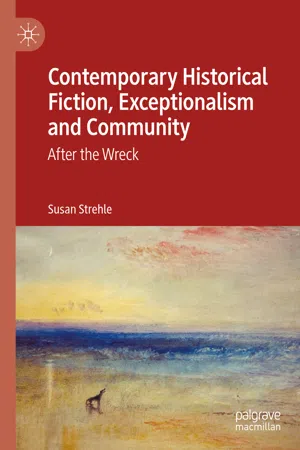
Late in his distinguished career, J. M. W. Turner painted the aftermath of an invisible tragedy. The watercolor of 1841 was named Dawn After the Wreck by John Ruskin, the Victorian critic and champion of Turner’s work; the work is also known as “The Baying Hound.” In the painting, sea and sky are lit with gold. A late crescent moon hangs in the sky and leaves a trail of white light across the sea and the wet beach. A bank of clouds at the upper right glows red, while the horizon at the left shows a mild pink. Deep aquamarine to frothy white, the sea breaks on the shore, but the waves are moderate, even tame. The seascape is peaceful, the dawn sky fair and glowing with early light. The wreck is invisible, except to the small figure of a scrawny hound in the foreground: tail down, head lifted to the sky, mouth open, the hound recalls, mourns, protests, and cries out to an empty landscape about what is past and absent. The canvas contrasts the lovely dawn morning on the beach and the hound’s isolated grief, a visible serenity and an implied catastrophe. Turner’s even more widely known oil painting, Slave Ship (Slavers Throwing Overboard the Dead and Dying—Typhon Coming On), similarly depicts mostly sea and sky, with the tragic narrative articulated by small signs in the foreground amid choppy waves: raised and imploring human hands, chains that bound slaves jettisoned by the ship. But Slave Ship, exhibited in 1840, referred to widely known stories of the jettison of living slaves, most famously in the Zong massacre,1 and it represents both sea and sky in shades of infernal fire and darkness. Dawn After the Wreck keeps enigmatic silence about the catastrophe mourned by the hound and focuses instead on the aftermath of historical tragedy (shipwreck, murder, cruelty, immitigable loss) as it haunts and grieves survivors in the midst of seeming peace.
“After the Wreck” speaks in several ways to and for the contemporary historical fiction explored in this book. Writers of a powerful group of historical novels written in the last quarter century represent moments of human wreckage generated by state and imperial exceptionalism: the invocation of an idealized national community that excludes its Others and legitimates violence against them. The novels represent sanctioned violations of human rights and widespread disavowals of the actions and implications of state violence. Referencing the Zong massacre, for example, living slaves are thrown overboard to drown in Unsworth’s Sacred Hunger because they are defined as insured cargo, objects with mercantile value, rather than members of a human community. In choosing to write about these moments, authors of recent historical novels take political positions from which they observe flagrant injustice in nationally sanctioned violations of human rights; they write from outrage as well as grief. They stand with the dog in Turner’s picture, giving voice to pain and anger as they narrate human, political, cosmic wrongs. The skies are bright with promise in the painting, however, and no observers gather to mourn what has disappeared; dog and author provide a witness to wake the unaware and the complacent. The dog’s solitariness is part of the pathos and loss; he mourns one or more companions, probably human, but he grieves alone. Where is the human community that should be gathered on the beach? Among the losses in historical moments of triumphant exceptionalism, the loss of kinship and collectivity with others ranks high; the dog alone howls, and the dog howls alone.
Historical fiction thrives at present, spurred by the drive to understand the moment and its roots. Among recent literary historical fictions, the kind I explore in this book represents histories “after the wreck”: histories of catastrophe, represented in vivid detail in order to mourn, commemorate, and warn. These novels chronicle civil wars, slavery, genocide, and oppression, violations of human rights and decimations of suffering people; they narrate not to explain and reassure that these events are safely past, but instead to trace the logic of their emergence and deadly progression. They expose the costs of such events and endeavors, to be sure; but their deeper and more compelling interest is in exploring the causes for the wreckage. As novels, they wonder first what sort of characters lead or engage in vast destructions of other peoples and how these characters understand their own motivations. Because the events are large, emerging from social units and grounded in political decisions, they wonder too what social and political attitudes legitimate destructive policies and actions and how personal motives intersect with political decisions. As a group, these contemporary historical novels imply that an understanding of the most damaging events in the past can illuminate our collective present—indeed, that we have an obligation to consider the wreckage of the past.
This book analyzes an important type of fiction that locates the origins of historical wreckage in state exceptionalism, or the claim of an exalted national identity. Exceptionalism evolves as an advanced form of nationalism which, as Edward W. Said writes, begins in “an assertion of belonging in and to a place, a people, a heritage”; what he calls “Triumphant” nationalisms selectively re-write history as “quasi-religious texts” that “consign truth exclusively to themselves and relegate falsehood and inferiority to outsiders” (2000, p. 176). Triumphant nationalism becomes exceptionalism, though Said does not use the term, when it turns a claim of belonging into an exclusionary principle and a narrative of national coherence into a claim of destined supremacy and global power. In Said’s view, all nationalisms progress toward this triumphalist phase. While American exceptionalism has been analyzed more than others, exceptionalism appears in the self-representation, immigration policies, and treatment of indigenous and minority peoples of most nation-states today. I argue that exceptionalist nationalisms also produce the very exile that Said addresses in his essay, “Reflections on Exile,” through their narrowing definitions of who belongs and who is relegated to the “immense aggregates of humanity” that “loiter as refugees and displaced persons” (2000, p. 177).
Exceptionalist nationalism constitutes a claim of community, indeed of exclusive community, in a nation-state distinguished by its ideals, its power, and the divine or historic favor it claims to enjoy as evidenced in its prosperity. In practice, however, the exceptionalist state isolates citizens in private forms of estrangement and exile. Far from abstract and passive entities, states act to enlist and interpellate citizens into their own constructed versions of an exceptional citizenry, a single unified homogeneous people who are bound to each other by shared understandings and values. The state then acts to discipline and police citizens into accord with their own governing logic, especially in relation to questions of belonging. The state relies on borders, distinctions, and exclusions: finding Others in its midst who have no place in the community of shared values, it denies their equality, rejects their right to belong, and disavows the violence with which they are placed outside. Since no citizen has fully incorporated the ideals of the original, mythic, and obedient citizenry, none can fully belong: the exceptional citizen is both righteous and wealthy, physically able, of a majority ethnicity and religion, in a respected profession and, of course, male. But many citizens fall short of these standards, and as a result they live a double life, not fully at home, always aware of impending discovery and fighting off the ravages of exile. The exceptionalist state thus rests on a perceptible contradiction, promising a communal belonging for which members yearn and providing only a thin simulacrum, limited to insubstantial gatherings of the same. It evokes the rich rewards of a diverse and inclusive community, one enabling meaningful dialogue and interaction, grounded in mutual respect and obligation, but it extinguishes the very possibility for such communities when it restricts belonging to a privileged few.
What in the contemporary moment would cause groups of novelists to write historical novels about exceptionalism and its damaging impacts on human community? When Virginia Woolf famously wrote, “On or about December, 1910, human character changed,”2 she was preparing support for an argument that because literature reflects contemporary culture, modern writers like Joyce and Eliot needed to change their tools and forms to reflect an altered character and world. Making the same connection in reverse, I argue that the changed forms of historical fiction, now focused on varieties of arrogant nationalism and the damaging exile of the nation’s Others, have arisen in response to real-world changes. The most powerful visual sign of the change, described by Said, appears near the end of Culture and Imperialism (1993): “For surely it is one of the unhappiest characteristics of the age to have produced more refugees, migrants, displaced persons, and exiles than ever before in history” (332). Indeed, the numbers of homeless exiles today have increased in ways Said could scarcely have imagined a quarter century ago, as the postcolonial conflicts he studied yielded to world-scale populist nationalisms making claims to exceptional rights for imaginary national peoples; these continue to produce war, dispossession, exile, and domestic exclusion of uncounted Others. Without the level of precision in Woolf’s “December 1910,” we can say that in the last few decades, many historical fictions have responded to a changing world landscape, to increasing national exceptionalisms, ongoing wars and internal conflicts, and massive displacements of peoples. Contemporary historical fictions of the kind analyzed in this book represent historical wreckage.
In response to the longing for more vital forms of social belonging, contemporary historical novels also represent extraordinary alternative counter-communities that form in resistance to exceptionalist pressures. The five fictions analyzed in this book imagine transformative communities of peoples whose differences cross race, gender, nationality, religion, age, education, ability, and political views. They often exist in the hinterlands rather than urban centers, as if to remain invisible to the state. Indeed, the five novels selected for analysis represent remarkable communities: in Unsworth’s novel, African slaves and British slave ship crew live together in an egalitarian and polyandrous social body governed by group consensus. Flanagan depicts socially and racially diverse Australian prisoners of war working together under extreme conditions to help each other survive. Morrison’s last two novels portray American communities that welcome and help those who have been rejected as Others. Erdrich represents Native communal groups that enable healing and growth after traumas both long-term, like the Indian schools, and immediate, like the accidental death of a child. Saunders imagines a community of ghosts, transforming their limited world to larger dimensions when they receive Others, experience empathy, and work together to accomplish change. These inclusive fictional collectives energize recent historical novels, suggesting the need for new models of social connection.
To map the complex territory explored in contemporary historical fiction, I begin by showing that exceptionalism supplies assumptions that not only enable and justify forms of social wreckage, but indeed sanctify the wreckage and cloak it in invisibility through habits of disavowal. This section of the introduction draws on the work of New Americanist scholars to develop the meanings, operations, and implications of exceptionalism, especially its exclusion of Others from the promised state community. A second section develops the potential meanings of community envisioned in contemporary historical fictions. I invoke here the work of a range of thinkers who define ethical and inclusive models of community that bind members through obligation and duty to the group. Replacing a vision of the exceptional state as an ahistorical polity of the same, united by private ownership and individual rights, recent historical novels imagine diverse communities of acceptance, obligation, kinship, and service. Chapter 2 places contemporary historical fiction in the genre’s history, arguing that while all historical fiction reflects on a shared public commons—the city, society, or nation—fictions of wreckage emerge when writers perceive the commons under threat.
To return, then, to my ekphrastic invocation of Turner, exceptionalism both constitutes and creates the invisible wreckage that troubles isolated but seemingly tranquil lives in modern nation-states, leaving debris perceptible to some citizens living in the compulsory shadow of disavowal. Contemporary novelists who write historical fiction of wreckage emulate the baying hound, expressing grief and anger over exceptionalism’s historical and ongoing damages. Their fiction calls a company of witnesses to mourn, protest, and collaborate, while it depicts the power of community to change lives and counter loss. It represents dramatic moments when historically invisible characters collaborate to create communal bonds, mutual responsibility, and more humane histories than those we inherit. This type of historical fiction exposes wreckage that has been made invisible; it also sketches the outlines of better communities emerging after the wreck.
Exceptionalism
Exceptionalism characterizes and serves nation-states and empires everywhere; it enabled the global slave trade, justified the seizure of lands from indigenous people all over the earth, and continues to demand the sacrifice of lives in war. Though it has been defined and interpreted most prominently in relation to the U.S.A., exceptionalism characterizes most nation-states. As a result, one prominent type of contemporary historical nov...
Table of contents
- Cover
- Front Matter
- 1. Contemporary Historical Fiction: Exceptionalism and Community After the Wreck
- 2. Historical Fiction and Wreckage: Hilary Mantel and Amitav Ghosh
- 3. Slavery and the Maroon Community: Barry Unsworth, Sacred Hunger
- 4. War and Communities of Suffering: Richard Flanagan, The Narrow Road to the Deep North
- 5. Racism and Communities Beyond Race: Toni Morrison, Home and God Help the Child
- 6. Indian Schools and Kinship Communities: Louise Erdrich, LaRose
- 7. Disavowed Others and Ghostly Communities: George Saunders, Lincoln in the Bardo
- 8. Global Fictions of Wreckage and Unsheltered Communities
- Back Matter
Trusted by 375,005 students
Access to over 1.5 million titles for a fair monthly price.
Study more efficiently using our study tools.
Frequently asked questions
Yes, you can cancel anytime from the Subscription tab in your account settings on the Perlego website. Your subscription will stay active until the end of your current billing period. Learn how to cancel your subscription
No, books cannot be downloaded as external files, such as PDFs, for use outside of Perlego. However, you can download books within the Perlego app for offline reading on mobile or tablet. Learn how to download books offline
Perlego offers two plans: Essential and Complete
- Essential is ideal for learners and professionals who enjoy exploring a wide range of subjects. Access the Essential Library with 800,000+ trusted titles and best-sellers across business, personal growth, and the humanities. Includes unlimited reading time and Standard Read Aloud voice.
- Complete: Perfect for advanced learners and researchers needing full, unrestricted access. Unlock 1.5M+ books across hundreds of subjects, including academic and specialized titles. The Complete Plan also includes advanced features like Premium Read Aloud and Research Assistant.
We are an online textbook subscription service, where you can get access to an entire online library for less than the price of a single book per month. With over 1.5 million books across 990+ topics, we’ve got you covered! Learn about our mission
Look out for the read-aloud symbol on your next book to see if you can listen to it. The read-aloud tool reads text aloud for you, highlighting the text as it is being read. You can pause it, speed it up and slow it down. Learn more about Read Aloud
Yes! You can use the Perlego app on both iOS and Android devices to read anytime, anywhere — even offline. Perfect for commutes or when you’re on the go.
Please note we cannot support devices running on iOS 13 and Android 7 or earlier. Learn more about using the app
Please note we cannot support devices running on iOS 13 and Android 7 or earlier. Learn more about using the app
Yes, you can access Contemporary Historical Fiction, Exceptionalism and Community by Susan Strehle in PDF and/or ePUB format, as well as other popular books in Literature & Literature General. We have over 1.5 million books available in our catalogue for you to explore.