Chapters 6, 7, 9 and 10 are available open access under a Creative Commons Attribution 4.0 International License via link.springer.com.
eBook - ePub
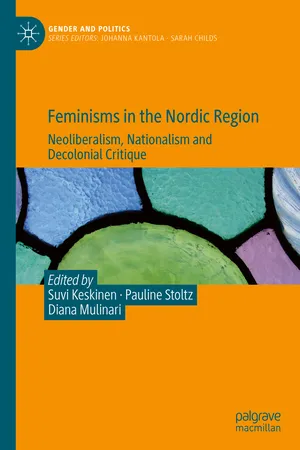
Feminisms in the Nordic Region
Neoliberalism, Nationalism and Decolonial Critique
- English
- ePUB (mobile friendly)
- Available on iOS & Android
eBook - ePub
Feminisms in the Nordic Region
Neoliberalism, Nationalism and Decolonial Critique
About this book
This book explores how feminist movements in the Nordic region challenge the increasing gender, race and class inequalities following the global economic crisis, neoliberal capitalism and austerity politics, and how they position themselves in the face of the rise of nationalism and right-wing populism. The book contextualizes these recent events in the long histories of racial and colonial power relations embedded in Nordic societies and their gender equality and welfare state regimes. It examines the role of whiteness and racism and seeks to decolonize feminist knowledge and genealogies of feminist movements in the region. The contributions provide in-depth knowledge on the different orientations, dilemmas and tactics that feminisms develop in these challenging times and show the centrality of antiracist and decolonizing critiques of feminisms. They further highlight the strategies of feminist and related antiracist and indigenous movements in regards to ideas about hope, solidarity,intersectionality, and social justice.
Information
Subtopic
Politica europea© The Author(s) 2021
S. Keskinen et al. (eds.)Feminisms in the Nordic RegionGender and Politicshttps://doi.org/10.1007/978-3-030-53464-6_11. Contextualising Feminisms in the Nordic Region: Neoliberalism, Nationalism, and Decolonial Critique
Pauline Stoltz1 , Diana Mulinari2 and Suvi Keskinen3
(1)
Department of Politics and Society, Aalborg University, Aalborg, Denmark
(2)
Department of Gender Studies, Lund University, Lund, Sweden
(3)
Swedish School of Social Science, University of Helsinki, Helsinki, Finland
Elle Marja: [to Njenna] ‘Don’t yoik at school…’.Sami Blood (2016)
Khaled: ‘Listen. I fell in love with Finland’.The Other Side of Hope (2017)
Sámi Blood [Sameblod] (2016) is a Swedish film, written and directed by Amanda Kernell.
The Sámi are the only recognised Indigenous people in Europe, and they live in Norway, Sweden, Finland, and the Kola Peninsula in Russia. The first aforementioned quote is from a moment in the film Sámi Blood [Sameblod] when 14-year-old Elle-Marja and her younger sister Njenna attend a nomad school in the 1930s—this is a boarding school for Sámi children. Here, a Swedish teacher teaches the children Swedish, and lets them know their place in Swedish society. A ‘yoik’ or ‘joik’ is a traditional form of song in Sámi music. To speak Sámi—or, as Elle-Marja explains to her sister, to yoik at school—will result in beatings which need to be avoided.
Amanda Kernell found inspiration for the film in her memories of stories by her grandmother. The film follows the character of Elle-Marja (who later calls herself Christina), as she navigates Swedish assimilationist education policies for Sámi children. The children are taught Swedish but refused higher education due to racist policies that position them as inferior. Additionally, Elle-Marja has to deal with her family and the Sámi community’s expectations about her behaviour. In other words, the film questions the relation between indigenous rights as human rights and the human right to education for Sámi children on the one hand, and on the other, how Swedish colonial policies have impacted Sámi peoples. It does this by describing and considering what happens to Ella-Marja’s hope for a just and equal future as we move through the 1930s to the beginning of this century.
In the Finnish film The Other Side of Hope (2017), directed by Aki Kaurismäki, Syrian refugee Khaled applies for asylum in Finland, but hides in a restaurant, after his asylum application has been denied. However, Waldemar, the restaurant owner, offers him both a job and refuge, and helps him look for his missing sister. Waldemar shows a form of solidarity, in contrast to the racist thug who nearly stabs Khaled to death. Similar to the aforementioned film and quote, there is a tension between hope and despair, and between solidarity and profound self-interest.
The politics of hope and solidarity are two recurring themes in this edited volume about feminisms in the Nordic region. The book is the result of a Nordic network on ‘The Future of Feminisms in the Nordic Region’ (2016–2017). Five Nordic universities—Aalborg University (Department of Politics and Society/FREIA), Lund University (Centre for Gender Studies), University of Oslo (Centre for Gender Research), Roskilde University (Department of Society and Globalisation), and University of Turku (Department of Sociology)—received funding from NOS-HS and the Nordic Council of Ministers/NIKK) to organise a series of workshops. Coordinated by Pauline Stoltz, Suvi Keskinen, Diana Mulinari, Beatrice Halsaa, and Christel Stormhøj, these workshops gathered a diverse group of participants who were encouraged to identify and discuss the commonalities and specificities of feminist movements in the Nordic countries; the present status of state feminism (Hernes 1987); and the transnational relations within feminist communities.
How, we ask, do feminist movements react to global crises such as the economic crisis of the last decade, with its roots in neoliberal capitalism, and austerity politics as its initial outcome? How do feminist movements position themselves in the face of the rise of right-wing populism and the extreme right movements that have flourished in the last two decades in Europe? We might also add among the crises of our times the others inevitably appearing in the wake of the COVID-19 pandemic that is unfolding at the time of writing. How do feminist movements react to increasing gender and class inequalities, and blatant racism? Which challenges are faced by feminist movements and feminist activism in other social movements, such as antiracist and indigenous movements, in the Nordic countries today?
The Nordic gender political landscape has changed dramatically from the 1930s of the film Sámi Blood to the 2010s of The Other Side of Hope. The institutionalisation of parts of the feminist movement and the women’s movements in the Nordic countries (and globally) has made central questions around relevant strategies of cooperation, the risks of cooptation, and what forms of resistance to state and international organisations should be prioritised by feminist politics and research.
Topics regarding sexuality, ethnicity, race, citizenship, and religion have moved from being peripheral to (most) feminist movements to being at the centre of politics. This has transformed the political landscape in the Nordic region. Antiracist, queer, and transgender activists have expressed the need to rethink gender, racial, and sexual politics. Gender politics regarding care, power, and resources need to be reformulated to consider more carefully the intersection of gender with different axes of inequalities (see Siim and Stoltz 2015; Stormhøj 2015; Nyhagen Predelli and Halsaa 2012; de los Reyes and Mulinari 2005; Keskinen et al. 2009). In other words, these new contexts involve challenges for the strategies and ideas of feminist movements in the Nordic countries as regards ideas about hope, solidarity, gender equality, and social justice, both at home and abroad.
Feminisms in the Nordic Region and Beyond
Many of the questions we discussed in the network were not unique to the Nordic region. It is, for example, difficult to claim that austerity politics in the aftermath of the 2008 economic crisis strengthened neoliberalism (Perugini et al. 2019), and that rising trends of populism and nationalism are typical Nordic phenomena. We recognise resistance to feminism in the Nordic region today (e.g. Keskinen 2013; Mulinari and Neergaard 2014; Svendsen 2015) that is commensurate with other parts of the world. Graff et al. (2019) engage in discussions about the role of cultural understandings of gender and sexuality as articulated by the ‘global Right’. They identify similar trends in different parts of the world, arguing that anti-feminism is a central value of the global Right, and essential to how it mobilises support. Other researchers have pointed out the need to differentiate between the intertwined processes of neoliberalism, right-wing populism, and gender conservatism, as well as to identify more clearly the influence of different actors and their diverse agendas (Verloo 2018; Verloo and Paternotte 2018; Paternotte and Kuhar 2018).
However, there is little comparative exploration of how resistance to feminism or interpretations of gender equality work in different contexts across the Nordic region (but see Stoltz and Hvenegård-Lassen 2013). We could potentially relate such studies of anti-feminism to studies which situate feminisms as hegemonic over time, and analyse whether anti-feminism targets all feminists, or isolates and scapegoats specific types of feminisms, such as antiracist, postcolonial, or queer feminism.
While we have not conducted systematic investigations, a quick look at the publications in Nordic gender studies journals and the programmes of Nordic gender studies conferences indicates that antiracist, postcolonial, indigenous, and queer feminisms have (together with masculinity studies) become a central part of feminist themes and narratives in the early 2020s. This implies a clear change compared to, say, the 1970s or the 1990s, although the situation and the timespan of how feminisms have developed in the Nordic countries differ to some extent. The contributions in this book bear witness to the same trend, with questions of migration, (anti)racism, and (de)coloniality being placed at the forefront in most of the chapters.
The strong emphasis on questions of migration, (anti)racism, indigeneity, and (de)coloniality can be interpreted as a sign of changing feminist narratives, and the hegemonies embedded in and upheld through them. The use of the notion of hegemonic feminism identifies the power to define the narratives of feminist and women’s movements, and suggests that we can understand such hegemonic narratives through the perspective of intersectional inequalities and narrative struggles amongst a multiplicity of narratives (Stoltz 2020). In the period between the 1960s and 1990s, often referred to as feminism’s second wave, hegemonic feminist narratives in the Nordic region marginalised the narratives of antiracist feminists, queer and trans* feminists, and indigenous feminists. This in turn limited the space for other feminist knowledges and politics, as well as hindering possibilities for seeing other worlds. Additionally, such hegemonic narratives narrowed feminist visions to (binary) gender equality frames that were often grounded in a subordination to capitalist market logics (through normative understandings of the emancipatory capacity of paying women for some forms of labour), and the transformation of men taking some responsibility for care work.
In understanding feminism as a floating signifier (Davis and Evans 2016), in this volume we seek to explore how feminism as an idea, a project, and a community of belonging is produced and given meaning by actors inside and outside of feminisms, but also, how feminism is acted upon in different contexts in the Nordic region. This could also be of interest for those outside of the region, since there might be similarities and differences between different part...
Table of contents
- Cover
- Front Matter
- 1. Contextualising Feminisms in the Nordic Region: Neoliberalism, Nationalism, and Decolonial Critique
- 2. Co-optation and Feminisms in the Nordic Region: ‘Gender-friendly’ Welfare States, ‘Nordic exceptionalism’ and Intersectionality
- Part I. Feminist Struggles over Gender Equality, Welfare and Solidarity
- Part II. Decolonising Feminisms in the Nordic Region
- Part III. Antiracism and Speaking the Truth to Power
- Correction to: Feminisms in the Nordic Region
- Back Matter
Trusted by 375,005 students
Access to over 1.5 million titles for a fair monthly price.
Study more efficiently using our study tools.
Frequently asked questions
Yes, you can cancel anytime from the Subscription tab in your account settings on the Perlego website. Your subscription will stay active until the end of your current billing period. Learn how to cancel your subscription
No, books cannot be downloaded as external files, such as PDFs, for use outside of Perlego. However, you can download books within the Perlego app for offline reading on mobile or tablet. Learn how to download books offline
Perlego offers two plans: Essential and Complete
- Essential is ideal for learners and professionals who enjoy exploring a wide range of subjects. Access the Essential Library with 800,000+ trusted titles and best-sellers across business, personal growth, and the humanities. Includes unlimited reading time and Standard Read Aloud voice.
- Complete: Perfect for advanced learners and researchers needing full, unrestricted access. Unlock 1.5M+ books across hundreds of subjects, including academic and specialized titles. The Complete Plan also includes advanced features like Premium Read Aloud and Research Assistant.
We are an online textbook subscription service, where you can get access to an entire online library for less than the price of a single book per month. With over 1.5 million books across 990+ topics, we’ve got you covered! Learn about our mission
Look out for the read-aloud symbol on your next book to see if you can listen to it. The read-aloud tool reads text aloud for you, highlighting the text as it is being read. You can pause it, speed it up and slow it down. Learn more about Read Aloud
Yes! You can use the Perlego app on both iOS and Android devices to read anytime, anywhere — even offline. Perfect for commutes or when you’re on the go.
Please note we cannot support devices running on iOS 13 and Android 7 or earlier. Learn more about using the app
Please note we cannot support devices running on iOS 13 and Android 7 or earlier. Learn more about using the app
Yes, you can access Feminisms in the Nordic Region by Suvi Keskinen, Pauline Stoltz, Diana Mulinari, Suvi Keskinen,Pauline Stoltz,Diana Mulinari in PDF and/or ePUB format, as well as other popular books in Politica e relazioni internazionali & Politica europea. We have over 1.5 million books available in our catalogue for you to explore.