eBook - ePub
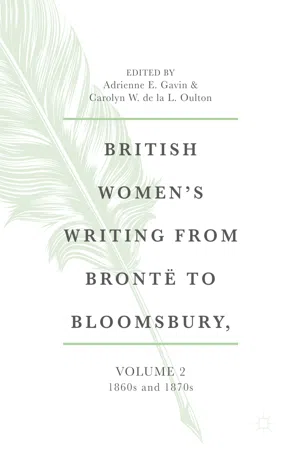
British Women's Writing from Brontë to Bloomsbury, Volume 2
1860s and 1870s
- English
- ePUB (mobile friendly)
- Available on iOS & Android
eBook - ePub
British Women's Writing from Brontë to Bloomsbury, Volume 2
1860s and 1870s
About this book
Information
© The Author(s) 2020
A. E. Gavin, C. W. de la L. Oulton (eds.)British Women's Writing from Brontë to Bloomsbury, Volume 2British Women’s Writing from Brontë to Bloomsbury, 1840-19402https://doi.org/10.1007/978-3-030-38528-6_11. Introduction
Adrienne E. Gavin1 and Carolyn W. de la L. Oulton2
(1)
Department of English and Language Studies, Canterbury Christ Church University, Canterbury, UK
(2)
School of Humanities, Canterbury Christ Church University, Canterbury, UK
This volume is the second in the five-volume series British Women’s Writing from Brontë to Bloomsbury, 1840–1940, which decade by decade critically reassesses women’s fiction, examining the ways in which it propels and challenges discourses of realism, sensation, and the new across a century of dynamic social, cultural, and technological change. Analysing confluences and developments in women’s writing across the 1860s and the 1870s, the 16 original chapters that follow critically reconsider fiction by canonical and lesser-known women writers, redefining the landscape of female authorship during these decades. By exploring women’s fiction within the social and cultural contexts of the 1860s and 1870s, the collection distils in terms of women’s writing how these decades discretely build on earlier work that is identifiably Victorian. In doing so, it reveals both points of departure and thematic and stylistic continuities.
The achievements and influence of the Brontës in the 1840s and 1850s, and of George Eliot from the 1850s, had already placed women’s writing in the spotlight. That these writers published pseudonymously in itself drew attention to the ambiguous status of women authors, whose proliferation had been the subject of much agitated commentary in the 1850s. From the 1860s the stage was set for an intense, even obsessive, examination of gendered authorship—the question of who could write what, for whom, and in what context, is played out across both literary criticism and fiction from this point in the nineteenth century.
Defined historically by decade, with chapters ordered chronologically to suggest shifting emphases in fiction as each decade progresses, the volume considers a broad range of developments in female writing. It reveals that women’s writing of the 1860s was able to incorporate melodramatic events into a realist mode, challenging readers to re-examine the type of novel they thought they were reading. In turn, female-authored fiction of the 1870s began to turn away from sensation to the serious, made women’s relationship to money central, and voiced the unvoiced including in relation to physical sensation and female desire.
From the emotive articles in the popular press one might be forgiven for thinking that by the 1860s ‘a book without a murder, a divorce, a seduction, or a bigamy, is not apparently considered worth either writing or reading; and a mystery and a secret are the chief qualifications of the modern novel’ (‘The Popular Novels’ 262). As the chapters in this volume show, sensation fiction does not have a monopoly on provoking or depicting physical sensation and affect, nor on representations of empathetic grief and difficult emotion. Following the death of Prince Albert in 1861 Queen Victoria entered a period of public mourning that persisted until her death 40 years later. The need to balance private feeling with public restraint emerges as a serious concern in a number of female-authored novels from this time.
Time itself is examined in new ways, as it becomes increasingly unstable or at least multivalent in the context of scientific discovery and technological advance. Time was at one and the same time hugely expanded by evolutionary theory, most notably propounded in Darwin’s On the Origin of Species in 1859, and—at the other end of the spectrum—collapsed through the sense of ever-increasing speed associated with the continued expansion of railway and transport networks throughout the 1860s and 1870s. As Elizabeth Ludlow argues in her chapter on Gaskell in this volume, that ‘the secret of Dunster’s murder (in A Dark Night’s Work [1863]) is uncovered through the process of railway expansion is indicative of how, in a decade that saw a boom in train lines, technological progress transformed the spatial and temporal landscape of individual lives.’ Indeed both Ludlow and Andrew F. Humphries here point to railway expansion as central to the discovery or solving of crimes, while ‘Gaskell responds to the pressures of time with an emphasis on the urgent need for reconciliation’ (Ludlow).
Greater mobility is also linked to the theme of disguise and the infiltration of the middle-class home by dissident adventurers in a number of sensation novels. The increasing difficulty of sustaining and policing social networks is set against the assurance that the criminal or interloper will finally be detected, as the rail network pits antagonists against each other in a race to discover or efface the past. The difficulty of recognizing figures from the past is also depicted in more nuanced ways across genres during these decades. Both Gaskell’s Sylvia’s Lovers (1860) and Ellen Wood’s East Lynne (1861) feature disfigured parents returning in disguise to see their children; while in Anna Sewell’s Black Beauty (1877) Black Beauty does not initially recognize ‘an old worn-out chestnut, with an ill-kept coat and bones that showed plainly through it’ as his once glorious friend Ginger (Black Beauty 131).
The volume is structured in two parts, each devoted to one decade so that specific trends can be identified. As Lucy Hartley observes, ‘the possibilities for a writerly life for nineteenth-century women were various and the gendered division of literary work from home work was surmountable, though not, as ever, without struggles or steadfastness’ (16). Both struggles and steadfastness are evidenced in women’s lives and fiction of the 1860s and 1870s, with female authors not only driving and adhering to new trends but also reacting against and varying them.
The 1860s were acutely conscious of the sensational possibilities offered by a new generation of writers. Exploring, complicating, or simply contesting this new genre provided one means by which a woman writer could define her own position in the literary marketplace. In the 1870s women writers continued to draw on the creative opportunities that 1860s sensation writing had made available. Developing an increasingly serious focus, some novelists such as Eliot and Sewell produced works that were at once powerfully affective and concerned with moral questions on a level deeper than the ‘moral’ or ‘improving’ literature that had so often been the assumed literary lot of the Victorian woman author. Women’s relationship to money also became a key 1870s concern.
Women’s Writing of the 1860s
The 1860s saw new developments in technology as well as the early stages of what has been termed the ‘Victorian crisis of faith’ in the context of the Higher Criticism and Charles Darwin’s On the Origin of Species (1859). At the same time, the press provided a new critical focus on women’s writing and intense debate over the limits within which it should confine itself, as well as a renewed attention to its impact on female readers in particular, who supposedly needed to be policed for their own safety. While for the increasingly public female author literature in these years might be ‘simply treated as an accessible profession’ (Peterson 47), the visceral nature of reading is nowhere better exemplified than in the supposed dangers of sensation fiction, in which the bodies of heroines on the page assume a dangerous physiological function in channelling not only affective responses but also physical arousal in their unsuspecting female readers.
The desire to redefine social identities as well as to establish connections and form new and extended social groups manifested itself in other ways during this decade as cartomania, the collection of small photographs and cartes de visite, reached a peak alongside the explosion of female-authored railway reading associated with W. H. Smith and the ever increasing dominance of Mudie’s circulating library. The debate over whether railway travel encourages the reading of more exciting, fast-paced fiction has never been wholly resolved. That it was widely believed to do so in the 1860s suggests that the publication of Lady Audley’s Secret in 1862, the same year that London Victoria railway station first opened a direct line to a public keen to find quicker and more convenient routes to the seaside resorts in Kent, is coincidental but could hardly have been better planned.
The modern women’s movement began in the 1860s, exemplified by the setting up of the feminist Victoria Press by Emily Faithfull in 1860, a parliamentary petition for female suffrage in 1866, John Stuart Mill’s drafting of an amendment (which failed to pass) to the Second Reform Act in 1867 that would have given voting rights to female property owners, and both the inauguration (as the College for Women) of Girton College, Cambridge, and the publication of Mill’s On the Subjection of Women in 1869. In 1869, too, the ‘Edinburgh Seven,’ led by Sophia Jex-Blake, became the first women to matriculate at a British university. Having won the right to study medicine at the University of Edinburgh, they were not allowed to take degrees or practise medicine (unless qualifying in Paris or elsewhere), but the opening of higher education to women had begun. In 1865 Elizabeth Garrett Anderson had become the first woman to be granted a licence to practise in medicine (through a loophole that was soon closed). The publication of Isabella Beeton’s Book of Household Management in 1861 and Eliza Warren’s bestseller How I Managed My Household on £200 a Year (1864) and How I Managed My Children from Infancy to Marriage (1865) stood as reminders of the ways i...
Table of contents
- Cover
- Front Matter
- 1. Introduction
- Part I
- Part II
- Back Matter
Trusted by 375,005 students
Access to over 1.5 million titles for a fair monthly price.
Study more efficiently using our study tools.
Frequently asked questions
Yes, you can cancel anytime from the Subscription tab in your account settings on the Perlego website. Your subscription will stay active until the end of your current billing period. Learn how to cancel your subscription
No, books cannot be downloaded as external files, such as PDFs, for use outside of Perlego. However, you can download books within the Perlego app for offline reading on mobile or tablet. Learn how to download books offline
Perlego offers two plans: Essential and Complete
- Essential is ideal for learners and professionals who enjoy exploring a wide range of subjects. Access the Essential Library with 800,000+ trusted titles and best-sellers across business, personal growth, and the humanities. Includes unlimited reading time and Standard Read Aloud voice.
- Complete: Perfect for advanced learners and researchers needing full, unrestricted access. Unlock 1.5M+ books across hundreds of subjects, including academic and specialized titles. The Complete Plan also includes advanced features like Premium Read Aloud and Research Assistant.
We are an online textbook subscription service, where you can get access to an entire online library for less than the price of a single book per month. With over 1.5 million books across 990+ topics, we’ve got you covered! Learn about our mission
Look out for the read-aloud symbol on your next book to see if you can listen to it. The read-aloud tool reads text aloud for you, highlighting the text as it is being read. You can pause it, speed it up and slow it down. Learn more about Read Aloud
Yes! You can use the Perlego app on both iOS and Android devices to read anytime, anywhere — even offline. Perfect for commutes or when you’re on the go.
Please note we cannot support devices running on iOS 13 and Android 7 or earlier. Learn more about using the app
Please note we cannot support devices running on iOS 13 and Android 7 or earlier. Learn more about using the app
Yes, you can access British Women's Writing from Brontë to Bloomsbury, Volume 2 by Adrienne E. Gavin, Carolyn W. de la L. Oulton, Adrienne E. Gavin,Carolyn W. de la L. Oulton in PDF and/or ePUB format, as well as other popular books in Literature & Literature General. We have over 1.5 million books available in our catalogue for you to explore.