eBook - ePub
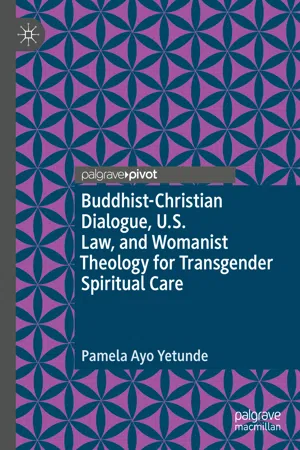
Buddhist-Christian Dialogue, U.S. Law, and Womanist Theology for Transgender Spiritual Care
- English
- ePUB (mobile friendly)
- Available on iOS & Android
eBook - ePub
Buddhist-Christian Dialogue, U.S. Law, and Womanist Theology for Transgender Spiritual Care
About this book
This book, written with hospital spiritual care providers in mind, investigates how to expand the field and scope of compassion within the hospital context, for the spiritual care and safety of transgender patients. Written by a law-educated pastoral counselor, it advocates for chaplain legal literacy, and explains the consequences of spiritual care providers not knowing more about the law. It explores the current political and legal situation transgender hospital patients find themselves in, and especially how these new policies put transgender people at risk when they are in a hospital setting. Pamela Ayo Yetunde offers Buddhist-Christian activist interreligious dialogue methods to promote deeper understanding of how spiritual practices can cultivate empathy for transgender patients.
Information
© The Author(s) 2020
P. A. YetundeBuddhist-Christian Dialogue, U.S. Law, and Womanist Theology for Transgender Spiritual Carehttps://doi.org/10.1007/978-3-030-42560-9_11. Buddhist-Christian Interreligious Dialogue for Spiritual Care for Transgender Hospital Patients
Pamela Ayo Yetunde1, 2
(1)
United Theological Seminary of the Twin Cities, St. Paul, MN, USA
(2)
Upaya Institute and Zen Center, Santa Fe, NM, USA
Pamela Ayo Yetunde
Abstract
The Pastoral Care profession in public hospitals in the United States has been largely populated and led by Protestant Christians. Buddhist practitioners have entered the field creating opportunities for Christian-Buddhist dialogue. Transgender US citizens are especially vulnerable to medical, social, and spiritual neglect in health care settings due to policy changes in the Department of Health and Human Services. Christians are also vulnerable to the manipulation of basic Christian principles by Trump and Pence. Buddhist-Christian dialogue can strengthen compassionate care and promote public practical theology for transgender hospital patients.
Keywords
BuddhistChristianTransgenderInterreligious DialogueLawIntroduction
First they came for the socialists, and I did not speak out—
Because I was not a socialist.
Then they came for the trade unionists, and I did not speak out—
Because I was not a trade unionist.
Then they came for the Jews, and I did not speak out—
Because I was not a Jew.
Then they came for me—and there was no one left to speak for me.
Lutheran pastor Martin Niemoller
Prescript. Years before I began writing this book, I anticipated President Trump would be impeached. He was impeached on December 18, 2019. COVID-19 was reported to the World Health Organization in late December of that year. Trump was acquitted on February 5, 2020, as the COVID-19 pandemic continued ravaging humanity. Before attention was paid to Trump’s dealings with Ukraine, and before COVID-19 reared its ugly head, our government targeted transgender people in nearly every facet and sector of American life. At the time of writing, COVID-19 is demanding something different from us—a political system that is transparent, responsive to public health concerns, economically nimble, and ceases the targeting of politically-vulnerable citizens. At this time, governments across the globe are aware of the desperate necessity of garnering nearly every possible resource to protect humanity from the scourge of the coronavirus. No country will “go it alone” and thrive. Communicable diseases remind us that we are all in this together, and spiritual care providers must attend to political situations outside our clinical contexts. What happens outside impacts what happens inside. Medical professionals (many of whom are wearing garbage bags for protective gear) are putting their lives as risk, and some are dying. This is a tragedy and travesty. Impeachment reminds us that the President is accountable to the US Constitution and Trump’s acquittal reminds us that in this Administration, foreign nationals are invited to meddle in our electoral processes without real consequence. Moreover, I hope these situations remind us, intergenerationally, that our survival as a species depends on recognizing and honoring our interdependence across gender, gender expression, sex, sexuality, sexual expressions, and all forms of human expression. This is what the Parable of the Good Samaritan or the Parable of Our Collective Survival, teaches us. Are we ready to learn?
Chaplains. We love chaplains who nonjudgmentally support us in times of need, often in places we don’t wish to be, or places we have a difficult time adjusting to. They represent the kinds of people Jesus talked about in The Parable of the Good Samaritan. Millions of Americans receive their primary spiritual care from “good Samaritan” chaplains,1 but chaplains are not known for collectively speaking out on behalf of the oppressed. I argue that pastoral and spiritual caregivers need to be involved in democratic institutions beyond voting; as educated, critically thinking spiritual leaders they hold the potential to wisely engage in the democratic process in ways that can contribute wisdom and compassion in the protection of minority rights while respecting religious freedom. Unfortunately, many spiritual care professionals are not prepared for such critical involvement because seminary education and Clinical Pastoral Education (CPE) are typically not infused with legal education. How might chaplains, spiritual caregivers, pastoral counselors, and chaplain educators with some education in US religious freedom law read Christian scriptures differently? More importantly, how might these spiritual caregivers and educators act differently?
Lawyers. We love lawyers when they successfully defend our rights; we hate them when they successfully defend the rights of someone suing or prosecuting us. Human rights lawyers are known for speaking out on behalf of the oppressed, but are not known for collectively offering spiritual care to those who are sick. Though this book is not written for lawyers, how might lawyers interpret laws differently, as the lawyer learned to do in his encounter with Jesus, if those interpretations were made with the sensibility of a spiritual caregiver?
Sagacious mystics. Everyone loves the wise person who sees us for who we truly are, without judgment, and who takes the time to direct our attention toward what is good. These people may irritate us when they puncture our egos, reminding us that we are not as great as we might imagine, and when they point out unseen forces in the universe greater than ourselves. They help us see beyond the mundane and they illuminate the sublime. Sagacious mystics, unlike chaplains and lawyers, tend to transcend professional categorization and do not separate their wisdom from their identities and their behavior. Scripture, law, and being are one.
So, what happens when the incisive lawyer confronts the mystical sage with questions about the rule of law and salvation, and the sage replies that caring for others is the path? This kind of confrontation unfolds in one of the most powerfully humanizing stories of all time: The Parable of the Good Samaritan (The Parable); but The Parable is under attack in the United States, especially with respect to transgender people. Why is it that a powerfully humanizing narrative would be intentionally threatened?
In the Christian Bible, in the Gospel of Luke, a lawyer asks Jesus what he must do in order to live forever. Jesus asks him how he interprets the law. The lawyer understands the law in this way: One must love God with every fiber of one’s being and love one’s neighbor as one loves oneself. Jesus affirms the lawyer’s understanding. Digging deeper, as good lawyers tend to do, the lawyer asks for Jesus’s definition of the word “neighbor.” Jesus tells the lawyer a story, a parable, about a man who is severely beaten and left for dead, even by religious leaders who see the dying man and cross to the other side of the road. A Samaritan, someone not esteemed in any religious or ethnic way, a commoner, perhaps even someone oppressed, gives the dying man aid and takes him to an inn for care. He pays the innkeeper, offering to pay even more than requested. The innkeeper takes the man into his care. After Jesus tells the story, he turns the question back on the lawyer, asking for his definition of the word “neighbor.” The lawyer responds by equating the word neighbor with the Samaritan—a neighbor is one who shows mercy, as the Samaritan showed mercy upon the dying man. Jesus affirms the answer and instructs the lawyer to do likewise.2 We do not know the end of the story; we don’t discover how the lawyer enacts or does not enact Jesus’s instruction. We do, however, know the story of a challenge to Jesus’s message, a challenge that is taking place in contemporary America. The Trump-Pence administration, in the name of Christianity, is currently flouting the Good Samaritan ethos. Why?
Prior to the 2016 presidential election in the United States, real-estate mogul and presidential candidate Donald J. Trump, with celebrity status and wealth but without a strong political base, struck a deal with some politicized and energized Christian evangelicals. These evangelicals sought political access and power they certainly would not have found with Trump’s opponent, liberal Protestant, feminist Hillary Rodham Clinton, a former first lady, US Senator, and secretary of state. Though candidate Trump did not espouse discrimination against transgender citizens in the presidential debates, the base brought their anti-LGBTQ and especially their anti-transgender agenda to his presidency. With the help of Russian meddling in social media and voting systems, Trump, despite his non-Christian lifestyle, became the darling of some Christian evangelicals, not to mention some African-American Christian pastors and many white nationalists, some of whom were and are in the Trump-Pence administration. Politics makes for strange bedfellows.
Trump entered the presidency on January 20, 2017. Just shy of a month in office, his administration eliminated federal protections that allowed transgender students to use bathrooms consistent with their gender identity.3 About one year later, President Trump said on Religious Freedom Day,
A Christian nun would not struggle between the tenets of her faith and The Parable, because The Parable is a part of her faith. A nurse would not struggle between The Parable and their profession, because The Parable is part of their profession. Through the equal protection clause of the Fourteenth Amendment, this country seeks to ensure that all citizens are treated as endowed with the same substance, thereby recognizing that no one is better than or more entitled to rights than anyone else. Under the Fourteenth Amendment, bakers and other business owners offering their services and products to the public may not deny their services and products to different classes of people; but that is indeed happening, and it is happening legally. The Parable is under attack in the name of religious freedom, but the Good Sama...Our Constitution and laws guarantee Americans the right not just to believe as they see fit, but to freely exercise their religion. … No American—whether a nun, nurse, baker, or business owner—should be forced to choose between the tenets of faith or adherence to the law.4
Table of contents
- Cover
- Front Matter
- 1. Buddhist-Christian Interreligious Dialogue for Spiritual Care for Transgender Hospital Patients
- 2. Spiritual Care and Political Involvement, Womanist Public Theology, and Boston Medical Center
- 3. Thich Nhat Hanh, the Avatamsaka Sutra, and Lady Mahamaya
- 4. Think Like a Lawyer, Act Like a Chaplain
- 5. A New “Shock Method” for Creating a Compassionate Health Care Team
- 6. Conclusions and Recommendations
- Back Matter
Trusted by 375,005 students
Access to over 1.5 million titles for a fair monthly price.
Study more efficiently using our study tools.
Frequently asked questions
Yes, you can cancel anytime from the Subscription tab in your account settings on the Perlego website. Your subscription will stay active until the end of your current billing period. Learn how to cancel your subscription
No, books cannot be downloaded as external files, such as PDFs, for use outside of Perlego. However, you can download books within the Perlego app for offline reading on mobile or tablet. Learn how to download books offline
Perlego offers two plans: Essential and Complete
- Essential is ideal for learners and professionals who enjoy exploring a wide range of subjects. Access the Essential Library with 800,000+ trusted titles and best-sellers across business, personal growth, and the humanities. Includes unlimited reading time and Standard Read Aloud voice.
- Complete: Perfect for advanced learners and researchers needing full, unrestricted access. Unlock 1.5M+ books across hundreds of subjects, including academic and specialized titles. The Complete Plan also includes advanced features like Premium Read Aloud and Research Assistant.
We are an online textbook subscription service, where you can get access to an entire online library for less than the price of a single book per month. With over 1.5 million books across 990+ topics, we’ve got you covered! Learn about our mission
Look out for the read-aloud symbol on your next book to see if you can listen to it. The read-aloud tool reads text aloud for you, highlighting the text as it is being read. You can pause it, speed it up and slow it down. Learn more about Read Aloud
Yes! You can use the Perlego app on both iOS and Android devices to read anytime, anywhere — even offline. Perfect for commutes or when you’re on the go.
Please note we cannot support devices running on iOS 13 and Android 7 or earlier. Learn more about using the app
Please note we cannot support devices running on iOS 13 and Android 7 or earlier. Learn more about using the app
Yes, you can access Buddhist-Christian Dialogue, U.S. Law, and Womanist Theology for Transgender Spiritual Care by Pamela Ayo Yetunde in PDF and/or ePUB format, as well as other popular books in Social Sciences & Psychotherapy Counselling. We have over 1.5 million books available in our catalogue for you to explore.