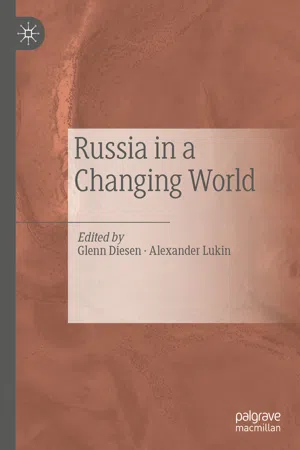
This book explores Russia's efforts towards both adapting to and shaping a world in transformation. Russia has been largely marginalized in the post-Cold War era and has struggled to find its place in the world, which means that the chaotic changes in the world present Russia with both threats and opportunities. The rapid shift in the international distribution of power and emergence of a multipolar world disrupts the existing order, although it also enables Russia to diversify it partnerships and restore balance. Adapting to these changes involves restructuring its economy and evolving the foreign policy. The crises in liberalism, environmental degradation, and challenge to state sovereignty undermine political and economic stability while also widening Russia's room for diplomatic maneuvering. This book analyzes how Russia interprets these developments and its ability to implement the appropriate responses.
- English
- ePUB (mobile friendly)
- Available on iOS & Android
eBook - ePub
Russia in a Changing World
About this book
Information
© The Author(s) 2020
G. Diesen, A. Lukin (eds.)Russia in a Changing Worldhttps://doi.org/10.1007/978-981-15-1895-9_11. The Military Underpinning of the Geopolitical Revolution
Sergey Karaganov1, 2
(1)
Faculty of World Economy and International Affairs, National Research University Higher School of Economics, Moscow, Russia
(2)
Presidium of the Council on Foreign and Defense Policy, Moscow, Russia
Among the reasons for the ongoing geopolitical revolution, unprecedented rapid change in the global balance of power away from the West and Europe and toward China and Asia—profound yet rarely noted shift of the military-political foundation on which world order is ultimately based. The world was “multipolar” until the sixteenth century, when Europe started to achieve military superiority that served as the basis of its economic, political, and cultural expansion and its ability to channel global Gross Domestic Product (GDP) to its own advantage. This situation began to change after the Soviet Union, and later China, developed nuclear weapons. This increasingly deprived the West of its ability to impose its interests through military force. Seeking to ensure its fundamental security interests, Russia has become a sort of “midwife of history” by largely ushering in the current shift in the global balance of power and by expanding the freedom of choice available to the world’s countries and peoples.
A Bit of Theory
The most important trend of the modern world is the relative weakening of the West—that had long dominated the world’s politics, economy, and culture—and the rise of other powers and civilizations, particularly those of Asia. This relative weakening is the main reason for the deepening Cold War-like rivalry today.
The many root causes of this macro-shift are the subject of much discussion in the international scholarly community. What is surprising, however, is how little attention has been given to what seems to me to be the single most important cause—namely, the loss by the West of its global military superiority, which Europe gained in the sixteenth and seventeenth centuries.
A great deal of literature examines how Europe managed to rise from its medieval nadir and come to dominate the world later alongside the U.S.1
Previously, this success was attributed primarily to Christianity and its code of ethics—and particularly to the Protestant work ethic and the ideology of building up savings and wealth through honest labor. There might be some truth in this explanation, but the Reformation that gave rise to Protestantism occurred only in the late seventeenth and early eighteenth centuries and did not cover the whole of Europe.
The strong work ethic was characteristic only of Protestant Europe. In any case, modern Europe—and particularly the formerly Protestant countries—has become almost completely a-religious, such that they can hardly be called “Christian” anymore. Among Western countries, Christian beliefs remain strong in the U.S.—the country that is also the most successful materially. What’s more, many of the other devoutly Christian countries in the world are relatively underdeveloped, and the work ethic in Japan and China or Korea is at least as strong, if not stronger than in the Protestant world. The people of those countries also save more. And, unlike China, Japan, and South Korea, the work ethic is becoming less pronounced in most Western countries—possibly due to the relative prosperity they have achieved.
In past centuries, theories of the racial “superiority” of white people were promulgated throughout most of Western culture, with the exception of Russia, as a way of explaining Europe’s success.
Political correctness and the powerful success of Asian countries have now pushed such theories aside.
The growth of democracy is often cited as one of the reasons for the success of the West. However, when Europe was developing at an especially rapid pace during the Industrial Revolution, most political regimes, even if they had formal elements of democracy, were, by modern standards, harshly authoritarian.
In other articles, I have written off the weakness of democracy (a very comfortable system for most) in terms of development. In fact, one can confidently state that democracy is not so much a tool of development as it is the prize for having achieved it.2 In addition, capitalism’s reliance on inequality contradicts democracy’s emphasis on equal rights.
In his writings, and particularly in his book “Civilization: The West and the Rest,” popular British/American historian Niall Ferguson provides the most complete list of reasons for the West’s dominance. They include competition, science, protection of property rights, a highly developed medical system, the consumer culture, and the work ethic. Overall, he points to the West’s standards and institutions as the reasons3 without making any mention of its military superiority. The only correct item on this list is property rights. A legacy of Roman law and the feudal period property rights form the basis of modern capitalism. And where such protections are ineffective, as in Russia—due to unsuccessful reforms in both the 1990s and 2000s—the economy develops slowly.
The other reasons Ferguson cites do not entirely hold water. Extreme forms of competition remain intrinsic to Chinese political and economic culture. China’s meritocratic system of exams for state officials is an obvious example. The Chinese axiom “Let 100 flowers bloom” largely lies at the heart of the country’s current economic success: it represents Beijing’s willingness to permit numerous economic and even political experiments at the grassroots. The authorities then encourage and disseminate the successful forms and either deem as dangerous or eliminate the unsuccessful ones. Of the hundreds of “flowers,” only a handful thrive and bloom. Those who have met students from Asia, and especially those of East Asia, know that they are more tenacious and hard-working and that they struggle harder than others to succeed.
It is unlikely that the development of science was the main reason behind the success of the West. In fact, science was far more advanced in Eastern civilizations until the sixteenth and seventeenth centuries and their scholars occupied a higher position in social hierarchies. Up until about the sixteenth century, much of what we would now call innovations and technical inventions were developed in the non-European world—by Arabs, Persians, the residents of present-day India and, of course, by the Chinese. These non-Europeans produced most of the world’s GDP, too. In modern phraseology, it was a multipolar world in the civilizational, political, cultural, and economic sense, with Europe being just one of the poles. Of course, the geographic scope of the world was smaller than today’s global community, and so that multipolarity also differed from today’s.
In Europe, relatively unhindered scientific research first appeared only four centuries ago. Recall the Inquisition, the mass burning of heretics like Giordano Bruno. The first universities appeared not in Europe, but in the Arab world. Relatively unrestricted scientific pursuits began developing in Europe only as recently as the seventeenth and eighteenth centuries.
The Age of Enlightenment, however, unquestionably played a significant role in strengthening first European, then Western, and from the eighteenth century, Russian civilization. But the accomplishments of the Enlightenment were also the result of these countries’ ability to invest more in science and education, and were partially based on income received from, among other things, the redistribution of world GDP in favor of Europe. This process had begun in the sixteenth and seventeenth centuries largely due to Europe’s ability to use its superior military might to impose its will on others (more on this below).
Similarly, 400–500 years ago, medicine was much more advanced in China, Persia, and the Arab world than it was in Europe.
The ideology of the consumer society apparently played a major role in the development of capitalism, especially in the Protestant, or lesser part of Europe. Catholicism and Orthodoxy, however, officially preached asceticism and detachment from material possessions.
Thus, these and similar explanations for the success of the West are either partially inadequate or entirely incorrect.
Although the combined effect of some of these factors might really have provided an advantage, they do not seem to explain fully how Europe and the West came to dominate the world for nearly 500 years.
This article will not dwell on the numerous reasons for the current weakening of Europe and the West. A vast body of literature already addresses that subject. I will, however, focus on what, as I have said, I believe to be the main reason, and one that is almost never cited—namely, the loss of the military superiority that Europe and the West enjoyed for the last half a millennium.
I will first allow myself to make several simple and almost trivial points. The cumulative power of states, their grouping, and even civilizations are determined by the dynamic combination of a number of factors. They include, though not necessarily in this order, military strength, economic power, their level of technological development, ideological and cultural attractiveness, the quality of leaders and ruling elites and their ability to adopt appropriate and timely policies, the governability of the countries and societies, the size and quality of the population and, most importantly—their will to fight, or what in Russian is referred to as “boldness of spirit” or “nerve.”
And of course, no country can succeed without a national goal and the willingness to pursue it by military means if necessary. J. Ortega y Gasset, perhaps the most famous Western philosopher of the twentieth century, formulated this idea as follows: “A people not experiencing any shame over the dissolution or poor organization of its armed forces is incapable of staying afloat or surviving.”4
Of course, it is a truism that foreign policy is an art, although such policy should be based on an accurate scientific understanding of trends in world development. Very often, however, it falls short due to intellectual or ideological limitations. Like traditional art, foreign policy is largely subject to the intuition and talent of leaders or ruling elites.
In addition, leaders’ roles vary in accordance with civilizational factors and the age in which they live. European monarchies became leadership democracies and then, in the last few decades, almost leaderless democracies (with countries such as Hungary and the U.S. the exceptions). In Asia, leaders play a much larger role, although the growing influence of public opinion born of the information revolution might limit their freedom of action.5
The great fourth century BC Indian strategist Kautilya (Chanakya) stated, as have many of his European and Chinese colleagues since: “From the strength of the treasury the army is born.”6 This is true, and a weak economy or excessive defense, security, and foreign policy expenditures have repeatedly undermined states—including my former country, the Soviet Union.
The role that excessive spending on defense and foreign policy has played in weakening the position of great powers is described in the almost classic works of British historian Paul Kennedy. His primary example is the U.S. of the 1960s–1980s. He also vividly described how excessive bureaucratization slows innovation and economic activity. In particular, he points to China during the Ming Dynasty (fourteenth to seventeenth centuries), and how the country began to gradually lose its lead in technology.7
In international competition, countries and societies naturally seek to emphasize their strengths.
During the heyday of U.S. economic might in the 1990s, President Clinton’s slogan, “It’s the economy, stupid,” seemed axiomatic. Accordingly, economists at that time occupied a leading position among the “high priests” of the social sciences—a standing they are now losing rapidly. For their part, European pundits almost always argued that the strength of the economy, the attractiveness of a high standard of living, and liberal democracy were most important. A great many people did, and still do believe them. Even while China is actually winning the game economically, while Russia, near the bottom of the Top Ten world economies, has managed—with its tough foreign policy, military might, and largely not liberal values that the overwhelming majority of the peoples of the world support—to surpass, in terms of aggregate power, all countries except China and the U.S.8
In the 1920s–1930s, ideologists of the poor and militarily weak Soviet Union promulgated the slogan of communism as the future of humanity. And until the 1950s–1960s, the country held an enormous influence in the world that far outweighed its economic, military, and even political might.
The theory of “soft power” by Joseph Nye arose during the wave of euphoria over the apparently decisive victory of “liberal democracy” and the West as a whole and served to underscore its strengths.9 That euphoria then led to a series of terrible failures. The interventions in Iraq and Libya ended in political calamities leading to hundreds of thousands of casualties and the rise of radicalism and terrorism. The NATO operations in Afghanistan also failed because they were based on the unreasonable idea of establishing a modern democracy in a traditional society.
Not only did the “Arab Spring” that the West supported ultimately fail, but it also destabilized the Middle East. The economic crisis that began in 2007–2008 also delivered a powerful blow to the ideological influence of the West. It undermined the myth of the infallibility of the Washington consensus model that the West had both offered and imposed on others. With the advent of D. Trump, something akin to a non-violent civil war against him by the majority of the U.S. elite started. The rise of so-called populism in Europe and the unfolding of multi-layered crises of the EU followed. In the process, the West somehow forgot about the ideological influence or its “soft power.”
Now the “information age” is being trumpeted, primarily in the West—one of the main bastions of influence of which is still exactly the sphere of information and mass media. Naturally, elites around t...
Table of contents
- Cover
- Front Matter
- 1. The Military Underpinning of the Geopolitical Revolution
- 2. Prefabricated World Order and Its Decline in Twenty-First Century
- 3. Russia and the Changing World Order: In Search of Multipolarity
- 4. Russia’s Economic Restructuring for the Fast-Changing Future
- 5. Securitizing Her Foreign Economic Policy: Evolution of the Russian Security Thinking in the 2010s
- 6. The Crisis in Liberalism and Renewal of Ideological Conflicts
- 7. Green Transformation of the World Economy: Risks and Opportunities for Russia
- 8. Energy in World Politics
- 9. Global Water Challenge and Prospects for Russian Agenda
- 10. Integration and Separatism in Europe: A Chance for Russia?
Trusted by 375,005 students
Access to over 1.5 million titles for a fair monthly price.
Study more efficiently using our study tools.
Frequently asked questions
Yes, you can cancel anytime from the Subscription tab in your account settings on the Perlego website. Your subscription will stay active until the end of your current billing period. Learn how to cancel your subscription
No, books cannot be downloaded as external files, such as PDFs, for use outside of Perlego. However, you can download books within the Perlego app for offline reading on mobile or tablet. Learn how to download books offline
Perlego offers two plans: Essential and Complete
- Essential is ideal for learners and professionals who enjoy exploring a wide range of subjects. Access the Essential Library with 800,000+ trusted titles and best-sellers across business, personal growth, and the humanities. Includes unlimited reading time and Standard Read Aloud voice.
- Complete: Perfect for advanced learners and researchers needing full, unrestricted access. Unlock 1.5M+ books across hundreds of subjects, including academic and specialized titles. The Complete Plan also includes advanced features like Premium Read Aloud and Research Assistant.
We are an online textbook subscription service, where you can get access to an entire online library for less than the price of a single book per month. With over 1.5 million books across 990+ topics, we’ve got you covered! Learn about our mission
Look out for the read-aloud symbol on your next book to see if you can listen to it. The read-aloud tool reads text aloud for you, highlighting the text as it is being read. You can pause it, speed it up and slow it down. Learn more about Read Aloud
Yes! You can use the Perlego app on both iOS and Android devices to read anytime, anywhere — even offline. Perfect for commutes or when you’re on the go.
Please note we cannot support devices running on iOS 13 and Android 7 or earlier. Learn more about using the app
Please note we cannot support devices running on iOS 13 and Android 7 or earlier. Learn more about using the app
Yes, you can access Russia in a Changing World by Glenn Diesen, Alexander Lukin, Glenn Diesen,Alexander Lukin in PDF and/or ePUB format, as well as other popular books in Politics & International Relations & Asian Politics. We have over 1.5 million books available in our catalogue for you to explore.