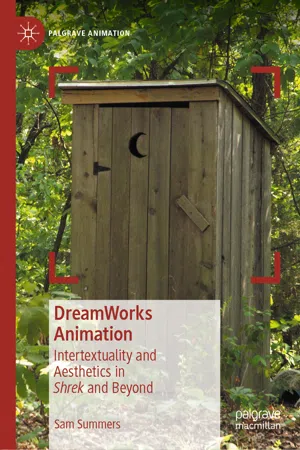
DreamWorks is one of the biggest names in modern computer-animation: a studio whose commercial success and impact on the medium rivals that of Pixar, and yet has received far less critical attention.The book will historicise DreamWorks' contribution to feature animation, while presenting a critical history of the form in the new millennium. It will look beyond the films' visual aesthetics to assess DreamWorks' influence on the narrative and tonal qualities which have come to define contemporary animated features, including their use of comedy, genre, music, stars, and intertextuality. It makes original interventions in the fields of film and animation studies by discussing each of these techniques in a uniquely animated context, with case studies from Shrek, Antz, Kung Fu Panda, Madagascar, Shark Tale, Bee Movie, Trolls and many others. It also looks at the unusual online afterlife of these films, and the ways in which they have been reappropriated and remixed by subversive online communities.
- English
- ePUB (mobile friendly)
- Available on iOS & Android
eBook - ePub
About this book
Information
Subtopic
Film & Video© The Author(s) 2020
S. SummersDreamWorks AnimationPalgrave Animationhttps://doi.org/10.1007/978-3-030-36851-7_11. Layered, Like Onions: Introducing DreamWorks’ Intertextuality
Following the release of Pixar’s Toy Story (Lasseter 1995), the first-ever computer-animated feature film, as well as its successors A Bug’s Life (Lasseter 1998) and Toy Story 2 (Lasseter 1999) in the 1990s, the 2000s would prove to be the computer-animated feature’s formative decade in the USA. The number of studios producing mainstream CG (computer-generated) features increased dramatically in the new millennium, just as the number of traditionally animated films began to stagnate. By 2006, CG had all but completely replaced traditional animation on cinema screens and has remained the dominant form ever since. It’s also during this period that the modal and aesthetic conventions of the American computer-animated feature began to crystallise, as the respective house styles of the emergent studios converged. Visually, the CG films of the 2000s retained the influence of Pixar, but on a narrative and tonal level, another studio had a more pervasive impact: DreamWorks Animation, creators of Antz (Darnell and Johnson 1998), the world’s second computer-animated feature, as well as some of the medium’s biggest commercial hits.
Between 2000 and 2009, DreamWorks Animation released more animated films than any other studio. Granted, Pixar’s films were more consistently commercially successful individually; only the entries in DreamWorks’ hugely lucrative Shrek franchise grossed as highly domestically as the average Pixar film.1 However, DreamWorks’ movies grossed more money in total, owing to the sheer quantity of their releases. Though Pixar enjoyed greater critical acclaim and brand recognition than their closest rivals, more money total was spent on tickets for DreamWorks films than on Pixar’s during the 2000s.2 This allowed DreamWorks to exert a considerable influence on the content of commercial American animated features simply by adhering to a distinct style and saturating the market with their product. Indeed, it is clear from reviews of CG family films from the latter half of the decade in mainstream outlets that the computer-animated efforts of multiple studios had come to be considered generic and formulaic. Whether invoked to criticise a film judged to be unremarkable, or as a point of comparison against which to measure a more unique movie, usually from Pixar, the notion of a computer-animation hegemony built on a collection of worn-out conventions was a popular one in the film press, with some specific criticisms speaking to DreamWorks’ influence. One convention in particular stands out as a recurrent target of such criticisms: what is often labelled the ‘pop culture reference’, but can more accurately and comprehensively be described as the deliberate and explicit manipulation of intertextuality. For instance, PopMatters’ Bill Gibron accuses Hollywood of ‘cranking out the CG family films, animated efforts relying on quirky pop culture riffs’ (Gibron 2009), while TVGuide’s Maitland McDonagh bemoans the ‘noisy, pop-culture joke-larded norm’ of computer animation’ (McDonagh 2007). Similarly, The Guardian’s Andrew Pulver critiques Meet the Robinsons (Anderson 2007), one of Disney’s early attempts at CG, for indulging in ‘the (now very tiresome) streams of pop culture self-referentiality’ (Pulver 2007), the reviewer’s fatigue reflecting the apparent prevalence of the technique. By 2008, Time’s Richard Corliss had gone as far as claiming that ‘ransacking pop culture is what cartoons [here referring to animated features] do’ (Corliss 2009), which would have been an implausible statement only ten years prior, in the midst of Disney’s cycle of oft-imitated, self-contained animated musicals. And yet, this newly developed tendency peculiar to the CG feature film was emphatically not the product of the influence of Pixar, the medium’s most prominent technological innovators. The National Review, for one, specifically praises Pixar’s Incredibles (Bird 2004) for ‘skip[ping] pop-culture references’ (National Review 2009), and The Telegraph’s SF Said confidently asserts that ‘Pixar films don’t indulge in the nudging, winking pop-cultural pastiches one sees in some other animated films’ (Said 2004).
Not every mention of the aesthetic uniformity of the CG feature, including its newfound affinity for pop-culture references, attributes the trend to DreamWorks’ impact, although a 2010 Time piece on the decade in review does recognise them as the medium’s ‘most influential studio’ (Corliss 2010). In it, writer Richard Corliss notes that ‘rivals have followed DreamWorks’ lead—not Pixar’s’ and that ‘the DreamWorks gestalt—impish, parodic, brimful with pop-culture references—has infiltrated animated films from Ice Age [Wedge 2002] to Despicable Me [Coffin and Renaud 2010] and plenty more’ (ibid.). Although this piece’s open recognition of DreamWorks’ influence is exceptional, its claims are difficult to deny. Reviewing the history of mainstream American animated features, it’s clear that DreamWorks’ Shrek (Adamson and Jenson 2001) utilised pre-existing pop songs and offhanded references to a wide range of pop-cultural miscellanea to what was at the time an unprecedented extent. While a select few hand-drawn features—most famously, Disney’s Aladdin (Musker and Clements 1992)—and even Pixar’s debut Toy Story had outfitted themselves with explicit intertextual connections in the recent past, they stopped short of Shrek’s complete immersion in the cultural touchstones past and present. Meanwhile Shrek, as a result of its enormous commercial success and its outright rejection of the earlier Disney paradigm in part through its ostentatious inclusion of pop-cultural references, ushered in a wave of imitative, intertextual CG features from other studios—including Blue Sky’s Robots (Wedge 2005), Disney’s Chicken Little (Dindal 2005), Nickelodeon’s Barnyard (Oedekerk 2006), and Sony’s Surf’s Up (Brannon and Buck 2006) to name only a prominent few—and in the process effectively codified the common perception of how a computer-animated feature was to behave for at least the remainder of the decade.
Despite their clear industrial impact, DreamWorks, their influence and their use of intertextuality have been underserved in animation scholarship. Insofar as critical histories of animation describe the 2000s, and the dramatic increase in the production of CG features, in detail at all, DreamWorks’ enormous aesthetic contribution is often minimised. For instance, in Maureen Furniss’ A New History of Animation, the entry on DreamWorks focusses entirely on their ‘digital advances’ (Furniss 2016, 379–381), while Chris Pallant’s chapter on computer-animation in Demystifying Disney only cursorily mentions DreamWorks’ influence on modern Disney (Pallant 2011, 144), understandable given the book’s focus. Pallant also refers elsewhere to hand-drawn animation by ‘computer generated Pixar-esque productions’ (ibid., 111 [emphasis added]), reflecting a wider academic bias towards the creators of the first CG feature with regard to the codification of the medium’s aesthetic qualities. This book is therefore positioned as a gentle corrective, a repositioning of DreamWorks at the centre of the narrative of the medium’s development in the twenty-first century.
In initiating the widespread use of deliberate intertextual references in CG movies, DreamWorks triggered a shift away from what had been the dominant mode of feature animation in America since the form’s inception with Disney’s Snow White (Hand et al.) in 1937—a mode characterised by a dedication to realism, sustained as the industry standard due to Disney’s consistent commercial success. Though retaining the realistic, three-dimensional visual style introduced by Pixar in Toy Story, DreamWorks deviate substantially from that paradigm on a non-visual level. Most significantly, by making substantial use of explicit references to other texts, DreamWorks and the studios who absorbed their influence are at the very least eroding the ‘fourth wall’ between the animated world and the audience, in many cases also importing objects from our reality into the diegetic reality in ways which can contradict the latter’s ostensible spatio-temporal setting. This lack of regard for the self-contained and logically consistent animated diegesis places these films in the cartoonal mode typified by the like of Warner Bros.’ classic Looney Tunes shorts. The fact that, post-DreamWorks, these conventions became ubiquitous characteristics of feature animation is therefore a significant shift for an industry which had largely adhered to realist conventions for the preceding six decades. Before embarking on my analysis of DreamWorks’ implementation of these cartoonal techniques, and their subsequent industrial impact, however, I must define and redefine a couple of somewhat contentious terms central to this discussion: ‘intertextuality’ and ‘realism’.
Defining Intertextuality
Although, as I shall come to explore, the deliberate use of intertextual references to convey meaning is far from a new development in the realm of animation, it is a device which increased in both popularity and prominence across all media in the postmodern era, continuing into the present day. Jim Collins argues that ‘the foregrounding of disparate intertexts and the all-pervasive hyperconsciousness concerning the history of both ‘high art’ and popular representation has become one of the most significant features of contemporary storytelling’ (Collins 2013, 464), demonstrating how integral the phenomenon of intertextuality has become to today’s media. While texts have always been in conversation with one another, creators are now more consciously aware of that fact than ever before, although while it may seem apt to describe this deliberate manipulation of ...
Table of contents
- Cover
- Front Matter
- 1. Layered, Like Onions: Introducing DreamWorks’ Intertextuality
- 2. Why Is Shrek Funny?: DreamWorks and the Intertextual Gag
- 3. ‘All Star’ Soundtracks: DreamWorks and the Pop Song
- 4. Woody Allen in the Anthill: DreamWorks and Star Performance
- 5. Parody, Pastiche and the Patchwork World: DreamWorks and Genre
- 6. The Shrekoning: DreamWorks’ Influence Over 2000s Animation
- 7. Shrek Gets Shreked: DreamWorks’ Online Afterlife
- Back Matter
Trusted by 375,005 students
Access to over 1.5 million titles for a fair monthly price.
Study more efficiently using our study tools.
Frequently asked questions
Yes, you can cancel anytime from the Subscription tab in your account settings on the Perlego website. Your subscription will stay active until the end of your current billing period. Learn how to cancel your subscription
No, books cannot be downloaded as external files, such as PDFs, for use outside of Perlego. However, you can download books within the Perlego app for offline reading on mobile or tablet. Learn how to download books offline
Perlego offers two plans: Essential and Complete
- Essential is ideal for learners and professionals who enjoy exploring a wide range of subjects. Access the Essential Library with 800,000+ trusted titles and best-sellers across business, personal growth, and the humanities. Includes unlimited reading time and Standard Read Aloud voice.
- Complete: Perfect for advanced learners and researchers needing full, unrestricted access. Unlock 1.5M+ books across hundreds of subjects, including academic and specialized titles. The Complete Plan also includes advanced features like Premium Read Aloud and Research Assistant.
We are an online textbook subscription service, where you can get access to an entire online library for less than the price of a single book per month. With over 1.5 million books across 990+ topics, we’ve got you covered! Learn about our mission
Look out for the read-aloud symbol on your next book to see if you can listen to it. The read-aloud tool reads text aloud for you, highlighting the text as it is being read. You can pause it, speed it up and slow it down. Learn more about Read Aloud
Yes! You can use the Perlego app on both iOS and Android devices to read anytime, anywhere — even offline. Perfect for commutes or when you’re on the go.
Please note we cannot support devices running on iOS 13 and Android 7 or earlier. Learn more about using the app
Please note we cannot support devices running on iOS 13 and Android 7 or earlier. Learn more about using the app
Yes, you can access DreamWorks Animation by Sam Summers in PDF and/or ePUB format, as well as other popular books in Media & Performing Arts & Film & Video. We have over 1.5 million books available in our catalogue for you to explore.