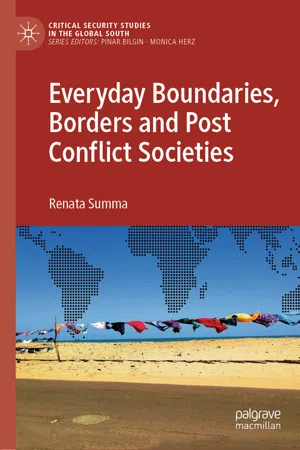
This book provides an in-depth analysis of border and boundary enactments in post-war and "deeply divided" societies. By exploring everyday places in post-conflict societies, it critically examines official narratives of how ethno-national divisions arise and are sustained. It challenges traditional accounts regarding the role that international intervention has in producing and/or weakening boundaries in such societies, while questioning clear-cut distinctions between the local and the international.
- English
- ePUB (mobile friendly)
- Available on iOS & Android
eBook - ePub
Everyday Boundaries, Borders and Post Conflict Societies
About this book
Information
© The Author(s) 2021
R. SummaEveryday Boundaries, Borders and Post Conflict SocietiesCritical Security Studies in the Global Southhttps://doi.org/10.1007/978-3-030-55817-8_11. Introduction
Renata Summa1
(1)
International Relations Institute, Pontifical Catholic University of Rio de Janeiro, Rio de Janeiro, Brazil
The tragedy of Dayton was that we created a state that was defined in terms of the people who created the war; and they defined the war ethnically; and they defined the state ethnically. And that, I don’t think, was the primary appellation ordinary Bosnians would use. (James O’Brien, [one of the Americans responsible to formulate the Dayton Accord], in Toal and Dahlman 2011: 164)
In 1989, while the Berlin Wall was being demolished, a famous comedic group from Sarajevo imagined the end of Yugoslavia and the division of the city of Sarajevo in two. In the episode ‘Podjela Sarajeva - Sarajevski Zid’1 (Divided Sarajevo-Sarajevan wall), a wall has been built in the middle of Sarajevo, dividing it into Zapadno Sarajevo (West Sarajevo) and Istočno Sarajevo (East Sarajevo), as had been the case in Berlin. Although it was recorded and broadcasted in 1989, the episode suggested that the action was taking place on 11 November 1995—a date when, indeed, representatives of the warring parties from Bosnia and Herzegovina (BiH) would later sit at the negotiation table in Dayton, Ohio (USA), along with leaders from the United States, France, Germany, United Kingdom, Russia, Croatia and Yugoslavia (now Serbia), to discuss precisely, among other topics, the division of Sarajevo.
Two of the main issues to be agreed upon by the parties during those 21 days of fierce negotiations were ‘the new Bosnian map’ and the future of approximately half of BiH’s population at that time (4.4 million people), who were driven from their homes,2 many through practices that have been denominated ‘ethnic cleansing’.
What emerged from these negotiations—the Dayton Peace Agreement—was an ambivalent response. On the one hand, the ethnic cleansing campaigns3 were sanctioned, when an internal Inter-Entity Boundary Line (IEBL) was agreed upon, dividing BiH into two entities and ‘confirming a de facto ethnoterritorialization of what was once simply Bosnian shared space by all’ (Toal and Dahlman 2011: 6). The division of BiH into two political entities—the Federation of Bosnia-Herzegovina, to be divided into ten cantons between Bosniaks 4 and Croats, and the Republika Srpska for the Serbs 5—was based on the territories conquered during the war by each group at the moment when the DPA was signed. Negotiations in Dayton thus operated ‘on the assumption that (…) war could be ended by a cartographic fix’ (ibidem: 149). The drawing of the IEBL and, consequently, the institutionalization of this ethnoterritorial logic, created several difficulties for those who suddenly found themselves living ‘on the other side’—and were called ‘minorities’. The Dayton Peace Agreement reduced spaces and places to matters of ethnonational ownership (Campbell 1998: 115), and was followed, in the first months after its signature, by a renewed practice of ‘unmixing’ of Bosnia and Herzegovina, this time led by ‘minorities’ moving towards their ‘proper’ entity. On the other hand, the DPA states that ‘the early return of refugees and displaced persons is an important objective of the settlement of the conflict’ and that ‘all refugees and displaced persons (…) to freely return to their homes of origin’ (General Framework Agreement,6 1995, Annex 7).
Dayton, thus, provides a ‘schizophrenic’ normative framework: while it foresees the re-mixing of Bosnian population, it also reinforces and legitimizes the drive for homogenization of spaces produced during the war. That ambivalence was for a long time reflected in the policies of returning refugees and internally displaced persons. While the United Nations High Commissioner for Refugees (UNHCR) has mobilized, since 1996, efforts to assure the returns, in the first years especially, returnees were often met with animosity and even violence by certain groups, especially in Republika Srpska, who wanted to maintain the recently achieved status quo. Sparks of violence led NATO’s Implementation Force (IFOR) responsible for securing the DPA’s Military Annex—to declare a halt to returns by establishing checkpoints in the IEBL and, thus, “giving it materiality (…) guarding Republika Srpska from ‘incursions’ and putting Annex 7 on hold for the first years after Dayton” (Toal and Dahlman 2011: 170).
Homogenization was, however, never achieved, and, as this book argues, it can never be achieved. Through the years, the returning process was resumed, although it is difficult to ascertain precisely the extent it has reached.7 For those who would find themselves as a ‘minority’ in the villages or cities where they were born or spent a part of their life, there were few incentives to ‘go back’ (Brubaker 2013; Halilovich 2013). Due to displacements and disruptions in the social fabric, many found themselves lacking in familiar bonds and connections, which are not only important for social life, but also in order to find employment, for example.8 Moreover, just as the Bosnian map has been reduced to matters of ethnonational ownership, many aspects of life were also ‘remade’. The DPA has taken ethnonationality as the primary category around which to organize political life in BiH, and many services on the everyday life have been reorganized accordingly, such as the health and schooling system, universities and the media. That has represented a shift for Bosnians, who were used to categories such as religion and ethnonational affiliations being considered a personal matter and mainly relegated to domestic life. For the generations that grew up in Yugoslavia after the Second World War, ‘being Bosnian was growing up in a multicultural and multireligious environment, an environment where cultural pluralism was seen as intrinsic to the social order’ (Bringa 1993: 87). There were differences in how this multiculturalism and multi-religious society was organized and lived, according to each region and, also, from one village to another. This distinction, however, was sharpened in what concerned rural and urban areas. In rural BiH, Bringa (2002) suggests, kinship was the primary bond of loyalty. Because interethnic marriages are rare in rural areas, even before the war, ‘kinship overlaps with ethnicity’, although it is ‘kinship and not ethnicity that held the primary emotional appeal and is the mobilizing factor’. In the cities, especially among ‘mixed families’9 and those who considered themselves communists or Yugoslavs, ethnonational categories would barely make sense10 and people would live intermingled, dwelling in the same buildings, attending the same schools etc.
There is something very personal and intimate about the war in Bosnia and Herzegovina, and part of it relies on what it takes to ‘unmix’ people who live together. Employing a strong image here, we could say that war in BiH called its victims by something as personal as their names, in the sense that, most of the time, someone’s name is the only way to distinguish between Serbs, Croats and Bosniaks.11 A myriad of accounts describes how people would recognize neighbours, colleagues or ancient teachers—familiar faces—among their tormentors. Thus, during and after the war, many marriages, friendships and neighbouring ties were reconfigured (Maček 2009) and the enactment of boundaries in Bosnia and Herzegovina became strongly related to spheres of life understood as private or personal.
Another episode from Top Lista Nadrealista deals with this question. In 1991, the group produced a sketch that would become symbolic in the years to come, named ‘Rat u familiji Popuslic’12 (War in Popuslic’s family). In the video, a building in the city of Sarajevo is on fire, and there is a ‘war’ going on in one of its apartments. A couple is about to divorce due to their ‘differences’. The woman, standing behind the trenches and holding a rifle, says she has conquered ‘the kitchen, the big room and a smaller room’. She then yells to her future ex-husband, who is behind the trenches from the other side of the apartment, that she has ‘historical rights, historical rights’ on those ‘territories’. As in the metaphor of the divided apartment, ‘everyday places’ have become more visibly politicized and contested.
However, it is also in the everyday life that we find cracks in this segregation and homogenization logic. Toal and Dahlman (2011), in their monumental effort to provide a portrait of this process of ‘ethnicization of spaces’ in BiH, suggest, in their conclusion, that:
Ethnic cleansing (…) has been the most powerful force in the remaking of Bosnia over the last two decades. Contemporary Bosnia has an ethnoterritorial structure it previously never had. Formerly entwined human geographies have largely been uprooted and destroyed. Ethnically mixed communities with strong neighborhood identities have been transformed into far more homogeneous communities characterized by divisions among locals, displaced settlers, and returnees. What was previously a marginal spatial form on the palimpsest of Bosnia-Herzegovina – so-called ethnic enclaves – has become the dominant pattern. Examine the details, however, and traces of a more complex human geography are visible. (p. 307, my emphasis)
Here, I decided not only to ‘examine the details’, but to look elsewhere, in order to understand how boundaries—which will be treated here as a process and dependent on enactments—are not only produced and reproduced, but, especially, subverted and destabilized. I turn to the everyday as an onto-epistemo-methodological choice, by claiming that the lived space of the everyday is full of contradictions, and those contradictions are precisely where we must look in order to capture alternative practices that provide for a different narrative of post-Dayton Bosnia and Herzegovina and, ultimately, post-conflict societies. As Gupta and Ferguson (1992) suggest, ‘important tensions may arise when places that have been imagined at a distance must become lived spaces’ (p. 11). Thus, one of the questions of this book might have been: What people ‘make-do’ of Dayton and its boundaries in their everyday lives? Such question, however, gives a false impressi...
Table of contents
- Cover
- Front Matter
- 1. Introduction
- 2. Enacting Boundaries
- 3. The Place(s) of Everyday and Everyday Places
- 4. Politics of (Im)mobility (or Everyday Practices Around a Coach Station)
- 5. Boundary Displacement and Displacement as Boundary (or a Saturday Afternoon in a Kafana)
- 6. ‘Meeting at BBI’ (or, on Shopping Malls, the ‘Local’ and the ‘International’)
- 7. Conclusion
- Back Matter
Trusted by 375,005 students
Access to over 1.5 million titles for a fair monthly price.
Study more efficiently using our study tools.
Frequently asked questions
Yes, you can cancel anytime from the Subscription tab in your account settings on the Perlego website. Your subscription will stay active until the end of your current billing period. Learn how to cancel your subscription
No, books cannot be downloaded as external files, such as PDFs, for use outside of Perlego. However, you can download books within the Perlego app for offline reading on mobile or tablet. Learn how to download books offline
Perlego offers two plans: Essential and Complete
- Essential is ideal for learners and professionals who enjoy exploring a wide range of subjects. Access the Essential Library with 800,000+ trusted titles and best-sellers across business, personal growth, and the humanities. Includes unlimited reading time and Standard Read Aloud voice.
- Complete: Perfect for advanced learners and researchers needing full, unrestricted access. Unlock 1.5M+ books across hundreds of subjects, including academic and specialized titles. The Complete Plan also includes advanced features like Premium Read Aloud and Research Assistant.
We are an online textbook subscription service, where you can get access to an entire online library for less than the price of a single book per month. With over 1.5 million books across 990+ topics, we’ve got you covered! Learn about our mission
Look out for the read-aloud symbol on your next book to see if you can listen to it. The read-aloud tool reads text aloud for you, highlighting the text as it is being read. You can pause it, speed it up and slow it down. Learn more about Read Aloud
Yes! You can use the Perlego app on both iOS and Android devices to read anytime, anywhere — even offline. Perfect for commutes or when you’re on the go.
Please note we cannot support devices running on iOS 13 and Android 7 or earlier. Learn more about using the app
Please note we cannot support devices running on iOS 13 and Android 7 or earlier. Learn more about using the app
Yes, you can access Everyday Boundaries, Borders and Post Conflict Societies by Renata Summa in PDF and/or ePUB format, as well as other popular books in Politics & International Relations & International Relations. We have over 1.5 million books available in our catalogue for you to explore.