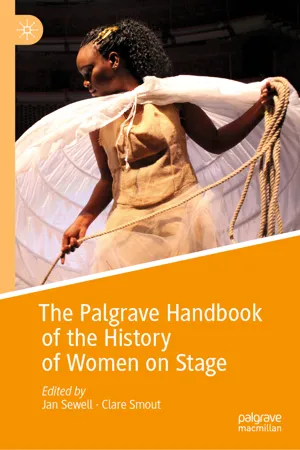
This book brings together nearly 40 academics and theatre practitioners to chronicle and celebrate the courage, determination and achievements of women on stage across the ages and around the globe. The collection stretches from ancient Greece to present-day Australasia via the United States, Soviet Russia, Europe, India, South Africa and Japan, offering a series of analytical snapshots of women performers, their work and the conditions in which they produced it. Individual chapters provide in-depth consideration of specific moments in time and geography while the volume as a whole and its juxtapositions stimulate consideration of the bigger picture, underlining the challenges women have faced across cultures in establishing themselves as performers and the range of ways in which they gained access to the stage. Organised chronologically, the volume looks not just to the past but the future: it challenges the very notions of 'history', 'stage' and even the definition of 'women' itself.
eBook - ePub
The Palgrave Handbook of the History of Women on Stage
- English
- ePUB (mobile friendly)
- Available on iOS & Android
eBook - ePub
The Palgrave Handbook of the History of Women on Stage
About this book
© The Author(s) 2019
J. Sewell, C. Smout (eds.)The Palgrave Handbook of the History of Women on Stagehttps://doi.org/10.1007/978-3-030-23828-5_11. General Introduction
Jan Sewell1 and Clare Smout2
(1)
The Open University, Milton Keynes, UK
(2)
University of Birmingham, Birmingham, UK
This volume chronicles and celebrates the courage, determination and achievements, despite the multiple obstacles put in their way, of women on stage across the ages and around the globe. Our intention is not to provide a comprehensive history of the topic—such an ambition would be doomed from the start—but rather to provide testimony to the work of women performers at different times and in different spaces and places—a kaleidoscope or collage, a series of snapshots of women performers and their work. Our hope is that not only will the individual chapters prove of interest in themselves but their juxtapositions will prove illuminating and fruitful. We are proud to be bringing together both academics and practitioners—distinguished scholars plus younger colleagues already producing cutting-edge research at the start of their journeys, experienced practitioners looking back on their careers and the new generation looking ahead to the future.
Aristotle argues in the Poetics (4) that mimesis (μίμησις), meaning mimicry, representation or play-acting, is an instinct that comes naturally to human beings from childhood and, furthermore, that it is this ability that enables us to develop and begin to learn about the world. Although he was writing at a time when the stage was seen as a male preserve, Aristotle here uses the word anthropos (ἄνθρωπος), signifying ‘human-being’, rather than the gender-specific alternative aner (ἄνηρ). It is the contention of this book that mimesis does indeed come as naturally to women as to men and that, despite cultural and social convention, and any number of prohibitions and exhortations to the contrary, women have contrived to exercise their talents and perform in the greatest possible variety of places and contexts at all times.
There are, of course, many books already available on the subject of women on stage, notably Rosamond Gilder’s ambitious but now dated 1931 study Enter the Actress, which covers ancient Greece to the eighteenth century, and Sandra Richards’ more recent and more specific The Rise of the English Actress (1993), as well as books on individual periods such as Julia Swindells and David Taylor’s excellent Oxford Handbook to Georgian Theatre (2014). From the late 1960s onwards, feminist theatre scholars have produced important collections such as Sue-Ellen Case’s Feminism and Theatre (1988), as well as theoretical analyses such as Elaine Aston’s exploration of the feminist concept of ‘women hidden from history’ in An Introduction to Feminism and Theatre (1995, 35). In The Routledge Reader in Gender and Performance (1998), Lizbeth Goodman and Jane de Gay explore what Katherine Cockin (1998, 21) calls the ‘dynamics of history-making and -forgetting’. Tracy C. Davis’s seminal study, Actresses as Working Women (1991), examines the place of women working in a profession dominated by men, while others have reclaimed the lost histories of women performers such as the work of the Actresses’ Franchise League, founded in 1908, or the Pioneer Players, formed in 1911; there have also been numerous biographies of distinguished individual performers. Most recently, the excellent 2007 Cambridge Companion to the Actress, edited by Maggie B. Gale and John Stokes, provides stimulating investigations into actresses in Europe and North America from 1660 onwards, while the 2005 collection of essays edited by Peter Parolin and Pamela Allen Brown Women Players in England, 1500–1660: Beyond the All-Male Stage, investigates the period immediately before that, challenging us to reconsider our traditional assumptions about the extent of female performance in England before 1660.
None of these authors, however, have been ambitious or crazy enough to attempt the chronological and geographical scope of the present volume, which stretches from ancient Greece to present-day Australasia via the United States, Soviet Russia, Europe, India, South Africa and Japan. While we would have loved to make it even more wide-ranging (China, with its distinguished performance history is a regrettable absence), it proved an over-ambitious aspiration to find authors across six continents interested in contributing chapters in English to a book to be printed only in Anglophone countries. In addition, there are inevitably more chapters chronicling the ‘modern’ era—the nineteenth, twentieth and twenty-first centuries—thanks in part to the increasing variety and sophistication of technology and the infinitely greater quantity and quality of archive material for researchers to work with, but in part also to the fact that these centuries saw opportunities for women around the world expanding personally, professionally, politically and legally.
The book’s chronological organisation was chosen for simplicity and ease of access; it also has the advantage of bringing together parallel or contrasting experiences in different parts of the world (as in Parts V and VII, discussing the early twentieth and early twenty-first centuries, respectively) or of focusing tightly on a set of specific interactions (as in Part VI, which includes interlocking chapters on the feminist movement in late twentieth-century British Theatre). Chronology, however, in this context is not an exact science: there are connections and overlaps between the Japanese and Greek chapters despite the section break that divides them, while several of the practitioners of the late twentieth century are still famously active today.
Furthermore, the volume’s organisational structure was never intended to invite a teleological interpretation of women’s progress in the performing arts, what Maggie Gale and Viv Gardner (2004, 5) have called ‘a “rise” from absence to presence, from mute to “motormouth”, from prostitute to artist’. Although it is possible to chart an increasingly high profile for women performers around the world and across the centuries—a movement in from the margins towards centre-stage—this movement takes place at different speeds and at different times in different places and it is often a matter of one step forward and two steps back. For instance, despite the welcome fact that female practitioners are now frequently to be found holding prestigious positions in the academic world, respected for their insights, knowledge and technical skills, nevertheless social media responses to women in the public eye show that in the wider world they are still frequently regarded with hostility and contempt, even in the so-called progressive West; female performers’ continued lack of parity with men in terms of power and remuneration—not to mention the #MeToo movement—indicates that progress is perhaps slower and more superficial than many hoped.
The chapters that follow are immensely varied in focus, content and location; yet reading contributions from different periods across the globe reveals certain recurrent patterns. Religion of all kinds is a frequent factor in the early stages of drama in many societies, both positively in terms of giving women initial opportunities to perform through involvement in ritual celebrations (often in a single-sex context) and negatively in providing moral justifications for subsequently excluding them from drama as it became more mainstream, public and secular in content. Women performers at different times and in very different places found themselves facing similar problems, not least the ever-underlying assumption that female performers were almost certainly ‘women of easy virtue’, if not actual prostitutes. Frequently they were excluded from the ‘legitimate’ drama entirely; at other times they were included only to provide glamour or sex-appeal. What is notable is the way that so many found (and continue to find) similar solutions to these problems, despite the widely differing socio-historical, religious and political contexts in which they worked. Apart from a few high-profile moments of rivalry, there seems to be a solid pattern of co-operation and support between female performers and a tradition of mentoring younger colleagues. The life of an actor is almost always a struggle; that of a female performer even more so. Repeatedly the women that survived in this profession have been multi-skilled, not only in terms of the range of their artistic talents and expertise, but also in combining organisational and managerial skills. Many have written their own material, frequently in the form of one-woman shows, and many have been entrepreneurs, establishing and running their own companies.
Often, however, the strategies women adopted meant operating at the margins, frequently in spheres scarcely recognised as ‘stages’ by male critics, so that, having been excluded from the major roles and major theatres, they were often rendered further invisible by being excluded from criticism and the historical record. Increasingly twenty-first-century scholarship and criticism is attempting to restore this imbalance, redefining what is meant by ‘stage’ and performance. This volume has excluded women working ‘on stage’ in the worlds of ballet, opera and most other musical contexts, but we have tried to extend the definition of ‘on stage’ in other ways to include such areas as Elizabeth I’s participation in tiltyard ceremonies and Anna of Denmark’s involvement in court masques, the performance art practised by 1960s–1990s America and twenty-first-century trans actors, even the wall paintings of ancient Rome.
It is not only the concepts of ‘history’ and ‘stage’ which are challenged by this volume; the definition of ‘women’ itself raises questions. Chapter 4, on ancient Rome, queries the post-Christian concept of gender as binary, arguing that gender was seen by Greeks and Romans as a spectrum, while the closing chapter analyses the contribution made by trans women to the world’s drama, their fight for equality with cis women and their demand for personal acknowledgement and authentic representation on stage.
Finally, terminology: ‘actor or actress?’—a common dilemma. We have generally opted for ‘women performers’, but left individual contributors free to make their own individual decisions. However one describes them, though, we wish to pay tribute to these centuries of talented and determined women and their achievements. In line with that, we have chosen to include all the performers discussed here in the index, regardless of whether they are simply a name on a Roman tombstone, a semi-anonymous ‘sister to Anita Bush’ whose first name is lost, or a prison inmate known here by her forename only, with the intention that the index stands as a comprehensive record of all the female performers considered in the volume. It is our hope that one of the chief outcomes of this book will be to inspire others to undertake further research and advance this rich, rewarding field in future studies.
Bibliography
- Aston, Elaine. 1995. An Introduction to Feminism and Theatre. London: Routledge.
- Aston, Elaine. 1999. Feminist Theatre Practice: A Handbook. London: Routledge.
- Brown, Pamela Allen., and Peter Parolin, eds. 2005. Women Players in England, 1500–1660: Beyond the All-Male Stage. Aldershot: Ashgate.
- Case, Sue-Ellen. 1988. Performing Feminisms: Feminist Critical Theory and Theatre. Baltimore: John Hopkins Press.
- Case, Sue-Ellen. 1990. Feminism and Theatre. Basingstoke: Macmillan.
- Case, Sue-Ellen, ed. 1996. Split Britches: Lesbian Practice/Feminist Performance. London: Routledge.
- Cockin, Katharine. 1998. ‘Introduction to Part One’. In The Routledge Reader in Gender and Performance, edited by Lizbet...
Table of contents
- Cover
- Front Matter
- 1. General Introduction
- Part I. Ancient Greece and Rome
- Part II. Medieval and Early Modern Europe
- Part III. Restoration and Eighteenth-Century England
- Part IV. Nineteenth-Century America, Europe and Japan
- Part V. Early to Mid-Twentieth-Century Greece, England, Russia and America
- Part VI. Late Twentieth-Century America and England
- Part VII. The Twenty-First Century—Around the Globe
- Back Matter
Trusted by 375,005 students
Access to over 1.5 million titles for a fair monthly price.
Study more efficiently using our study tools.
Information
Publisher
Palgrave MacmillanYear
2020Print ISBN
9783030238278
Subtopic
Performing ArtseBook ISBN
9783030238285
Frequently asked questions
Yes, you can cancel anytime from the Subscription tab in your account settings on the Perlego website. Your subscription will stay active until the end of your current billing period. Learn how to cancel your subscription
No, books cannot be downloaded as external files, such as PDFs, for use outside of Perlego. However, you can download books within the Perlego app for offline reading on mobile or tablet. Learn how to download books offline
Perlego offers two plans: Essential and Complete
- Essential is ideal for learners and professionals who enjoy exploring a wide range of subjects. Access the Essential Library with 800,000+ trusted titles and best-sellers across business, personal growth, and the humanities. Includes unlimited reading time and Standard Read Aloud voice.
- Complete: Perfect for advanced learners and researchers needing full, unrestricted access. Unlock 1.5M+ books across hundreds of subjects, including academic and specialized titles. The Complete Plan also includes advanced features like Premium Read Aloud and Research Assistant.
We are an online textbook subscription service, where you can get access to an entire online library for less than the price of a single book per month. With over 1.5 million books across 990+ topics, we’ve got you covered! Learn about our mission
Look out for the read-aloud symbol on your next book to see if you can listen to it. The read-aloud tool reads text aloud for you, highlighting the text as it is being read. You can pause it, speed it up and slow it down. Learn more about Read Aloud
Yes! You can use the Perlego app on both iOS and Android devices to read anytime, anywhere — even offline. Perfect for commutes or when you’re on the go.
Please note we cannot support devices running on iOS 13 and Android 7 or earlier. Learn more about using the app
Please note we cannot support devices running on iOS 13 and Android 7 or earlier. Learn more about using the app
Yes, you can access The Palgrave Handbook of the History of Women on Stage by Jan Sewell, Clare Smout, Jan Sewell,Clare Smout in PDF and/or ePUB format, as well as other popular books in Media & Performing Arts & Performing Arts. We have over 1.5 million books available in our catalogue for you to explore.