This book offers some important lessons regarding the functioning and dismantling of monetary areas, and on the importance of central-banks' co-operation.
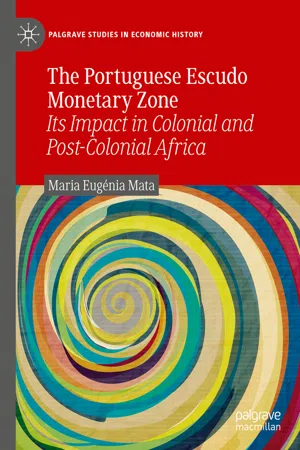
eBook - ePub
The Portuguese Escudo Monetary Zone
Its Impact in Colonial and Post-Colonial Africa
- English
- ePUB (mobile friendly)
- Available on iOS & Android
eBook - ePub
The Portuguese Escudo Monetary Zone
Its Impact in Colonial and Post-Colonial Africa
About this book
This monograph examines the failure of the Portuguese Escudo Monetary Zone and the birth of new monetary and financial systems in Portuguese-speaking African countries. Examining colonial and post-colonial times, Mata analyses the decision to build a Portuguese monetary area in the early 1960s and mid-1970s when the decolonisation process was peaking.
Information
© The Author(s) 2020
M. E. MataThe Portuguese Escudo Monetary ZonePalgrave Studies in Economic Historyhttps://doi.org/10.1007/978-3-030-33857-2_11. Introduction: Why to Study “The Portuguese Escudo Monetary Zone and its Impact in Colonial and Post-Colonial Africa”
Maria Eugénia Mata1
(1)
Nova School of Business and Economics, Universidade Nova de Lisboa, Carcavelos, Portugal
Waves of globalisation connected European countries with all regions of the world. Thanks to sailing abilities and technological superiority, Portugal and other European powers established not only trade connections but also European presence in all continents under great competition for the control of trade and territories over the centuries.
The independence of some territories in the late eighteenth and early nineteenth century resulted into a new political map of mixed-migration nations particularly in the American continent, which used their Metropolises’ languages (namely English and French in North America, and Spanish in South America). The late nineteenth-century globalisation framed new colonial empires under the Berlin conference agreement to share territories, in Africa. Economic integration of Metropolis territories (the Metropolises) and their colonised territories built great empires for the U.K., Belgium, France, the Netherlands, Germany, Italy, Spain, and Portugal.1
Many of these empires established monetary zones where the absence of exchange rate risks was a major aspect to implement businesses and economic integration, not only with Metropolises but also among them.2 The Portuguese empire survived consequences of the First World War as a reward for the Portuguese participation in the conflict as a member of the Allies. It also survived the Second World War because of Portugal’s neutral position in this conflict. The study of the Portuguese monetary zone is an issue of interest, both for international comparative history on economic integration patterns, and for domestic purposes related with economic efficiency in currency areas.
From the late 1950s, the Portuguese link to the European Free Trade Association (EFTA) for economic integration purposes led to commitments with the General Agreement on Tariffs and Trade, GATT. The free-trade philosophy was very useful to the increment of trade with other European partners, to where it was possible to export tropical commodities produced in the Portuguese empire. The Escudo Monetary Zone (ZME, Zona Monetária do Escudo) was founded in this historical context, in order to also improve the economic integration of Portugal and the territories of the empire, and to take advantage of the new international opportunities created by the European economic integration.3 As trade always means economic co-operation and peaceful relationships, the EMZ was considered to be a very important instrument to keep the political ties between the Mainland and the territories of the empire.
When this purpose began to be implemented in 1963 seven territories were under Portuguese political rule, five in Africa: Cabo Verde (4000 km2), Guiné (36,000), S. Tomé e Príncipe (1000), Angola (1,247,000), Moçambique (802,000), and two in Asia, Macau (less than 1000), and Timor (15,000). In 1954 the Portuguese empire had lost Dadrá and Nagar Aveli in India, in July 1961 the African fortress of S. João Baptista de Ajudá, and in December 1961 the small territories of Goa, Damão, and Diu, in India, which were conquered by the Indian Union. The development levels of the Portuguese colonial territories were quite different at that time: In the Metropolis (Portugal-Mainland and the Adjacent Islands of Azores and Madeira) was about 2000 USD per capita, in Angola and Moçambique were about one half of that value, and Cabo Verde was about ¼. Maddison 2001 has no data for other territories, which were presumably poorer.
According to the official political philosophy expressed by Oliveira Salazar, the Prime-Minister (more precisely, the President of the Board of Ministers, Presidente do Conselho de Ministros), Portugal was a multi-continental country, using a same language (Portuguese), and working under a same flag, as it had always been for centuries, since the early times of the Portuguese nationality in medieval times. He considered education and economic growth as instrumental to integrate the nation:
As territories will develop and education will spread, local elites will become more numerous and able to assume increased tasks without risk, and advantage, for the national community.4
We have been criticized for our persistent commitment to the ideal multiracial society in the tropics, as if such an idea was opposite to the human nature, the universal moral order or the interests of people, but it is the contrary that happens. Without discussing this problem, I will say that we, the Portuguese, don’t know how to be in the world in a different way, even because it was in a kind of multi-racialty in which we framed our nation eight centuries ago, after the end of several invasions, coming from the East, North and South, that is to say, from Africa itself. From then we preserve a natural trend – which we quote at ease, as it has been recognised by remarkable foreign sociologists – for contacts with other people, from where any concepts of superiority or racial discrimination have been always absent.5
With exaggeration, this political speech was produced in 1962, in the context of the colonial wars against the Portuguese rule and administration, and disregarded the traditional colonial pact practices of protectionism to favour the production of commodities in the Mainland.
The Mainland’s exports to colonised territories lost weight in 1960 and 1961. From 23.83% in 1955 they steadily increased to 28.91 until 1959. The decline to 25.57 and 23.23 in 1960 and 1961, respectively, in contrast with increasing exports to foreign countries (including USA, EFTA and ECC partners), was a worrying development that was considered to be the proof for the need of greater economic cohesion.
In the 1960s Mundell “supported the idea of a monetary union in Europe”. On the one hand, Europe was a promising continent for the purpose of economic integration following the ravages of the Second World War, and the success of the reconstruction plans, thanks to the Marshall Plan. European empires of victorious nations in the First World War had been enlarged with the German defeat, thanks to sharing the German empire among them, and all the empires offered extension opportunities for economic integration after the Second World War.6 The focus of Mundell’s theories for the European continent is historically understandable. All American attention was devoted to European integration under trade liberalisation. In the context of the Cold War this was a strategic vision. Optimum currency areas were conceived to benefit from geographical scale, and also included geopolitical consideration. In Mundell’s (1961) mindset, which reflected his British education, the International Monetary System needed a stable monetary anchor (which was the dollar), because currencies pegged to precious metal recalls the desire of stability, which had been expressed in the earlier historical experiences of the gold-standard (before 1914, and even after the First World War).7
Mundell’s theories did not refer to the growing desire for independence that colonies expressed in all European colonial empires in the world after the end of the Second World War, in the historical context of the Cold War clash between the USA and the USSR, the two global powers. They consider, however, that all European countries were suffering from the extensive destruction that resulted from the ravaging military conflict of 1939–45.8 However, a European common currency unit also had a role to perform. In the cold war context, any US difficulties might have a counterbalance to the dollar if two major cu...
Table of contents
- Cover
- Front Matter
- 1. Introduction: Why to Study “The Portuguese Escudo Monetary Zone and its Impact in Colonial and Post-Colonial Africa”
- Part I. The Origin of the Escudo Monetary Zone
- Part II. The Transition to a Revised Escudo Monetary Zone
- Part III. The End of the Revised Escudo Monetary System
- Part IV. Co-operation from Independences to the End of the Millenium
- Back Matter
Trusted by 375,005 students
Access to over 1.5 million titles for a fair monthly price.
Study more efficiently using our study tools.
Frequently asked questions
Yes, you can cancel anytime from the Subscription tab in your account settings on the Perlego website. Your subscription will stay active until the end of your current billing period. Learn how to cancel your subscription
No, books cannot be downloaded as external files, such as PDFs, for use outside of Perlego. However, you can download books within the Perlego app for offline reading on mobile or tablet. Learn how to download books offline
Perlego offers two plans: Essential and Complete
- Essential is ideal for learners and professionals who enjoy exploring a wide range of subjects. Access the Essential Library with 800,000+ trusted titles and best-sellers across business, personal growth, and the humanities. Includes unlimited reading time and Standard Read Aloud voice.
- Complete: Perfect for advanced learners and researchers needing full, unrestricted access. Unlock 1.5M+ books across hundreds of subjects, including academic and specialized titles. The Complete Plan also includes advanced features like Premium Read Aloud and Research Assistant.
We are an online textbook subscription service, where you can get access to an entire online library for less than the price of a single book per month. With over 1.5 million books across 990+ topics, we’ve got you covered! Learn about our mission
Look out for the read-aloud symbol on your next book to see if you can listen to it. The read-aloud tool reads text aloud for you, highlighting the text as it is being read. You can pause it, speed it up and slow it down. Learn more about Read Aloud
Yes! You can use the Perlego app on both iOS and Android devices to read anytime, anywhere — even offline. Perfect for commutes or when you’re on the go.
Please note we cannot support devices running on iOS 13 and Android 7 or earlier. Learn more about using the app
Please note we cannot support devices running on iOS 13 and Android 7 or earlier. Learn more about using the app
Yes, you can access The Portuguese Escudo Monetary Zone by Maria Eugénia Mata in PDF and/or ePUB format, as well as other popular books in Economics & International Business. We have over 1.5 million books available in our catalogue for you to explore.