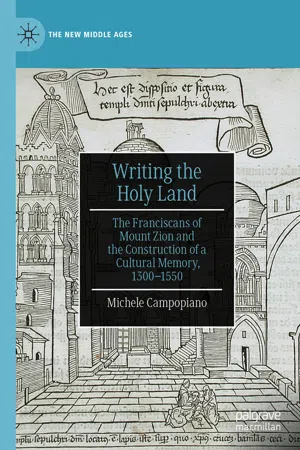
The book shows how the Franciscans in Jerusalem in the fourteenth to sixteenth centuries wrote works which standardized the cultural memory of the Holy Land. The experience of the late medieval Holy Land was deeply connected to the presence of the Franciscans of the Convent of Mount Zion in Jerusalem, who welcomed and guided pilgrims. This book analyses this construction of a shared memory based on the continuous availability of these texts in the Franciscan library of Mount Zion, where they were copied and adapted to respond to new historical contexts. This book shows how the Franciscans developed a representation of the Holy Land by elaborating on its history and describing its religious groups and the geography of the region. This representation circulated among pilgrims and influenced how contemporaries imagined the Holy Land
eBook - ePub
Writing the Holy Land
The Franciscans of Mount Zion and the Construction of a Cultural Memory, 1300–1550
- English
- ePUB (mobile friendly)
- Available on iOS & Android
eBook - ePub
Writing the Holy Land
The Franciscans of Mount Zion and the Construction of a Cultural Memory, 1300–1550
About this book
Information
© The Author(s) 2020
M. CampopianoWriting the Holy LandThe New Middle Ageshttps://doi.org/10.1007/978-3-030-52774-7_11. Introduction: Writing the Holy Land
Michele Campopiano1
(1)
Centre for Medieval Studies and Department of English and Related Literature, University of York, York, UK
For anyone coming to Jerusalem, the sight of Franciscan habits might not seem surprising in a city that so many people of different religions consider holy. What the modern pilgrims or tourists may not know is that the Franciscan presence in Jerusalem has a long history. The friars shaped the way Western travellers and pilgrims have seen, imagined and written about the Holy Land for centuries. This book explores the writings on the Holy Land from the Franciscan convent in Jerusalem and investigates their role in the construction of the memory of holy places, in the period from around 1333, when the Franciscans started to settle in the Holy Land, to the 1530s (after the Ottoman conquest of the Holy Land in 1517). Pilgrimage to the Holy Land declined shortly thereafter also owing to the pressures of the Ottoman expansion.1 During this period, the Franciscans of Mount Zion played a crucial role in mediating the relationship between Western Europe and the Holy Land. Settled on the Cenacle in Jerusalem, the friars played a part in welcoming and guiding pilgrims, orchestrating their devotional practices and acting as intermediaries between the local population and the Muslim authorities.2 The Friars also played a major role in diplomatic relations between the Holy See and the Eastern Churches, and acted as inquisitors into heresy in the East, especially among pilgrims.3 Pilgrimage to the Holy Land offered a model for other pilgrimages in which collective devotion was framed by a religious order (in this case the Franciscan order).
At the root of the Franciscan endeavour there was the role the Land of Promise played in Christian thought and piety. The Holy Land, as the site of the life of Jesus Christ and the Apostolic Community, played a major role in the construction of a Christian identity. Christianity as a religion is grounded on the historical accounts of the Bible. In De vera religione , Augustine writes: “Huius religionis sectandae caput est historia et prophetia dispensationis temporalis divinae providentiae pro salute generis humani in aeternam vitam reformandi atque reparandi.”4 Writing on the Holy Land was an integral part of the process by which Christianity was transformed from a dissident sect within Palestinian Judaism to a universal religion, which could be “read” and understood everywhere in the world. The text of the Bible referred by name to the places, people and events of the history of this region, which were invoked in liturgy, preaching and visual arts. The representation of the Holy Land was developed as a supplement to a text, due to its connection to the events of the Bible.5 The Old and New Testaments mention events that take place in a real, worldly space. However, this link between Christianity and geographical space was not contemporary with the beginning of Christianity as a religion, which instead emphasized the possibility of achieving salvation everywhere. Early Christians did not link divine presence to a specific territory; pilgrimage was not part of early Christian practices.6 Instead, this link was forged by a historical process that exalted the role of certain places in Christian piety, defined the Holy Land as a sacred space crucial to Christian identity and identified the places mentioned in the Holy Scripture with existing places. The representation of the Holy Land and of its history was not set once and for all. It was subject to re-mediation: re-presented again and again, over decades and centuries and in different media.7 It is therefore more accurate to talk about a process of sacralization of holy places, rather than as places being declared sacred once and for all. The construction and identification of these places was always underway, and written texts played a major role in establishing their sacrality.8
This process of construction has its roots in the Hebrew Bible, in particular Deuteronomy : “The Lord your God will bring you into the land that your ancestors possessed, and you will possess it” (Deut. 30: 3–5). The term Holy Land first appears in Zechariah , but it is foreshadowed in Ezekiel’s vision of Mount Zion and Jerusalem. According to Ezekiel, God will return on Mount Zion. The expression, Holy Land, is found again in the second book of the Maccabees.
After the destruction of the Temple in 70 AD, the Christian and Jewish communities were dispersed, and the memory of their holy places largely lost.9 After the Bar Kochba Rebellion in 135, the city of Jerusalem was replaced by Colonia Aelia Capitolina, founded on its site by Hadrian. During the fourth to seventh centuries, different Christian groups began to think of Jerusalem as their city, as the Christian city, and Palestine as a place set apart. Monks began to settle in this area. They spoke of themselves as the inhabitants of the Holy Land, and they were the first to use the expression in a “distinctively Christian way.”10 The fourth century saw the intensive work of the valorization of the Holy Land by Constantine and Helena. In 324, Constantine defeated the Eastern emperor Licinius at Chrysopolis, thus reunifying the Empire: within a few months, he ordered extensive works on the Eastern side of Hadrian’s buildings in Aelia. This led to the discovery of the Holy Sepulchre and of the Wood of the Cross, and to the identification of a column of rock as the hill of Calvary, in the place where the chapel of Calvary still stands.11 The extensive construction works memorialized these places. The efforts of Constantine and Helen strengthened the relationship between the events narrated in the Holy Writings and Jerusalem, creating in the Holy Land a veritable lieu de mémoire (site of memory)12 for the now-Christian empire. Eusebius, in his Life of Constantine, reports on the discovery of the sepulchre and the building of the Anastasis, directing attention to the religious significance of space: for him this place was holy from the beginning, and it is now holier because it has brought to light proof of the suffering of the Saviour.13 He explained that the tomb was a sign of the veracity of the Gospels.14 Before the discovery of the tomb, Eusebius had already written the Onomasticon on the location and names of places among the Hebrews. He identified obscure biblical sites, apparently without distinction between the Hebrew Bible and New Testament. Significantly, Eusebius began to envision Palestine not as a Roman province but as a land whose character and identity were formed by biblical and Christian history. As early as the third century, Origen mentions the tradition that the body of Adam, the first human being, was buried where Christ had been crucified.15 Perhaps this is why Eusebius says that the place was holy “from the beginning,” since Jerusalem would have hosted the remains of the first man. Among the Latin fathers, Ambrose, too, connects the place of the Cross with the burial place of Adam beneath it.16
The Constantinian basilicas in Palestine could only be intelligible to Christians at the time due to the more or less contemporary rise of the cult of the saints. The prominence of the cult of the martyrs paved the way...
Table of contents
- Cover
- Front Matter
- 1. Introduction: Writing the Holy Land
- 2. The Franciscan Holy Land
- 3. The Convent of Mount Zion and Book Production and Circulation
- 4. Early Franciscan Descriptions and Maps of the Holy Land
- 5. Franciscan Compilations, Miscellaneous Manuscripts and Composite Volumes on the Holy Land
- 6. Franciscan Descriptions of the Holy Land in the Fifteenth Century
- 7. Between the Late Middle Ages and the Renaissance
- 8. The Lists of Holy Places and Indulgences (Indulgenziari) and Their Diffusion
- 9. Franciscan Texts and Late Medieval Pilgrimage Accounts
- 10. Conclusions: Loss, Trauma, Recovery
- Back Matter
Trusted by 375,005 students
Access to over 1.5 million titles for a fair monthly price.
Study more efficiently using our study tools.
Frequently asked questions
Yes, you can cancel anytime from the Subscription tab in your account settings on the Perlego website. Your subscription will stay active until the end of your current billing period. Learn how to cancel your subscription
No, books cannot be downloaded as external files, such as PDFs, for use outside of Perlego. However, you can download books within the Perlego app for offline reading on mobile or tablet. Learn how to download books offline
Perlego offers two plans: Essential and Complete
- Essential is ideal for learners and professionals who enjoy exploring a wide range of subjects. Access the Essential Library with 800,000+ trusted titles and best-sellers across business, personal growth, and the humanities. Includes unlimited reading time and Standard Read Aloud voice.
- Complete: Perfect for advanced learners and researchers needing full, unrestricted access. Unlock 1.5M+ books across hundreds of subjects, including academic and specialized titles. The Complete Plan also includes advanced features like Premium Read Aloud and Research Assistant.
We are an online textbook subscription service, where you can get access to an entire online library for less than the price of a single book per month. With over 1.5 million books across 990+ topics, we’ve got you covered! Learn about our mission
Look out for the read-aloud symbol on your next book to see if you can listen to it. The read-aloud tool reads text aloud for you, highlighting the text as it is being read. You can pause it, speed it up and slow it down. Learn more about Read Aloud
Yes! You can use the Perlego app on both iOS and Android devices to read anytime, anywhere — even offline. Perfect for commutes or when you’re on the go.
Please note we cannot support devices running on iOS 13 and Android 7 or earlier. Learn more about using the app
Please note we cannot support devices running on iOS 13 and Android 7 or earlier. Learn more about using the app
Yes, you can access Writing the Holy Land by Michele Campopiano in PDF and/or ePUB format, as well as other popular books in History & European Medieval History. We have over 1.5 million books available in our catalogue for you to explore.