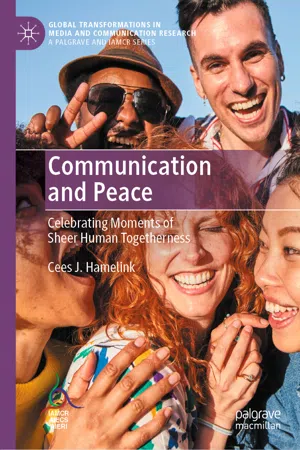
This book provides a robust conceptualization of peace. Hamelink defines peace as conceived of moments of celebrating human togetherness, with deep fractures that polarize society standing in the way of collectively celebrating togetherness and posing a serious existential risk to humanity. 'Deep dialogue' is the form of human cooperative communication that is needed to build communities that can overcome polarization. This is the most difficult form of human conversation as it is based upon trust, mutuality, patience and freedom, and requires safe, non-threatening spaces, but this book explains how to overcome the essential obstacles that prevent this dialogue. To curate a 'deep dialogue' we must turn to humanity's unique resource: our ability to communicate pro-socially and cooperatively.
- English
- ePUB (mobile friendly)
- Available on iOS & Android
eBook - ePub
About this book
Information
© The Author(s) 2020
C. J. HamelinkCommunication and PeaceGlobal Transformations in Media and Communication Research - A Palgrave and IAMCR Serieshttps://doi.org/10.1057/978-1-137-50354-1_11. The Concept
Cees J. Hamelink1
(1)
University of Amsterdam, Amsterdam, Noord-Holland, The Netherlands
Cees J. Hamelink
The United States Strategic Air Command: “Peace is our profession”
Erasmus “Peace is the mother and nurse of all that is good for humanity”
End AbstractWhat a joy to greet your readers with peace be with you, pax vobiscum, as-salamu alaykum or shalom aleichem. The words sound wonderful. But what do these sweet words mean? And what do we want to achieve when we refer to cultures of peace, to peace mentality or peace spirituality. What do we expect that peacemakers should do? How well have we conceptualized peace? And why is this relevant? The International Day of Peace (“Peace Day”) is observed around the world each year on 21 September. Established in 1981 by a unanimous United Nations resolution, Peace Day provides a globally shared date for all humanity to contribute to building a Culture of Peace. But in order to build bridge engineers need to know what a bridge is. In order to build a culture of peace we need to know what peace is. What is on our minds when we engage in peace education? What are we educating for? And could it be that many of our well-intended peace efforts have failed because we never had a clear idea of what peace really is?
It seems sensible therefore to explore whether in studies of international law, in peace studies, in theology, studies on communication and peace or modern political thought we can find a productive, realistic and inclusive conceptualization of peace.
Peace in International Law
In international law, one finds numerous references to the strengthening of international peace but no definition of what should be strengthened. In most international legal instruments, there is no definition of peace. Most relevant texts suggest that international peace should be promoted however without demanding a commitment to concrete measures. Most of the international instruments speak in the most general way about the ideal of peace, the spirit of peace and how various means (such as mutual respect and understanding) will strengthen peace. Could it be that the beautifully worded legal texts that leave the notion of peace a nebulous target serve the political purpose of convenient ambiguity?
From its establishment the League of Nations (predecessor to the United Nations) was concerned about the relation between communication and peace, in particular the contribution of the press to peace. In 1931 the League asked the Institute for Intellectual Cooperation (predecessor to UNESCO) to conduct a study on all questions related to the use of radio for good international relations. In 1933 the study “Broadcasting and Peace” was published and it recommended the drafting of a binding multilateral treaty. This treaty was concluded in September 1936 as the International Convention concerning the Use of Broadcasting in the Cause of Peace with the signature from 28 states. The fascist states did not participate. The convention entered into force on 2 April 1938 after accession or ratification by nine countries, Brazil, the UK, Denmark, France, India, Luxembourg, New Zealand, the Union of South Africa and Australia. Basic to the provisions of the convention was the recognition of the need to prevent broadcasting from being used in a manner prejudicial to good international understanding. The contracting parties agreed on the prohibition of transmissions which were likely to harm international understanding by incorrect statements (Hamelink 1994, 19). In the 1980s, several countries denounced the convention. Among them were Australia, France and the UK. In the late 1990s, the convention was still in force and had been ratified by 26 member states of the United Nations.
The complex interaction of media and peace remained on the agenda of world politics after the Second World War and did generate some important norm-setting instruments that, however, did not define peace. This lack of a concrete conceptualization of peace is found in most of the international instruments that refer to peace. Examples are the Declaration on the use of scientific and technological progress in the interests of peace and the benefit of mankind (1975) or the UN Declaration on the promotion among youth of the ideals of peace, mutual respect and understanding between peoples (1965), and the UN declaration on the participation of women in promoting international peace and cooperation (1977). Even the United Nations Charter that addresses the peace issue in its first article provides no clarification as to what “living in peace” would mean. In the Declaration on the preparation of societies for life in peace (1978), there is reference to an inherent right to life in peace. But the explanation states only that advocacy of hatred and prejudice against other peoples is contrary to the principles of peaceful coexistence. In the Declaration on the right of people to peace (1984), it is provided that “people of our planet have a sacred right to peace”. The exercise of this right demands the elimination of the threat of war and the renunciation of the use of force. Also the International Year of Peace (1986) that focuses on the removal of threats to peace narrows the concept of peace down to the prevention of war and the use of violence. In the 1998 United Nations General Assembly Declaration on a Culture of Peace, art. 3 provides that a culture of peace includes the compliance with international obligations under the UN Charter and international law, such as the promotion of democracy and development. This seems to link the concept peace above all with the capacity to deal with violence. “Education for peace…..broadly includes nurturing knowledge, values, behaviours, and capacities to confront violence” (422). According to UNESCO the culture of peace is defined as a set of values, attitudes, modes of behaviour and ways of life that reject violence and aim to prevent conflicts by tackling their root causes through dialogue and negotiation between individuals, groups and nations (http://www.peace.ca/unesco.htm). Among the Proposals for a Culture of Peace Presented to the International Conference on Education (Geneva, October 1994) are: training and practice of conflict resolution and mediation in school systems, among staff and students, and extension through community involvement to the rest of society, linkage of school activities to ongoing activities in the community which promote participation by all in culture and development, and incorporation into curricula of information about social movements for peace and non-violence, democracy and equitable development. Systematic review and renovation of curricula were recommended to ensure an approach to ethnic, racial and cultural differences which emphasize their equality and unique contributions to the enrichment of the common good. Also the teaching of history should be systematically reviewed and renewed and should give as much emphasis to non-violent social change as to military aspects of history, and there should be special attention to the role of women in history.
Essential to most international legal instruments is their embeddedness in a statal framework that by promoting peace through international law almost inherently focuses on peace as the absence of war or armed conflict. In an important contribution to combining international law and peace the authors state “Hence, peace may be situated within the micro-level of home and family, centring on interpersonal relations and the requirements of human dignity as an element of peace; as well as at the macro level, exploring the aspiration of equality between states and peoples” (Bailliet and Larsen 2015, 4). This would seem a welcome broadening of the concept but the authors never seriously address the micro-level. This is understandable as they do not manage to rid themselves of the statal framework. States are seen as the key actors in promoting peace because they have the legal obligation to do so. In the foreword to the study of Bailliet and Larsen, Asbjorn Eide refers to the UN resolution (39/11 of 1984) that provides that the peoples of our planet have a sacred right to peace. “The Assembly claimed that the preservation of the right of peoples to peace and the promotion of its implementation constitute a fundamental obligation of each state”. The editors do agree that “peace is an inherently elusive concept” (2) and “it is especially vague within the realm of international law” (2). Within the international statal framework legal instruments either provide no definition of the concept peace or narrow the conceptualization down to an opposition of peace versus war/violent conflict. This follows the thesis of Grotius that “between war and peace there is no middle position” (Grotius 1625 quoted in Dower 2009, 6).
Peace in Peace Studies
Most peace studies programmes focus on questions like: What are the sources of violent political conflict and what institutions, strategies and tools are available to secure peace and justice? How can international and domestic factors foster peace, and what are the roles of norms, values and beliefs in peace efforts. Prominent peace researcher Johan Galtung distinguished (1996) negative peace and positive peace. According to him, peace does not mean the total absence of any conflict. It means the absence of violence in all forms (including structural and cultural violence) and the creative transformation of conflict in a constructive way. This raises the question as to how realistic the suggestion of a progression towards a state of non-violence is. There may be moments in human relations when there is no violence but in Galtung’s broad formulation of structural violence these moments would seem very scarce. In peace studies there is a tendency to see peace as a process of conflict transformation. The question however is whether all conflicts can be transformed and if they can what are they transformed into? Also Galtung’s positive conceptualization remains linked to notions of war, conflict and violence. It also seems to me to be too broad. It encompasses so much (human rights, development, justice) that it becomes unrealistic and not useful for a productive conceptualization of peace. It is obviously important that we should teach our fellow human beings and ourselves to respect the claims of others to equality, dignity, freedom and security. This would render the planet a more agreeable place to live. And, obviously, if we could learn how to de-escalate deep conflict we would all be better off. But even when achieving this the question remains whether we would really live in peace.
Peace in Religions
The Jewish Tradition
Peace is central to Judaism. Is it the ultimate purpose of the whole Torah that was written for the sake of peace and peace is what will save the Jewish people: “God announceth to Jerusalem that they (Israel) will be redeemed only through peace” (Deuteronomy Rabah 5:15). And as the prophets (Isaiah 2:4 and Micah 4:3) said, “And they shall beat their swords into ploughshares, and their spears into pruning hooks; nation shall not lift up sword against nation, neither shall they learn war anymore”. In Hebrew, the word for peace is shalom which stands for wholeness, health and harmonious relationships with others. At its core, shalom refers to more than just an absence of war or a resolution of conflict among formerly hostile parties. In Jewish Messianism there is the expectation that in the future a Messiah will emerge to bring all Jews to Israel and this will be the beginning of eternal global peace. An interesting concept in Judaism is Tikkun Olam the imperative to “repair the world”. This concept, originally formulated by Rabbi Isaac Luria in sixteenth-century Safed (Northern Israel), reflects the Jewish values of Justice (tzedakah), Compassion (chesed) and Peace (shalom), and it has come to symbolize a quest for social justice, freedom, equality, peace and the restoration of the environment. It is a call to repair the world through social action. It recognizes that each act of kindness, no matter how small, helps to build a new world. As the book Deuteronomy states “You shall not pervert justice. You shall not show partiality, and you shall not accept a bribe, for a bribe blinds the eyes of the wise and subverts the cause of the righteous. Justice, and only justice, you shall follow, that you may live and inherit the land that the Lord your God is giving you” (Deuteronomy 16:18–21:9). Peace is so important a concept in Judaism that Jews have a religious obligation to pursue it. “Seek peace, and pursue it - seek it in your own place, and pursue it even to another place as well” (Leviticus Rabah 9:9). The Jewish concept also recognizes that true peace is part of a totality which includes justice and compassion. The traditional greeting, “Shalom Aleichem”, is the name of the song that begins the Shabbat meal every Friday night. Through this song the blessing of Jewish homes with peace is asked and this means that there should be no conflict between friends or family, especially not on Shabbat. The important blessing of Aaron the High Priest and brother of Moses, states “May the Lord bless you and keep you; the Lord make His face shine upon you and be gracious to you; the Lord lift up His face toward you and give you Peace” (Numbers 6:24–26).
The Christian Tradition
In a long sermon at Carthage (in the year 413) Church father Augustine preached “Peacekeepers are people who are at peace with themselves and thus remain mindful to strengthen and make known the good of others. But even if you want to restore peace between two of your friends who have disagreement, you must begin by yourself to be peaceful. You must bring peace to yourself from within, where you are likely to struggle with yourself every day (De sermone Domini in monte 1,56). The Second Assembly of the World Council of Churches stated in 1956 “Deeply and persistently man longs for peace…..Christians everywhere are committed to world peace as a goal. However, for them peace means far more than absence of war; it is characterized positively by freedom, justice, truth and love. For such peace the Church must labour and pray”. Within the World Council of Churches and its member churches there has always been a strong conviction that peace should be pursued within the framework of justice. As the United Presbyterian Church (UPC) stated in 1980 “The pursuit of peace is the pursuit of Shalom, of what is right and just”. One of the consequences of this position is according to the UPC document “We cannot expect to have a peaceful world if the enormous disproportion of wealth and opportunity that now exist in the world are not brought under judgement and significantly modified”.
Also in the theology of Paul Tillich peace is essentially linked with justice and this implies necessarily a discussion about the ambiguities of power because without this “a realistic approach to the peace problem is impossible” (1990, 176). The dilemma in the exercise of power with or without justice has been solved for many centuries with the idea of “just war”. In a nuclear age, Tillich argues, that notion has lost its meaning. “Most differences about the problems of peace are rooted ultimately in different interpretations of human nature and consequently of the meaning of history” (ibidem, 177). Hope for peace was often grounded in the belief in “humanity’s growing reasonableness” (ibidem, 178). A hope that time and again would be disappointed and therefore “….we cannot hope for a final stage of justice and peace within history, but we can hope for partial victories over the forces of evil in a particular moment of time” (ibidem, 181). Tillich points to the possibility that the resistance against those who violate the dignity principle can go from rebellion, to revolution and to warfare. It is a complex and controversial idea and religious wars over contra...
Table of contents
- Cover
- Front Matter
- 1. The Concept
- 2. A Polarized Planet
- 3. Deep Dialogue
- 4. A Tall Order
- 5. Desperate Optimism
- Back Matter
Trusted by 375,005 students
Access to over 1.5 million titles for a fair monthly price.
Study more efficiently using our study tools.
Frequently asked questions
Yes, you can cancel anytime from the Subscription tab in your account settings on the Perlego website. Your subscription will stay active until the end of your current billing period. Learn how to cancel your subscription
No, books cannot be downloaded as external files, such as PDFs, for use outside of Perlego. However, you can download books within the Perlego app for offline reading on mobile or tablet. Learn how to download books offline
Perlego offers two plans: Essential and Complete
- Essential is ideal for learners and professionals who enjoy exploring a wide range of subjects. Access the Essential Library with 800,000+ trusted titles and best-sellers across business, personal growth, and the humanities. Includes unlimited reading time and Standard Read Aloud voice.
- Complete: Perfect for advanced learners and researchers needing full, unrestricted access. Unlock 1.5M+ books across hundreds of subjects, including academic and specialized titles. The Complete Plan also includes advanced features like Premium Read Aloud and Research Assistant.
We are an online textbook subscription service, where you can get access to an entire online library for less than the price of a single book per month. With over 1.5 million books across 990+ topics, we’ve got you covered! Learn about our mission
Look out for the read-aloud symbol on your next book to see if you can listen to it. The read-aloud tool reads text aloud for you, highlighting the text as it is being read. You can pause it, speed it up and slow it down. Learn more about Read Aloud
Yes! You can use the Perlego app on both iOS and Android devices to read anytime, anywhere — even offline. Perfect for commutes or when you’re on the go.
Please note we cannot support devices running on iOS 13 and Android 7 or earlier. Learn more about using the app
Please note we cannot support devices running on iOS 13 and Android 7 or earlier. Learn more about using the app
Yes, you can access Communication and Peace by Cees J. Hamelink in PDF and/or ePUB format, as well as other popular books in Social Sciences & Peace & Global Development. We have over 1.5 million books available in our catalogue for you to explore.