eBook - ePub
The Transnational Voices of Australia’s Migrant and Minority Press
- English
- ePUB (mobile friendly)
- Available on iOS & Android
eBook - ePub
The Transnational Voices of Australia’s Migrant and Minority Press
About this book
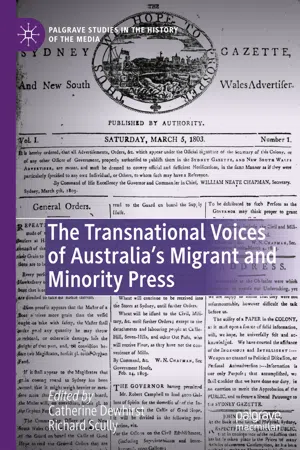
This edited collection invites the reader to enter the diverse worlds of Australia's migrant and minority communities through the latest research on the contemporary printed press, spanning the mid-nineteenth century to our current day. With a focus on the rare, radical and foreign-language print culture of multiple and frequently concurrent minority groups' newspaper ventures, this volume has two overarching aims: firstly to demonstrate how the local experiences and narratives of such communities are always forged and negotiated within a context of globalising forces – the global within the local; and secondly to enrich an understanding of the complexity of Australian 'voices' through this medium not only as a means for appreciating how the cultural heritage of such communities were sustained, but also for exploring their contributions to the wider society.
Information
© The Author(s) 2020
C. Dewhirst, R. Scully (eds.)The Transnational Voices of Australia’s Migrant and Minority PressPalgrave Studies in the History of the Mediahttps://doi.org/10.1007/978-3-030-43639-1_11. Australia’s Minority Community Printed Press History in Global Context: An Introduction
Catherine Dewhirst1 and Richard Scully2
(1)
University of Southern Queensland, Toowoomba, QLD, Australia
(2)
University of New England, Armidale, NSW, Australia
The processes of colonisation and the global networks they established engendered unprecedented change in the way people conceived of themselves, the societies and countries to which they belonged, and the wider world. The printed press was one of the many commodities transported through exploration/invasion and settlement in Australia and elsewhere. Beyond material culture, however, it also facilitated an ongoing sense of connection under circumstances of separation, which must have felt surreal to those who had never travelled beyond their village, town, or city before. The newspaper (which itself emerged in the seventeenth century in Britain and Europe from earlier forms of pamphlets, corantos, diurnalls, and newsbooks) was created initially “not within a small local compass but as an instrument for describing events across immense geographical areas”.1 This convergence between a local initiative and a broader, if not global, orientation can be illustrated by a story from the familiar history of the humble beginnings of print culture in Australia.
The first antipodean newspaper went to print on 5 March 1803 in the colony of New South Wales, produced by the government printer, George Howe (1765–1821). On the front of this modest four-page weekly, Howe advised his readers that The Sydney Gazette, And New South Wales Advertiser would provide:
Howe was well-versed in his craft. A creole of Irish heritage from Saint Kitts in the West Indies, where he had completed an apprenticeship as a printer under the government printer—his father—and claimed a classical education, Howe found himself in difficulty for having “discussed the politics of George III so unfavourably” as to make emigrating to England the only option in order “to escape being embroiled in the American Independence question”.3 However, as a participant in the transoceanic migrations, his life became even more complicated after settling in Britain.a source of solid information which will, we hope, be universally felt and acknowledged… [and that] Information is our only Purpose […] our duty, in an exertion to merit the Approbation of the PUBLIC, and to secure a liberal Patronage to the SYDNEY GAZETTE.2
In London, Howe began work at The Times and other print houses, married, and had an infant boy, only to be charged for shoplifting in 1799 while in the Midlands. Yet he managed to escape the death penalty pronounced at the Warwick Assizes when his sentence was commuted to transportation to the colony of New South Wales in 1800. Once in Sydney Town, financial troubles followed in the wake of his taking on the job as government printer. In addition to the colony’s fluctuating supply and variable quality of paper, his readers tended not to pay their subscriptions (something that worsened his cash-flow, especially after his convict salary stopped in 1806, when he was granted emancipation). He frequently addressed his readers about both issues in the newspaper.
The Sydney Gazette, however, reflects more than mere “information”. In fact, Howe also explained to his readers that it would include a section on morality and religion, as the first issue reveals:
In this example of a popular cultural tradition, used to instruct the reading public on behaviour that was unacceptable, Howe was also articulating his vision of The Sydney Gazette’s role. He positioned the newspaper as a guardian over the civic and moral standards of this new society in the making, including respectful gender relations (based on the Bible’s teachings). This guardianship suggests three features which the migrant and minority press would, in time, share: the importance of drawing from the homeland’s political, social, cultural, and sometimes religious news for instructional purposes; the space created by such news for engaging in conversation or debate, and securing ongoing business (elsewhere Howe invited readers to contribute their own “Articles of Information”); and the authoritative presence of the editor through the personal “voice”.An English Paper informs us that a practice equally disgraceful and immoral had been prevented in the Town of Manchester since the ratification of the Treaty of Paris: Wives had been quickly exhibited for sale; good ones, being scarce, brought a great price – but the market being overstocked with those of a contrary description, they sold for little or nothing. Much to the credit of the Magistrates, they supressed the growing evil, and restored the Fair Sex to their ORIGINAL value.4
If the history of the printed press in Australia commences in 1803, then the historiography arguably begins with the late nineteenth century publication of James Bonwick’s Early Struggles of the Australian Press, in which he chronicles and describes 77 major and minor print periodicals, including one extant copy of Die Deutsche Post (1848) and both Melbourne Punch (1855–1925) and Queensland Punch (1878–1885, 1890–1901).5 One other study in the late 1930s and two in the 1960s updated the state of this history considerably, in line with twentieth-century developments: W. Macmahon Ball’s edited Radio Press and World Affairs: Australia’s Outlook; W. S. Holden’s Australia Goes to Press; and Henry Mayer’s The Press in Australia.6 But these were definitely histories of the Anglophone mainstream. Although the foreign-language and minority presses date back to colonial times—some of the earliest being The Aboriginal or Flinders Island Chronicle (1836–1837), Deutsche Zeitung fuer Sudaustralischen (1848–1851), Yang-Tang Zhaoti (English-Chinese Advertiser) (1856–1858), Sydney Punch (1856, 1857, 1864–1888), L’Italo-Australiano (1885), Le Courrier Australien (1892–2011), Australian Worker (Sydney) (1893), and Norden (1896–1940)—there was virtually no scholarly interest until Miriam Gilson and Jerzy Zubrzycki’s The Foreign-language Press in Australia, 1848–1964. Three exceptions can be noted all the same, again in the 1930s and 1960s, with Rudolf Lowenthal’s The Chinese Press in Australia appearing first and, in light of the American post-war interest in ethnic group studies, a similar focus appeared in works by Derek van Abbé on the German press in South Australia, and Desmond O’Grady on Italian-migrant newspapers.7
There is no doubt that Gilson and Zubrzycki’s work stands out as a seminal study, which was published at a time when academic and wider political and societal attention was shifting from beliefs in assimilation to a recognition of the value of minority group cultural identity cultural identity and diversity.8 Against a backdrop of developments in mass media technologies, the mass migrations of post-war refugees (Displaced Persons), the government’s Colombo Plan of 1951, the Indigenous Australian land and civil rights movements in the 1960s, and the “boat people” asylum seekers of the 1970s, as well as bi-partisan support for a multicultural policy, acted as powerful contributors to change. Gilson and Zubrzycki’s largely sociological approach linked the appearance and disappearance of foreign-language newspapers to migrant settlement patterns, pointing out the more dramatic change after 1945 when the mass circulation press resulted from an unprecedented volume of new settlers.9 They remark on the “tremendous degree of enterprise and industry” displayed within such newspapers over Australian history and the characteristic “free opinion” that defined the first German-language and other early newspapers of the nineteenth century.10 Their enquiry engaged with questions, first about whether the maintenance of cultural or ethnic identities was a central concern of these newspapers and, second, whether the aims of these newspapers went beyond providing news to communicating “Australian” societal values and customs. What became apparent was the tendency of the foreign-language press to advise readers on avoiding polemicising national politics and trade unionism, to encourage integration within mainstream society, and to condemn racial discrimination.11 While acknowledging the great range of diversity of these presses, they also note how post-war editors tended “to exhort, criticize, and give praise”, acting “as an agency of social control” over migrant behaviour.12 What is interesting here, however—as they suggest—is the fact that this was not for the sake of reinforcing ethnic identification, but to direct the core business of the sale of news.
Gilson and Zubrzycki’s study largely examined the migrant press but included other print ventures from religious, trade-union, and political groups, and government departments; which are best defined as the “minority” press. In essence, all ethnic journalism is part of a minority category when considered in comparison with the larger daily circulations of colonial and national mainstream broadsheets, as it mostly serves a distinct readership of non-English-speaking origins. Although the migrant press should also be understood as “transnational” because of an interchange of influence and print journalism with the homeland and diasporic communities, there is no separation. Conceptualising migrant newspapers and other periodicals as both migrant initiatives and minority enterprises provides a much more realistic appreciation of how their editors, writers, and readers understood them to be, and lifts them from the stereotype of “foreign” or “other” within the frame of Australia’s media history. In fact, Australia’s migrant and minority community newspapers have always resonated in character with the provincial press, in contrast with the metropolitan mainstream newspapers, most evident from their localised readership. According to Rod Kirkpatrick in his analysis of the Queensland provincial press, such newspapers exhibit “a personality, and the...
Table of contents
- Cover
- Front Matter
- 1. Australia’s Minority Community Printed Press History in Global Context: An Introduction
- 2. The Satirical Press of Colonial Australia: A Migrant and Minority Enterprise
- 3. “Cement, Guide and Representative for the Exile and the Emigrant”: Ideological Discourse and italianità in L’Italo-Australiano
- 4. Australia’s Early Russian-Language Press (1912–1919)
- 5. Respectability and Disloyalty: The Competing Obligations of L’Italiano’s Editors
- 6. Zionism, Assimilationism and Antifascism: Divergent International Jewish Pathways in Three Post-War Australian Jewish Magazines
- 7. Literary Ambitions: The Polish-Language Press in Australia
- 8. Exploring the Migrant Experience Through an Examination of Letters to The New Australian
- 9. Crónicas in Australia’s Spanish-Language Press: The Case of El Expreso
- 10. News Reporting of Italian Organised Crime in Australia: Examining Il Globo’s Editorial Commentary
- 11. A Treasure Trove of Community Language Newspapers
- Back Matter
Trusted by 375,005 students
Access to over 1.5 million titles for a fair monthly price.
Study more efficiently using our study tools.
Frequently asked questions
Yes, you can cancel anytime from the Subscription tab in your account settings on the Perlego website. Your subscription will stay active until the end of your current billing period. Learn how to cancel your subscription
No, books cannot be downloaded as external files, such as PDFs, for use outside of Perlego. However, you can download books within the Perlego app for offline reading on mobile or tablet. Learn how to download books offline
Perlego offers two plans: Essential and Complete
- Essential is ideal for learners and professionals who enjoy exploring a wide range of subjects. Access the Essential Library with 800,000+ trusted titles and best-sellers across business, personal growth, and the humanities. Includes unlimited reading time and Standard Read Aloud voice.
- Complete: Perfect for advanced learners and researchers needing full, unrestricted access. Unlock 1.5M+ books across hundreds of subjects, including academic and specialized titles. The Complete Plan also includes advanced features like Premium Read Aloud and Research Assistant.
We are an online textbook subscription service, where you can get access to an entire online library for less than the price of a single book per month. With over 1.5 million books across 990+ topics, we’ve got you covered! Learn about our mission
Look out for the read-aloud symbol on your next book to see if you can listen to it. The read-aloud tool reads text aloud for you, highlighting the text as it is being read. You can pause it, speed it up and slow it down. Learn more about Read Aloud
Yes! You can use the Perlego app on both iOS and Android devices to read anytime, anywhere — even offline. Perfect for commutes or when you’re on the go.
Please note we cannot support devices running on iOS 13 and Android 7 or earlier. Learn more about using the app
Please note we cannot support devices running on iOS 13 and Android 7 or earlier. Learn more about using the app
Yes, you can access The Transnational Voices of Australia’s Migrant and Minority Press by Catherine Dewhirst, Richard Scully, Catherine Dewhirst,Richard Scully in PDF and/or ePUB format, as well as other popular books in History & Australian & Oceanian History. We have over 1.5 million books available in our catalogue for you to explore.