This book presents a revolutionary new reading of manuscript records left by puritan minister Thomas Shepard in Cambridge, Massachusetts that have been studied for decades as his on-the-spot recording of oral relations of faith delivered by candidates for church membership. This book proves that these records are not relations, but Shepard's personal record of sessions of trial—meetings with candidates still working out their spiritual seeking. New transcriptions of the original manuscript records, and corresponding never-before-published writing by Shepard, dispel much of the confusion produced by the published transcriptions. Close-readings of the manuscripts, contrasted with the published transcriptions, set the stage for a new understanding of puritan spiritual preparation in Shepard's Cambridge church. The book concludes with a challenge to the negative reading of the women's records that is central to established scholarship, revealing their powerful, confident spiritual identities and voices.
eBook - ePub
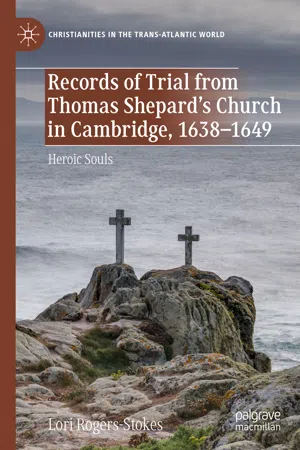
Records of Trial from Thomas Shepard’s Church in Cambridge, 1638–1649
Heroic Souls
- English
- ePUB (mobile friendly)
- Available on iOS & Android
eBook - ePub
Records of Trial from Thomas Shepard’s Church in Cambridge, 1638–1649
Heroic Souls
About this book
Information
© The Author(s) 2020
L. Rogers-StokesRecords of Trial from Thomas Shepard’s Church in Cambridge, 1638–1649Christianities in the Trans-Atlantic Worldhttps://doi.org/10.1007/978-3-030-50845-6_11. Re-reading, Re-interpreting, and Recovering Priceless Texts
A sample exploration of the records suggests that a thorough study would answer some old questions and provoke new ones. (Edmund S. Morgan, “New England Puritanism: Another Approach,” The William and Mary Quarterly 18, No. 2 [April 1961]: 238)
—Edmund S. Morgan
End AbstractFifty-seven years ago, the renowned puritan scholar Edmund Morgan published a short piece in the “Notes and Documents” section of The William and Mary Quarterly, in which he suggested that a “thorough examination of the records of a large number of towns—records of births, marriages, and deaths, of baptisms, admissions to communion, and church discipline” would allow historians to “test our current assumptions” about puritan religion and society in New England.1 One respected scholar, Darrett B. Rutman, responded a little over a year later in the pages of the same journal by tearing Morgan’s hypothesis to shreds.2 Unpersuaded as he was by Morgan’s suggestion that scholars revisit their certainties about puritan next-generation declension, Rutman did agree with Morgan’s call for a re-examination of the primary records. “There should be no argument with Morgan’s method,” he stated on his first page. “Advocates of one school of thought or another regarding New England Puritanism and the section as a whole have long drawn generalities from generalities; Morgan would have generalities built upon specifics.”3
I am in good company, then, in writing this book. It is dedicated to re-examining records which are very familiar to scholars of puritan New England, to provoking new questions, and, unavoidably, to arguing forcefully against long-established hypotheses about those records. My respect for the scholars I argue with is real, but my opposition to their hypotheses is often fundamental.
My arguments are drawn from the specifics provided by the transcriptions of two sets of manuscript records, one published in 1981 by George Selement and Bruce C. Woolley and another published in 1991 by Mary Rhinelander McCarl. Each was described as a transcription of puritan minister Thomas Shepard’s on-the-spot recording of oral relations of faith delivered by candidates for full church membership in the town of Cambridge, in the Massachusetts Bay Colony. Selement and Woolley presented fifty-one narratives dated roughly 1638–1645 as The Confessions of Thomas Shepard. McCarl published sixteen later Shepard-era narratives as “Thomas Shepard’s Record of Relations of Religious Experience, 1648-1649” and presented them as the copies Shepard made of his own on-the-spot dictation at some point afterward. Scholars ever since have accepted them as such.
My study of both sets of records has led me to a bold conclusion: they are not in fact relations of faith, and they were not written down in the moment as people made their bid for church membership. They are instead records of trial sessions—the multiple private or semi-private meetings between a New England puritan seeker and their minister, elders, and/or selected laypeople, during which relations were developed over time as seekers shared their progress and their problems. This fundamentally changes our approach to and understanding of the Shepard manuscripts. As records of relations, they present a congregation of lost and miserable souls struggling and failing to express assurance of grace—yet somehow granted church membership. As records of trial, they reveal an amazing snapshot of puritan spiritual seeking, a “you are there” glimpse into a specific moment in time: an intimate meeting between seeker and minister where the ongoing work of discovering grace is reviewed, picked up, and carried forward.4
The misrepresentation of the manuscripts as relations of faith set in motion a domino effect: scholars read them as such, were baffled by the fact that so few of them expressed assurance of grace, and developed theories to explain this that demonized Shepard, his congregants, the Congregational church in New England, and the puritan society within which the church stood. I will refer to many of these theories in this book. Before I do that, however, I will give a brief overview of why the rediscovery, transcription, and publication of these records were so exciting to scholars, what led me to the understanding that they are records of trial, and why reading them as relations warps our understanding of Shepard, his congregation, and the only existing records they left us.
To understand why these finds were so exciting, one has to understand a little of the process through which early puritan, or Congregational, church-goers became full church members. In early puritan New England, all inhabitants of a town were expected to attend church, but only those who were able to narrate a persuasive personal history of their successful spiritual seeking were granted the full church membership that allowed them to baptize their infant children and to take communion. (These were the only two sacraments the puritans observed.) These spiritual autobiographies, called conversion narratives or relations of faith, were delivered in front of an audience of other church members and the minister. We know this from descriptions of this requirement given by contemporary Congregational ministers and New England observers.5 But for a few centuries, actual records of these relations were scanty. There were a wealth of publications arguing about this unique requirement for church membership in New England, but very few examples of the relations themselves.6
Thus when Selement and Woolley published what they described as a set of fifty-one relations from early Cambridge, and McCarl followed with sixteen more ten years later, the impact on scholarship was substantial. The notebook of Thomas Shepard, where the Selement and Woolley records are found, had technically been available to scholars at the New England Historic Genealogical Society in Boston, Massachusetts, for about a century by 1981, but Shepard’s handwriting was difficult, and small, and it seems that either few people managed to decipher it, or few people made the attempt. The refusal of NEHGS’ turn-of-the-twentieth-century leadership to allow the transcription and publication of this notebook reserved it to those few scholars who traveled to Boston and attempted to read it.7 The records McCarl found had been similarly lost to scholars when they were misfiled in a past century into the Mather Family papers at the American Antiquarian Society and described partly as “visits to prisoners.” When at last the modern NEHGS allowed Selement and Woolley to transcribe and publish the records, and McCarl found the AAS notebook, realized what it was, and transcribed and published it, both collections were eagerly devoured by scholars of puritan New England.
In part, that eagerness was rewarded. Here was a priceless opportunity to read the stories average people told about their lives—a window into the lived experience of common English puritans in the seventeenth century. Here were mostly average people telling personal, even intimate, stories of their personal search for God’s will. Farmers, students, housewives, and servants described their efforts to discover whether God had granted them salvation through predestination.8 They talked about the sermons they heard, the conversations they had, their highest moments of triumph, and their lowest moments of despair. They recorded the impact of epidemic sickness, personal bereavement, and political upheaval on their individual lives. They explained the thought processes that led them through what the puritans called spiritual preparation—preparation to receive God’s message of salvation or damnation. Reading the descriptions that average women and men gave of this journey toward God’s will was revelatory. Principles expounded in sermons were seen for the first time through the immediate lens of common listeners’ real-world application. Learning how the people understood and used the tools of spiritual seeking was powerful for scholars of puritan New England, who had been brought up in the historical school of Perry Miller and Samuel Eliot Morison, which taught roughly that puritan ministers exerted dictatorial control over their congregations, telling them what to think and what to do at every turn.9 Instead, the Cambridge records showed people thinking deeply on their own about the path of spiritual preparation that they followed as puritans, people actively engaged with sermons and other means of godly instruction, and relating them to their own life circumstances.10
But this upside was paired with a powerful downside: the records were very difficult to understand. The language was compressed, sometimes to the point of being impenetrable. Sentences were missing key words. The text ran in long blocks down the printed pages of both Selement and Woolley and McCarl, unrelieved by paragraph breaks or organization of thought. Many sentences were fragmentary, and some seemed nonsensical. Attempting to parse what exactly people had meant became a full-time job of dismayed historians approaching the Cambridge records.
Scholars concluded that the compressed language of the records was the result of Shepard taking dictation, as it were, as a candidate made their formal relation to the church.11 As Michael McGiffert put it,
This scene makes sense as an explanation of Shepard’s compressed language. Why else would he fail to write out the important Bible verses that the candidates recite or reference, or even give the book and verse? Why would he skip so many words, creating jazz-like sentences where one must hear the words that were not spoken as much as those that were? He must have been in a hurry to keep up as each candidate’s narrative spilled out.Picture the scene at Cambridge at the moment we cut in. The church members [pack] the benches of the small, plain meetinghouse. The minister sits at one side, quill pen poised. The candidate for admission stands, takes a breath, gets ready—no speaking had even been so hard.12
Yet McCarl explicitly argued that both sets of records served an official purpose. “Shepard made his original notes on separate pieces of paper, which he later copied into his notebook. [This] was a formal record kept for a formal parochial purpose on the model of the notebook kept by John Fiske of Wenham and Chelmsford.”13 The question McCarl’s theory begs is this: if Shepard were carefully recording a “formal record” of a relation for a “formal parochial purpose,” why didn’t he do a better job? He had been present at the live relation, so when he set out to write a formal record of it at some later point, he could have filled in the gaps of his hurried transcription with what he remembered. Then the record would have made sense as a formal, parochial resource—something later pastors, or elders, could easily read and understand. He could have properly cited those all-important biblical references. As it is, the records we have are not clear and easily usable as formal records.
Scholars developed one theory to explain why a supposedly formal record from an early puritan church in New England would be so difficult to make sense of, which was that even a full record of the candidates’ speech would have revealed much the same thing as the compressed record: a miserable people unable to understand or accurately identify or express their deepest emotions, a people controlled by their powerful minister, and in particular, miserably oppressed and inarticulate women.14 These were a hopeless people striving for a salvation that did not and could not exist, and deep down, they knew it.
It was, ironically, this theory in the secondary material that began to change my mind about the primary material. When I first approached these records, I too found them disappointing, as I struggled to make sense of the language in so many of them. Yet something kept pulling me back to these voices.15 A passage I could not understand in the Cambridge records, when explained by another scholar as a proof of the misery of puritanism, and particularly its sexism, seemed to me to stubbornly resist that reading.16
In this context, I began to read the women’s records almost exclusively. Most of the records in both collections are women’s, and as I read them, new features began to leap out at me. As I will document at length below, they are astoundingly anachronous. Most are completely unbounded by sex or gender—without Shepard’s labeling (“Mistress Gookin” or “Goodman Fessingdon”), a reader could not tell whether the speaker was a man or a woman. To find seventeenth-century women’s narratives that are missing the basic markers of sex is amazing.17 They are also unbounded by traditional roles of parent, spouse, child, relative, or even parishioner. In these narratives, there is only the individual woman and her God, and her search for that God’s will, informed by others along the way who offer help or harm, but in the end completely reliant on that individual woman’s ability to read, listen, and talk, to interpret and decipher scripture, to make use of sermons, and to enter into counsel with others, sometimes in the form of the minister or elder, but often in the form of her female friends and relatives. This strong individuality in the primary records contradicted the secondary literature’s descriptions of women crippled by sexism and self-doubt. The voices of the women reasserted themselves over the joined voices of their later readers.
As I re-read the records, I began to recognize the language in many of them that signaled assurance, and my perception of the stories they told was slowly transformed. Fortified by new insights, I published an article on the Cambridge records in which I confidently stated that all ...
Table of contents
- Cover
- Front Matter
- 1. Re-reading, Re-interpreting, and Recovering Priceless Texts
- 2. Close-Reading the Shepard Manuscripts
- 3. “Venture and Try”: Women Taking the Ultimate Leap of Faith
- 4. The Shepard Context
- 5. Heroic Souls: Reading the Cambridge Women’s Records
- 6. Conclusion
- Back Matter
Trusted by 375,005 students
Access to over 1.5 million titles for a fair monthly price.
Study more efficiently using our study tools.
Frequently asked questions
Yes, you can cancel anytime from the Subscription tab in your account settings on the Perlego website. Your subscription will stay active until the end of your current billing period. Learn how to cancel your subscription
No, books cannot be downloaded as external files, such as PDFs, for use outside of Perlego. However, you can download books within the Perlego app for offline reading on mobile or tablet. Learn how to download books offline
Perlego offers two plans: Essential and Complete
- Essential is ideal for learners and professionals who enjoy exploring a wide range of subjects. Access the Essential Library with 800,000+ trusted titles and best-sellers across business, personal growth, and the humanities. Includes unlimited reading time and Standard Read Aloud voice.
- Complete: Perfect for advanced learners and researchers needing full, unrestricted access. Unlock 1.5M+ books across hundreds of subjects, including academic and specialized titles. The Complete Plan also includes advanced features like Premium Read Aloud and Research Assistant.
We are an online textbook subscription service, where you can get access to an entire online library for less than the price of a single book per month. With over 1.5 million books across 990+ topics, we’ve got you covered! Learn about our mission
Look out for the read-aloud symbol on your next book to see if you can listen to it. The read-aloud tool reads text aloud for you, highlighting the text as it is being read. You can pause it, speed it up and slow it down. Learn more about Read Aloud
Yes! You can use the Perlego app on both iOS and Android devices to read anytime, anywhere — even offline. Perfect for commutes or when you’re on the go.
Please note we cannot support devices running on iOS 13 and Android 7 or earlier. Learn more about using the app
Please note we cannot support devices running on iOS 13 and Android 7 or earlier. Learn more about using the app
Yes, you can access Records of Trial from Thomas Shepard’s Church in Cambridge, 1638–1649 by Lori Rogers-Stokes in PDF and/or ePUB format, as well as other popular books in History & North American History. We have over 1.5 million books available in our catalogue for you to explore.