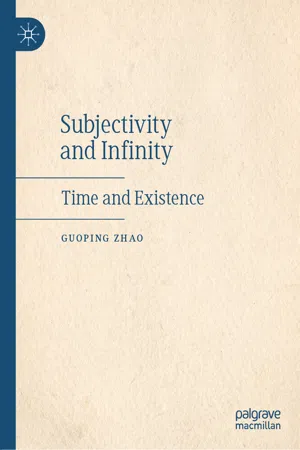
This book formulates a new theory of subjectivity in the context of the claimed "death of the subject" in the post-modern and post-human age. The new theory is developed against the conception of the subject as a transcendental ego whose constitutive roles, recognition, and representation lead to the objectivization and totalization of the world and denial of its inner infinity and heterogeneity. Critically scrutinizing ideas from Bergson, James, Husserl, Heidegger, Derrida, Zen Buddhism, and Chinese Zhuangzi, and through an analysis of time and temporality, this book advances a number of new concepts, including "primal sensibility" and "pure experience," and proposes a porous structure of subjectivity with an ex-egological and ex-subjective zone that allows nothingness and absence to ground presence. Such a theory of subjectivity provides the basis for an understanding of thinking as imagination and self-identity as narrative presentation in the intersubjective world.
- English
- ePUB (mobile friendly)
- Available on iOS & Android
eBook - ePub
About this book
Information
Topic
PhilosophySubtopic
Mind & Body in PhilosophyPart ITemporality and Subjectivity
© The Author(s) 2020
G. ZhaoSubjectivity and Infinityhttps://doi.org/10.1007/978-3-030-45590-3_11. Introduction
Guoping Zhao1
(1)
Oklahoma State University, Stillwater, OK, USA
The most significant, and perhaps also unfortunate, philosophical events in modern history may have been the establishment—and subsequent collapse—of a transcendental and all-encompassing egological subject against the world and “experience.” The absolutization of man as a rational animal in the metaphysical configuration, and the path opened up thereafter to the truth of Being, eventually led to the well-known theme of the “death of the subject.” Many great thinkers, including Marx, Nietzsche, Freud, Husserl, Heidegger, Bataille, and Wittgenstein, have participated in or contributed to the critique and deconstruction of the transcendental and egological subject. This critique and deconstruction, in Jean-Luc Nancy’s words, is “one of the great motifs of contemporary philosophical work.”1 With it, philosophy can no longer claim knowledge or truth about a “given” subjectivity. With much of the post-Cartesian philosophy beginning with such a “subject,” we have witnessed the crisis of the “subject,” which nearly spelled the “end” of philosophy in the West.
But the question of being still haunts philosophy. The collapse of the transcendental subject does not put a stop to the haunting question of being and existence. How might we still arrive at an understanding of our existence? How might we come to terms with our being so that our life acquires an existential meaning? What happens to experience? Without the pretense of speaking of the “validity” of the knowledge of Being, what is there about existence and experience of which it is still possible to speak? The question of being is at the heart of our understanding of what it means to be human; when it stops being an epistemological question, it becomes ever more saliently an ethical and spiritual question. To confirm Levinas’ claim that “being is not an empty notion”2 and to echo what Derrida calls “the subject of a proposition,”3 I propose that the current task is to attend to the forgotten, the unrecognized, and the unrecognizable experiences that nevertheless constitute subjectivity, without forgetting the salient and long-recognized presence. We do not need to destroy the long history of insights and misconceptions in order to shatter the “transcendence of the Ego,”4 but we do need to listen more carefully to the undercurrent that fills and grounds human life. An existential analysis of human subjectivity that gives full weight to the unrecognizable is essential if we are to do justice at all to experiences that are uniquely human.
Two decades ago, Eduardo Cadava, Peter Connor, and Jean-Luc Nancy invited several leading French philosophers to ponder what may happen after the “subject” has been demolished. A compilation resulted from this endeavor: What Comes after the Subject? What has survived, perhaps, “after” or “outside” of the subject? With an accentuated consideration of “after-subject” or “otherwise than being,” philosophical humanism, in which the “I think” and the Presence encompass the sphere of the subject, rendering ego and consciousness transcendental to the world and to “experience,” has been challenged by an appeal to the other, to the outside of consciousness (e.g., Levinas’ alterity, and Derrida’s différance), and to the uncapturable (to consciousness) and therefore to the transcendental flow of experience from within (e.g., Deleuze).5 Intensifying the nonidentity, untraceability, and irreducibility of the subject has given hope to Alain Badiou, who exclaimed: “A Finally Objectless Subject”!6
But what we witness soon after these considerations is not, unfortunately, the final arrival of the future of an objectless subject, but is in reality more like a subjectless object, “an unexpected turn” that Badiou himself “would never have foreseen.”7 Our age has certainly witnessed the rise of post-humanism and post-anthropocentrism, which have pushed their way into many areas of social and political life. The deliberate diminishing of distinctions between human and nonhuman, subject and object, and living and nonliving in the subjectivity conversations, the prominent themes of embodiment, materiality, and “affect” in working out propositions about the subject, come partly from the changed material and technoscientific, and hence socio-historical, conditions of our age, but also from some of the specific philosophical strategies that have emerged in reinterpreting, displacing, decentering, and reinscribing the subject. The Deleuzian announcement of “hecceities”—the “individuations that no longer constitute persons or ‘egos,’”8—and Derrida’s complaint that “the discourse on the subject, even if it locates difference, inadequation, the dehiscence within auto-affection, etc., [continues] to link subjectivity with man,”9 certainly have both contributed to the turn to post-humanism and post-anthropocentrism in philosophy. But clearly it is Deleuze’s overall philosophical project that has paved the way for such a move. Ivan Callus and Stefan Herbrechter even suggest that the recent shift away from Derrida and deconstruction to Deleuze’s vitalism “epitomized”10 the post-human move. With this move, theories are preoccupied with “affects” that are visceral and vital and with forces and relations in-between bodies, while “exploring animal subjectivity, object ontology, actor-network theory, new forms of materiality and materialism, … and so on” rises to the center of attention.11
While it is interesting and refreshing to consider human lives from a materialistic, affective, even nonliving perspective, and while it is important to acknowledge the non-consciousness, the psychological and physiologic mechanisms that have long been dismissed from the consideration of human subjectivity, suggesting a post-human subject may have defeated its own purpose. In what sense is such a concept still a “human” subject? Hasn’t the so-called post-human and post-anthropocentric turn, in the name of decentering the human perspective, been turning into anything but a “human” perspective? Intentionally or not, the philosophical movement that deliberately intensifies and redesigns the forms and conditions of human experiences as incompatible with any sense of “predetermination, transcendence, or timelessness”12 has much to contribute to the post-human turn. But with this turn, not only do we lose the “human” perspective, we also face the daunting challenge of ethics. This is perhaps why the relationship between life/nonlife forces and ethics and politics has come to be “at the centre of present philosophy.”13 Ethics is to be redefined and limited to freedom from oppression and constraints, but not the power to choose right and to choose love. In significant ways, we are paralyzed in the face of the current social and political challenges, and we compromise our responsibility as philosophers.
Thus precisely because of the post-human turn, the question of what is human after the “death of the subject” is most pressing. Nancy is aware that after the subject lies a yearning and a promise. We cannot escape the yearning and we have to address the promise, a truly “objectless subject,” perhaps? Heidegger was right when he famously said that only for man is “being” a problem. But why is “being” a problem and what kind of problem is it? Perhaps it is time to get back to the Heideggerian tradition, which either has not gone far enough or has gone astray, and take on again the task of a phenomenological investigation of the temporal constitution of being, to address the question of infinite temporality, not only to “propose” a subjectivity that may lead to creative and diverse ways of living, but also to find a new way to express ethics and the spirituality of human life.
Footnote...
Table of contents
- Cover
- Front Matter
- Part I. Temporality and Subjectivity
- Part II. Thinking, Imagination, and Self-Identity
- Back Matter
Trusted by 375,005 students
Access to over 1.5 million titles for a fair monthly price.
Study more efficiently using our study tools.
Frequently asked questions
Yes, you can cancel anytime from the Subscription tab in your account settings on the Perlego website. Your subscription will stay active until the end of your current billing period. Learn how to cancel your subscription
No, books cannot be downloaded as external files, such as PDFs, for use outside of Perlego. However, you can download books within the Perlego app for offline reading on mobile or tablet. Learn how to download books offline
Perlego offers two plans: Essential and Complete
- Essential is ideal for learners and professionals who enjoy exploring a wide range of subjects. Access the Essential Library with 800,000+ trusted titles and best-sellers across business, personal growth, and the humanities. Includes unlimited reading time and Standard Read Aloud voice.
- Complete: Perfect for advanced learners and researchers needing full, unrestricted access. Unlock 1.5M+ books across hundreds of subjects, including academic and specialized titles. The Complete Plan also includes advanced features like Premium Read Aloud and Research Assistant.
We are an online textbook subscription service, where you can get access to an entire online library for less than the price of a single book per month. With over 1.5 million books across 990+ topics, we’ve got you covered! Learn about our mission
Look out for the read-aloud symbol on your next book to see if you can listen to it. The read-aloud tool reads text aloud for you, highlighting the text as it is being read. You can pause it, speed it up and slow it down. Learn more about Read Aloud
Yes! You can use the Perlego app on both iOS and Android devices to read anytime, anywhere — even offline. Perfect for commutes or when you’re on the go.
Please note we cannot support devices running on iOS 13 and Android 7 or earlier. Learn more about using the app
Please note we cannot support devices running on iOS 13 and Android 7 or earlier. Learn more about using the app
Yes, you can access Subjectivity and Infinity by Guoping Zhao in PDF and/or ePUB format, as well as other popular books in Philosophy & Mind & Body in Philosophy. We have over 1.5 million books available in our catalogue for you to explore.