The profile of prisoners across many Western countries is strikingly similar – 95% male, predominantly undereducated and underemployed, from the most deprived neighbourhoods. This book reflects on how similarly positioned men configure masculinities against global economic shifts that have seen the decimation of traditional, manual-heavy industry and with it the disruption of long-established relations of labour. Drawing on life history interviews and classical ethnography, the book charts a group of men's experiences pre, during and post prison. Tracking the development of masculinities from childhood to adulthood, across impoverished streets, 'failing' schools and inadequate state 'care', the book questions whether this proved better preparation for serving prison time than working in their local, service-dominated, labour markets. It integrates theories of crime, geography, economics and masculinity to take into account structural and global economic shifts as well as individual long-term perspectives in order to provide a broad examination on pathways to prison and post prison.
eBook - ePub
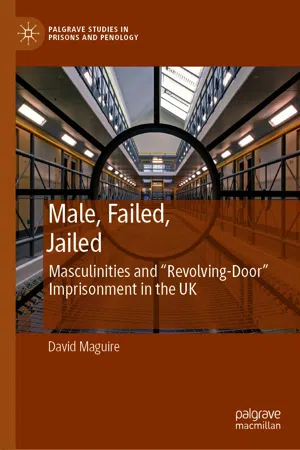
Male, Failed, Jailed
Masculinities and “Revolving-Door” Imprisonment in the UK
- English
- ePUB (mobile friendly)
- Available on iOS & Android
eBook - ePub
About this book
Information
© The Author(s) 2021
D. MaguireMale, Failed, JailedPalgrave Studies in Prisons and Penologyhttps://doi.org/10.1007/978-3-030-61059-3_11. Introduction: Failing Masculinities
David Maguire1
(1)
Institute of Education, University College London, London, UK
Shortly after being released from what would be my last time in prison, I started a journey in higher education that has culminated in the publication of this book. It was the close of the 1990s and the beginning of the millennium: a time when an interest in masculinities and a so-called “crisis in masculinity” had for a number of years been fiercely debated both in the academy and in popular media. The late 1990s marked the height of oversimplified media and political representations of the crisis discourse that positioned boys and men as a homogenous group who were suffering as a result of the success of women/girls in education and the workplace. I spent a large part of this decade in and out of a Manchester prison, encountering time and time again the same types of men. There were no noticeable changes in this population to reflect this crisis among all men; we all came from very similar environments.
I was born and raised on a council estate in Greater Manchester. I lived with my mother and stepfather who—after a number of redundancies (before I was old enough to remember them ever being employed)—survived on benefits that were occasionally topped up with “fiddly” cash-in-hand work. After being expelled from school at the age of 15—having become involved in low-level criminality and accumulating several convictions during my childhood and early teens—I sought out legitimate forms of employment once I was old enough to. For a number of years, as a young man without qualifications and with a criminal record, I moved between exploitive—and, in some cases, abusive—employment positions, unemployment and sporadic crime. With growing disillusionment at my prospects of finding legitimate work and falling ever deeper into local drug and criminal cultures, criminality took over as my main activity and source of income. Inevitably, periods of incarceration followed.
In the concluding chapter, I discuss the critical moment that prompted my transition from a prisoner to an academic. The important point to emphasise here—and the reason for this disclosure—is to highlight how central my introduction to feminist-inspired theory and research was in the early stages of my higher education career. As I explain in Chapter 2, this scholarship—largely influenced by the work of Connell (1995, 2000)—challenges the idea of a singular or homogenous masculinity espoused by the proponents of crisis discourses and instead recognises the intersection of class, place and other social categories in creating multiple and hierarchically positioned masculinities. Most importantly, it profoundly captures many of my experiences as a boy and then a young man negotiating the challenges of the streets, education and employment. This personal identification with writing on masculinities is what has both nurtured and sustained my interest. It is what inspired this project and in doing so it has afforded me the necessary capital(s) to be able to contribute to “doing masculinity” differently.
Having been out of prison for almost two decades, my research career has been punctuated by—and enriched by—my experiences of working with excluded boys and men in various contexts: on the streets of impoverished estates, in schools’ exclusion centres and in prisons. Unfortunately, in doing this work I have not seen enough research on gender and masculinities that has been conducted outside of the academy in order to inform and improve the lives of the men who it represents.
Over the same period, academic interest in boys, men and masculinities has grown at a remarkable rate and there has been increasing rates of recognition of the cost of constructing masculinities under profound structural disadvantages. With this the UK has witnessed some of the highest rates of academic underachievement among often “bright, working-class boys” (see Allen et al. 2015; House of Commons Educational Committee 2014). During this period, England and Wales have also seen surging incarceration rates, with numbers more than doubling from 41,800 in 1993 to a record 88,179 at the close of 2011 (Sturge 2020). The vast majority of this population—indeed, of all prisoners around the world—are male. Mostly undereducated men were drawn from some of the most impoverished working-class neighbourhoods (Crewe 2009; Jewkes 2002; McAra and McVie 2013; Phillips 2012).
A recent sweep of the longitudinal study, The Edinburgh Study of Youth Transitions and Crime, for instance, has found that pupils who have been excluded from school at the age of 12 are four times more likely to end up in prison than other children (McAra and McVie 2013). Kennedy (2013) discovered that 900 of the 942 young male prisoners who were surveyed had, at some point, been excluded from school; more than a third of these individuals were aged just 14 when they last attended school. Sally Coates (2016), in her Review of Education in Prison, noted that 42% of individuals across the prison estate report having been excluded from school. In the same review, she points out that more than half of those who enter prison are assessed as having the literacy and numeracy abilities of primary school age children and that 47% of them have no qualifications (ibid.).
Data released from the Ministry of Justice’s (MOJ) recent analysis of the Surveying Prisoner Crime Reduction (SPCR) longitudinal cohort study found that over two-thirds of newly sentenced prisoners were unemployed four weeks before they had been taken into custody. Those who had worked reported being paid lower wages than the average rate of pay for the working-age population (Brunton-Smith and Hopkins 2013). In their 2018 Employment and Education Strategy, the Ministry of Justice highlight the fact that just 17% of people who leave prison have managed to secure paid, P45 employment a year after their release (MoJ 2018).
There is a body of rich empirical research looking at masculinities of marginalised (young) men in education (Corrigan 1979; Evans 2006; Frosh et al. 2002; Mac an Ghaill 1994; O’Donnell and Sharpe 2000; Willis 1977), on the streets (Anderson 1999; Alexander 2000; Bourgois 2003; Gunter 2010), in employment and in the workplace (McDowell 2003; McDowell et al. 2014; Nayak 2006; Roberts 2018). Largely, this scholarship has explored how the relationship between structural disadvantages and (restricted) agency generates cultures or identities that reproduce and amplify existing forms of marginalisation that for many—as the data above suggest—lead to imprisonment.
Scholarship on schooling in poor neighbourhoods has shown, for instance, how some schools are under-resourced. Consequently, they are failing to equip many of their pupils—particularly boys—with adequate social capital to transcend the barriers of poverty. Instead these schools become key sites in which patterns of exclusion are reproduced (Ball 2003; Reay 2018). Paul Willis’s (1977) and Paul Corrigan’s (1979) studies in the mid to late 1970s and the surge of interest in masculinities over the last three decades have generated an impressive interdisciplinary scholarship that has shown how schools are crucial sites in the formation and reproduction of versions of working-class masculinities constructed through having a “laff” (Willis 1977) fighting, fucking and football (Mac an Ghaill 1994).
Previously...
Table of contents
- Cover
- Front Matter
- 1. Introduction: Failing Masculinities
- 2. Theorising Marginalised Masculinities
- 3. Economic Change: Post-industrial Masculinities
- 4. Background and Methods: Epistemological Privilege?
- 5. Local Lads: Pathways to Prison
- 6. (Non)Working Lives
- 7. Boys to “Cons”: Adolescent-to-Adult Transitions in the Local Prison
- 8. Vulnerable Masculinities: Absent Men and Imagined Futures
- 9. Conclusion: Marginalised from the Margins
- Correction to: Male, Failed, Jailed
- Back Matter
Trusted by 375,005 students
Access to over 1.5 million titles for a fair monthly price.
Study more efficiently using our study tools.
Frequently asked questions
Yes, you can cancel anytime from the Subscription tab in your account settings on the Perlego website. Your subscription will stay active until the end of your current billing period. Learn how to cancel your subscription
No, books cannot be downloaded as external files, such as PDFs, for use outside of Perlego. However, you can download books within the Perlego app for offline reading on mobile or tablet. Learn how to download books offline
Perlego offers two plans: Essential and Complete
- Essential is ideal for learners and professionals who enjoy exploring a wide range of subjects. Access the Essential Library with 800,000+ trusted titles and best-sellers across business, personal growth, and the humanities. Includes unlimited reading time and Standard Read Aloud voice.
- Complete: Perfect for advanced learners and researchers needing full, unrestricted access. Unlock 1.5M+ books across hundreds of subjects, including academic and specialized titles. The Complete Plan also includes advanced features like Premium Read Aloud and Research Assistant.
We are an online textbook subscription service, where you can get access to an entire online library for less than the price of a single book per month. With over 1.5 million books across 990+ topics, we’ve got you covered! Learn about our mission
Look out for the read-aloud symbol on your next book to see if you can listen to it. The read-aloud tool reads text aloud for you, highlighting the text as it is being read. You can pause it, speed it up and slow it down. Learn more about Read Aloud
Yes! You can use the Perlego app on both iOS and Android devices to read anytime, anywhere — even offline. Perfect for commutes or when you’re on the go.
Please note we cannot support devices running on iOS 13 and Android 7 or earlier. Learn more about using the app
Please note we cannot support devices running on iOS 13 and Android 7 or earlier. Learn more about using the app
Yes, you can access Male, Failed, Jailed by David Maguire in PDF and/or ePUB format, as well as other popular books in Social Sciences & Criminology. We have over 1.5 million books available in our catalogue for you to explore.